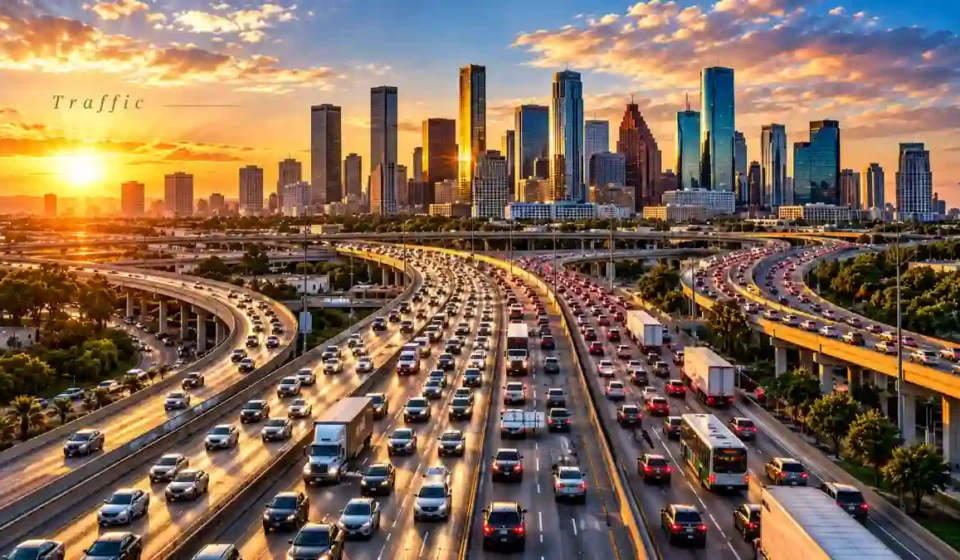

Road traffic is the flow of cars, trucks, buses, motorcycles, bicycles, pedestrians, etc., on roads and highways. When there are too many vehicles competing for a limited amount of space, or when an accident occurs, construction takes place, weather causes disruption, or another event interrupts normal vehicle movement, road traffic is said to be congested.
For those driving within the U.S., traffic delays represent a much larger problem than just an inconvenience. In addition to creating delays for individuals on their daily commute, delays also create financial strain (due to increased gasoline usage) as well as scheduling conflicts (missed appointments, delayed deliveries) and potential hazards on the road.
Knowing what causes road congestion can help us select more appropriate travel times, recognize possible dangers, and find effective solutions.
This handbook will describe how road networks function; identify the seven primary factors that contribute to traffic congestion; outline several of the most critical U.S. driving safety rules; and provide practical methods for both individuals and community groups to minimize delay.
What Is Traffic?
The term describes the motion of people and vehicles through the streets, intersections, highways, and other forms of transportation. This includes the use of personal vehicles, commercial transportation, public transit, and individuals walking or riding bicycles.
Road travel is a typical method of moving people/goods. Issues occur when the number of people using the roads (or a sudden problem) is too great for the transportation system to deal with promptly.
Traffic Meaning and Definition
Simply put, road traffic is the way that cars, trucks, and other types of road users travel between two different locations.
Imagine a bustling intersection in the city of Chicago. Vehicles continue straight forward, buses come to a halt to allow passengers to board, people cross the street using designated crossing areas (crosswalks), and delivery vehicles turn at the corner. Each of these activities represents a portion of the overall transportation system.
Engineers study how roads function safely and effectively through studying the interaction of vehicles, drivers, pedestrians, etc.
Traffic vs. Traffic Congestion
Although people often use these terms interchangeably, they have different meanings.
| Term | Meaning | Example |
| Traffic | Normal movement of road users | Vehicles traveling along a highway |
| Congestion | Movement becomes slower because of limited capacity or disruption | Rush-hour highway delays |
| Traffic jam | A severe slowdown or queue | Cars barely moving after a collision |
| Gridlock | Interconnected queues prevent vehicles from progressing | Blocked downtown intersections |
A road can carry thousands of vehicles while operating efficiently. Congestion begins when the system cannot accommodate demand at normal speeds or a disruption restricts movement.
Why Traffic Matters in the United States
American transportation networks support millions of daily activities, from commuting and school transportation to freight deliveries and emergency response.
Road conditions influence:
- Workers: Unpredictable travel can affect arrival times and schedules.
- Businesses: Delayed deliveries increase logistical uncertainty.
- Families: School pickups, appointments, and daily errands become harder to plan.
- Emergency services: Congested routes can complicate ambulance and fire department responses.
- Communities: Transportation affects air quality, accessibility, and economic activity.
Understanding road conditions helps people make informed travel decisions and supports better transportation planning.
How Does Traffic Flow Work?
Road movement depends on how many vehicles use a roadway, how quickly they travel, and how much space is available.
Engineers commonly examine three connected measurements: volume, speed, and density.
Traffic Volume, Speed, and Density
Volume measures the number of vehicles passing a particular location during a specified period, often vehicles per hour.
Speed measures how quickly vehicles move.
Density describes how many vehicles occupy a given length of road, commonly expressed as vehicles per mile per lane.
When a highway has relatively few vehicles, drivers can usually maintain comfortable spacing and steady speeds.
As more vehicles enter, available gaps become smaller. Eventually, even minor braking can create delays.
The basic relationship for a uniform stream of vehicles is:
\[ \text{Flow}=\text{Density}\times\text{Average Speed} \]
For example, if a lane contains an average of 30 vehicles per mile and their average speed is 50 mph, the corresponding flow is approximately 1,500 vehicles per hour.
This is a simplified illustration. Real roads experience changing speeds, lane movements, and vehicle types.
Road Capacity and Bottlenecks
Road capacity is the maximum rate at which vehicles can reasonably pass a location under specified conditions.
A bottleneck occurs when one section can handle fewer vehicles than the sections feeding into it.
Common examples include:
- A three-lane highway narrowing to two lanes.
- A busy freeway entrance where vehicles merge.
- A bridge carrying more demand than its approaches can accommodate.
- An intersection with insufficient green-light time.
- A work zone that temporarily closes a lane.
Suppose 2,200 vehicles per hour approach a section capable of processing only 1,800 vehicles per hour. If those rates continue, approximately 400 vehicles accumulate in the queue during that hour.
This simplified example shows why delays can grow even without an accident.
Why Traffic Jams Can Form Without an Accident
Not every slowdown has an obvious cause.
A driver brakes slightly because another vehicle changes lanes. The driver behind reacts a little more strongly, followed by several others.
As the reactions spread backward, some vehicles may slow almost to a stop.
This phenomenon is commonly called a phantom traffic jam or a stop-and-go shockwave.
How a stop-and-go wave develops
Steady movement
Slowing vehicles
Growing queue
Conceptual illustration: small speed disturbances can grow into stop-and-go conditions as they propagate through dense vehicle streams.
Maintaining a reasonable following distance and avoiding unnecessary braking can help reduce these disturbances, although individual drivers cannot eliminate system-wide congestion.
What Are the Different Types of Traffic?
Not all road conditions are the same. Identifying the type of congestion helps determine whether the best response is changing departure times, avoiding an incident, or improving road operations.
Free-Flow Traffic
Free-flow conditions occur when vehicle demand is sufficiently low that drivers can travel without substantial interference from other vehicles.
A lightly traveled interstate highway outside peak hours is a common example.
Free-flowing conditions do not remove the need to follow speed limits, watch for hazards, and maintain safe distances.
Heavy and Stop-and-Go Traffic
Heavy conditions occur when many vehicles occupy a limited amount of road space.
Drivers may experience slower speeds, smaller gaps, and frequent braking.
Stop-and-go conditions are more severe, with repeated cycles of accelerating, slowing, and stopping.
These patterns are common near busy merges, lane reductions, and overloaded urban corridors.
Recurring vs. Nonrecurring Congestion
Recurring congestion appears regularly at predictable locations and times.
For example, a freeway approaching downtown Atlanta may experience delays during weekday commuting periods.
Nonrecurring congestion results from temporary or unexpected conditions such as collisions, storms, disabled vehicles, or special events.
The distinction matters because recurring problems often require changes in demand or roadway operations, while unexpected disruptions benefit from rapid incident response and timely traveler information.
Urban Traffic vs. Highway Traffic
Urban roads and highways have different operating challenges.
City streets feature frequent intersections, turning vehicles, parking activity, cyclists, and pedestrian crossings.
Highways typically have fewer intersections but involve higher speeds, merges, lane changes, and large vehicle volumes.
| Condition | Typical example | Main characteristic |
| Free flow | Light interstate travel | Relatively unrestricted movement |
| Recurring congestion | Weekday commute | Predictable high demand |
| Nonrecurring congestion | Crash-related backup | Temporary disruption |
| Stop-and-go | Busy freeway merge | Repeated braking and acceleration |
| Urban congestion | Downtown intersection | Signals and competing road movements |
What Are the 7 Major Causes of Traffic Congestion?
Congestion rarely has one universal cause. A city may experience predictable commuter demand in the morning, while a nearby highway becomes crowded because of construction or a crash.
The following seven categories explain many common problems across US roads.
1. Rush-Hour Demand and Too Many Vehicles
Rush hour occurs when large numbers of people travel during similar periods, commonly before and after traditional work schedules.
School drop-offs, office commuting, and business deliveries can overlap, creating concentrated demand.
When incoming vehicles approach or exceed a roadway’s effective capacity, queues form.
Example: A highway that moves freely at 11 a.m. may become crowded at 8 a.m. because thousands of commuters are trying to use the same limited number of lanes.
Flexible work schedules, public transit, and staggered departure times can help distribute demand.
2. Road Bottlenecks and Poor Infrastructure Design
Some road sections restrict movement more than others.
Lane reductions, closely spaced ramps, difficult merges, and overloaded intersections can produce recurring delays.
A bottleneck may also develop when a roadway designed for older travel patterns no longer meets current demand.
Potential improvements include redesigned merges, better signal coordination, targeted operational changes, and carefully evaluated infrastructure upgrades.
3. Accidents and Disabled Vehicles
A crash or stalled vehicle can suddenly reduce roadway capacity.
Even when an incident occupies only the shoulder, nearby drivers may slow down, creating additional queues.
When lanes close, the effects can extend several miles upstream.
Rapid incident detection, emergency response, safe vehicle removal, and accurate traveler alerts help limit disruption.
Drivers should avoid unnecessary slowing to look at an incident and follow emergency personnel’s directions.
4. Road Construction and Lane Closures
Maintenance and construction are necessary to keep transportation infrastructure safe and functional.
However, temporary lane closures, reduced speeds, and detours can cause delays.
Construction-related congestion may become predictable when work continues for weeks or months.
Travelers should review work-zone notices before leaving and follow posted restrictions.
State transportation agencies often provide project schedules and lane-closure information online.
5. Weather Conditions
Rain, snow, ice, fog, and flooding affect roadway movement.
Drivers generally need more time and distance to stop on slippery roads. Reduced visibility also requires greater caution.
Severe weather can close highways, disable vehicles, or make certain routes unsafe.
For example, winter storms in the Midwest may reduce road capacity and increase travel times even when there is no collision.
During dangerous conditions, postponing nonessential travel may be safer than attempting to save time with an alternate route.
6. Traffic Signals and Intersection Delays
Intersections control competing movements from several directions.
When signal timing does not match demand, long queues may develop.
Problems can occur when:
- Green-light periods are insufficient for major movements.
- Turning lanes fill and block through lanes.
- Nearby signals are poorly coordinated.
- Queues extend into adjacent intersections.
Modern signal systems can adjust timings based on measured conditions, although improvements depend on roadway design and local demand.
7. Driver Behavior and Special Events
Driver behavior can make existing congestion worse.
Unnecessary lane changes, abrupt braking, distracted driving, illegal parking, and blocking intersections disrupt smooth movement.
Special events create a different challenge: large numbers of vehicles arrive or depart within a short period.
A major football game or concert may overload roads that operate normally on other days.
Event organizers and transportation agencies can reduce disruption through coordinated signals, transit services, parking management, and advance travel guidance.
How Does Traffic Congestion Affect Everyday Life?
Road delays affect more than arrival times. They influence transportation expenses, air quality, economic activity, and personal well-being.
Lost Time and Unpredictable Commutes
A commute that usually takes 25 minutes may occasionally take 45 minutes or longer.
The uncertainty makes planning difficult because drivers must leave earlier to protect against unexpected delays.
Over a year, small daily delays can accumulate into dozens of hours.
Reliable travel times are often as valuable to commuters as faster average speeds.
Fuel Costs and Vehicle Operating Expenses
Frequent acceleration, braking, and idling can increase fuel consumption, especially in conventional gasoline-powered vehicles.
However, the relationship varies with engine design, vehicle weight, driving style, and road conditions.
Hybrid vehicles may recover some energy through regenerative braking, while electric vehicles avoid engine idling but still consume energy during operation.
Drivers can reduce unnecessary fuel use by maintaining their vehicles, avoiding aggressive acceleration, and choosing sensible routes.
Air Pollution and Environmental Impacts
Transportation contributes to air pollution and greenhouse gas emissions.
Vehicle exhaust can contain carbon dioxide, nitrogen oxides, and other pollutants, depending on the vehicle and fuel type.
Stop-and-go driving can increase emissions in some circumstances, although the actual impact depends on speeds, vehicle technology, congestion duration, and driving behavior.
Cleaner vehicles, efficient public transportation, and improved road operations can help reduce environmental impacts.
For additional context, see the US Environmental Protection Agency’s transportation and air pollution resources.
Stress, Fatigue, and Road Safety
Long, unpredictable journeys can contribute to frustration and fatigue.
Some drivers respond by following too closely, changing lanes aggressively, or becoming distracted.
These behaviors increase risk.
Congested roads often have lower travel speeds, but frequent braking and close vehicle spacing can create rear-end collision hazards.
On uncongested roads, higher travel speeds may increase the severity of crashes.
Safe driving requires attention in both situations.
Economic Costs and Emergency Response
Congestion can affect businesses through delayed deliveries, uncertain travel schedules, and higher transportation costs.
Commercial vehicles may require additional time to complete routes.
Emergency responders can also encounter delays when roads are blocked or drivers fail to make room.
The Texas A&M Transportation Institute publishes transportation research, including the Urban Mobility Report, that can help readers understand the economic and travel-time impacts of congestion in US urban areas.
Traffic Safety and Important US Driving Rules
Safe road movement depends on drivers, pedestrians, cyclists, and other users understanding and following applicable rules.
US driving laws vary by state, so readers should consult their state’s official driver’s handbook for specific legal requirements.
Speed Limits and Safe Following Distance
Posted speed limits establish legal maximum speeds under applicable conditions, but a lower speed may be necessary during heavy rain, snow, poor visibility, or congestion.
Maintaining sufficient following distance provides time to recognize hazards and brake safely.
Avoid tailgating, especially when vehicles ahead are stopping unpredictably.
Traffic Lights, Signs, and Right-of-Way
Signals and road signs coordinate movement and reduce conflicts.
Drivers should understand:
- Red, yellow, and green signals.
- Stop and yield signs.
- Lane-control signs.
- Pedestrian crossings.
- Turning restrictions.
- Right-of-way rules.
Exact rules for turning, yielding, and intersections vary by jurisdiction.
Distracted and Impaired Driving
Distractions reduce attention to road conditions.
Texting, adjusting devices, or focusing on activities unrelated to driving can delay reactions.
Alcohol and drugs can impair judgment, coordination, and reaction time. Fatigue can also reduce alertness.
The safest approach is to remain focused on driving, avoid impaired driving entirely, and stop in a safe location when necessary.The National
The National Highway Traffic Safety Administration provides official information about risky driving behaviors and crash prevention.
Pedestrian, Cyclist, and Motorcyclist Safety
People outside passenger vehicles are particularly vulnerable in collisions.
Drivers should check blind spots, yield where required, watch for cyclists before turning, and approach crosswalks cautiously.
Motorcyclists should maintain visibility, use appropriate protective equipment, and avoid unsafe positioning around larger vehicles.
Safer road design also matters. Well-marked crossings, protected cycling facilities, and suitable intersection layouts can reduce conflicts.
What to Do When Approaching an Emergency Scene
When approaching emergency vehicles or roadside responders:
- Reduce speed safely.
- Watch for responders and stopped vehicles.
- Move over when required and safe to do so.
- Follow instructions from police and emergency personnel.
- Avoid stopping to observe an incident.
All US states have some form of Move Over law, but the specific requirements and vehicles covered vary.
Check your state’s current law rather than assuming the same rule applies everywhere.
How Can Drivers Avoid or Reduce Traffic Delays?
While individual drivers cannot fix an overloaded transportation network, they can make smarter decisions that reduce unnecessary delays and improve safety.
Check Real-Time Traffic Before Leaving
Navigation tools such as Google Maps and Waze can help drivers review congestion, estimated travel times, and reported incidents.
Before starting a trip, enter your destination and compare the available routes.
Check whether a delay is caused by normal commuting demand, a collision, roadwork, or a closure. Also consider official state Department of Transportation traveler-information websites for highway conditions.
Live estimates can change quickly, so treat arrival times as predictions rather than guarantees.
Choose a Better Departure Time
Changing your departure time by 15–30 minutes may reduce delays on some routes.
For example, a commuter who regularly encounters a major bottleneck at 8:15 a.m. might compare travel times at 7:30, 8:00, and 9:00 a.m. over several weekdays.
The best departure time depends on local patterns, not a universal rule.
Workers with flexible schedules may also benefit from staggered hours or occasional remote work.
Compare Routes by Travel Time, Not Distance
The shortest route is not always the fastest.
Consider two hypothetical options:
| Route | Distance | Estimated travel time | Additional consideration |
| Route A | 12 miles | 35 minutes | Multiple busy intersections |
| Route B | 16 miles | 28 minutes | Longer distance and potentially higher fuel use |
Route B saves seven minutes in this example, but the additional mileage may increase operating costs.
Compare arrival time, reliability, tolls, road conditions, and safety before choosing.
Avoid unsafe shortcuts through residential neighborhoods simply to save a few minutes.
Use Public Transit, Carpooling, or Telework
Public transportation can reduce the number of individual vehicles needed to move a given number of people.
Carpooling allows multiple travelers to share one vehicle, while remote work can eliminate certain commute trips.
These alternatives are not equally practical everywhere. A city with frequent rail or bus service may offer more options than a rural community.
Choose based on availability, total travel time, affordability, and accessibility.
Drive Smoothly and Safely in Congestion
Aggressive driving rarely solves a widespread slowdown.
Maintain a safe following distance, watch several vehicles ahead when possible, and avoid unnecessary acceleration and braking.
Do not use a phone while driving or change lanes abruptly to gain a small advantage.
Before-your-commute checklist
- Check estimated arrival time and reported incidents.
- Compare reasonable alternative routes.
- Review severe-weather warnings and road closures.
- Allow extra time for important appointments.
- Consider transit or carpooling when practical.
- Keep your attention on the road and maintain safe spacing.
How Can Cities Reduce Traffic Congestion?
Long-term improvements require more than asking drivers to change their habits.
Transportation agencies must identify the causes of delays and select interventions that fit local conditions.
The Federal Highway Administration distinguishes problems involving roadway capacity, incidents, work zones, weather, demand fluctuations, and control systems.
Improve Public Transportation
Reliable buses, trains, and other shared services can move large numbers of people without requiring each traveler to use a separate car.
Improvements may include more frequent service, dedicated bus lanes, accessible stops, and better connections between neighborhoods and employment centers.
The benefits depend on whether services reach destinations people actually need.
Optimize Traffic Signal Timing
Traffic signals can be coordinated so that vehicles encounter fewer unnecessary stops along a corridor.
Adaptive signal systems use information about current roadway conditions to adjust certain signal timings.
However, signal optimization cannot eliminate delays when vehicle demand substantially exceeds available capacity.
Manage Highway Bottlenecks
Agencies can address recurring bottlenecks through targeted improvements.
Examples include redesigned merge areas, improved ramp operations, lane-use adjustments, and faster incident clearance.
Ramp metering controls how vehicles enter a freeway to help maintain smoother mainline movement.
Some projects improve existing infrastructure without requiring a major highway expansion.
Improve Walking and Cycling Infrastructure
Safe sidewalks, protected bike facilities, and convenient crossings can make short trips possible without a car.
These improvements are especially useful when residential areas, schools, shops, and workplaces are relatively close together.
Better infrastructure also improves accessibility for people who do not drive.
Use Intelligent Transportation Systems
Intelligent transportation systems use technology to monitor and manage road operations.
They may include roadway sensors, cameras, electronic message signs, incident-detection systems, and traveler-information services.
For example, transportation agencies can warn drivers about a crash ahead and coordinate emergency response to restore normal operations.
Manage Travel Demand
Demand management aims to reduce or redistribute trips during the busiest periods.
Strategies include flexible work hours, transit incentives, carpooling programs, parking policies, and congestion pricing.
Congestion pricing charges drivers for access to certain roads or areas during specified periods. Its effects depend on pricing design, alternatives, exemptions, and local travel behavior.
Cities should consider affordability and accessibility when evaluating these programs.
| Approach | Typical time horizon | Best suited for |
| Incident clearance | Immediate to short term | Unexpected disruptions |
| Signal adjustments | Short to medium term | Intersection delays |
| Ramp management | Medium term | Freeway merging problems |
| Transit improvements | Medium to long term | High travel demand |
| Walking and cycling networks | Medium to long term | Short local trips |
| Major roadway redesign | Long term | Documented infrastructure constraints |
No single strategy works equally well in every location.
How to Identify the Cause of a Traffic Jam
The most useful question is not simply, “Why are the roads crowded?” It is, “What is causing this particular delay?”
Identifying the likely cause helps drivers choose a reasonable response and helps transportation agencies select effective improvements.
Identify Whether the Delay Is Predictable
Start by looking for patterns.
Does the slowdown happen at the same highway exit every weekday morning? Does it disappear after the commuting period?
A repeated pattern suggests a recurring capacity or demand problem.
If a normally clear road suddenly becomes congested at an unusual time, a temporary disruption may be responsible.
Consider the location, time, day of the week, and recent changes in road conditions.
Check for Crashes, Closures, and Weather Alerts
Use a navigation app or official state traveler-information service to check for reported incidents.
Look for:
- Crashes and stalled vehicles.
- Closed lanes or ramps.
- Construction projects.
- Flooding, snow, or ice.
- Special events.
- Emergency road restrictions.
Not every disruption is immediately reported, and incident locations may be approximate.
Check information before driving rather than attempting to investigate it on a handheld device while moving.
Match the Problem to the Right Response
The following table helps distinguish common situations.
| What you notice | Possible explanation | Practical response |
| Same slowdown every weekday | Recurring bottleneck | Test a different departure time |
| Sudden highway backup | Crash or disabled vehicle | Review incident alerts |
| Congestion near a merge | Capacity restriction | Maintain safe spacing |
| Long queues at a signal | High demand or signal timing | Compare alternative routes |
| Delays near a stadium | Special-event demand | Plan around event schedules |
| Repeated braking without an obvious cause | Stop-and-go shockwave | Avoid unnecessary braking |
| Unexpected slowdown during rain | Reduced visibility or road friction | Reduce speed safely |
These are possible explanations, not certain diagnoses.
For example, a merge area may be congested because of regular demand, a nearby collision, or both.
FHWA emphasizes that identifying where and when bottlenecks occur is an important part of developing effective responses.
Traffic Costs and Travel-Time Examples
Congestion can feel like a minor daily inconvenience until the additional minutes are calculated over an entire year.
A few simple calculations can help commuters understand the impact.
How to Calculate Time Lost in Traffic
Use this formula:
\[ \text{Annual delay hours}=\frac{\text{Extra minutes per trip}\times\text{Trips per year}}{60} \]
Suppose a commuter experiences 15 extra minutes on 250 one-way trips each year.
The annual delay is:
1525060=62.5hours
That equals more than two and a half full days spent in additional travel time.
The result depends on the number of trips and the difference between normal and congested journey times.
Commute Delay Calculator
Estimate how much additional time congestion adds to your annual travel.
Extra minutes per one-way trip
15 min
One-way trips per year
250
Personal value of time ($/hour)
$20
Annual extra time
62.5 hrs
Estimated time value
$1,250
Copy my results. Illustrative personal estimate, not a measurement of actual financial losses.
How to Estimate the Value of Lost Time
Some people find it helpful to assign an approximate personal value to their time.
For example, valuing 62.5 hours at $20 per hour produces an estimated time value of $1,250.
That does not mean the commuter necessarily lost $1,250 in wages.
The figure represents a subjective estimate of how much the additional time may be worth to that individual.
Actual financial costs, such as additional fuel or paid childcare, should be calculated separately.
When an Alternate Route Is Worth Taking
Consider a hypothetical commute with two choices:
| Factor | Route A | Route B |
| Distance | 12 miles | 16 miles |
| Expected travel time | 35 minutes | 28 minutes |
| Tolls | $0 | $2 |
| Additional distance | — | 4 miles |
Route B saves seven minutes but requires more driving and a toll.
Whether it is worthwhile depends on the driver’s priorities, fuel costs, route reliability, and road conditions.
For time-sensitive trips, predictable arrival times may matter more than the shortest distance.
Common Myths About Traffic
Several popular assumptions about congestion are incomplete or misleading.
Does Adding More Lanes Always Fix Traffic?
Not necessarily.
Additional capacity can reduce delays at certain bottlenecks, particularly when a specific physical constraint is responsible.
However, road expansion can also encourage additional driving over time, a phenomenon known as induced demand.
The long-term outcome depends on land use, travel patterns, available alternatives, and project design.
Transportation planners should evaluate whether targeted operational improvements or alternative travel options can address the underlying problem more effectively.
Is the Shortest Route Always the Fastest?
No.
A shorter route may include numerous signals, difficult turns, or recurring queues.
A longer route with more consistent speeds can sometimes provide a faster or more predictable journey.
Drivers should compare expected travel time, not mileage alone.
Does Switching Lanes Frequently Save Time?
Frequent lane changes do not guarantee a meaningful time advantage.
Drivers may move into a temporarily faster lane only to find that it slows moments later.
Unnecessary weaving also creates conflicts and forces nearby vehicles to adjust their speeds.
Choose lanes based on the route, upcoming exits, and road conditions rather than constantly chasing small gaps.
Read More: Traffic Explained
Is Every Traffic Jam Caused by an Accident?
No.
Roads can become congested because of high demand, bottlenecks, signal timing, weather, construction, or ordinary fluctuations in vehicle speeds.
Some stop-and-go waves develop without any visible obstruction.
FHWA identifies multiple interacting causes of congestion, making a single explanation unsuitable for every roadway.
Frequently Asked Questions About Traffic
What is traffic in simple words?
Traffic is the movement of vehicles and other road users along streets and highways. It includes cars, trucks, buses, motorcycles, bicycles, and pedestrians. When too many vehicles use the same road, or something disrupts normal movement, congestion can develop.
What is the difference between traffic and a traffic jam?
Traffic describes normal road movement, whether vehicles are traveling quickly or slowly. A traffic jam occurs when movement becomes severely restricted, often creating long queues and stop-and-go conditions. Not every busy road is experiencing a jam.
Why is traffic worse during rush hour?
Rush-hour congestion happens because many people travel at approximately the same time. Work commutes, school schedules, and other activities concentrate vehicle demand into relatively short periods. When that demand approaches or exceeds road capacity, delays increase.
What causes traffic jams when there is no accident?
Jams can form because of highway merges, lane reductions, overloaded intersections, or small braking disturbances. When vehicles are closely spaced, one driver’s braking can trigger a wave of slowing that moves backward through the roadway.
What is the difference between recurring and nonrecurring congestion?
Recurring congestion happens regularly, often at the same location during weekday commuting periods. Nonrecurring congestion results from temporary events such as crashes, severe weather, construction, or special events. Recognizing the difference helps drivers choose more effective travel strategies.
How can I check traffic conditions near me?
Use a navigation application such as Google Maps or Waze to review current congestion, reported incidents, and estimated travel times. For official highway closures, weather-related restrictions, and construction notices, consult your state’s Department of Transportation traveler-information website.
What is the safest way to drive in stop-and-go traffic?
Maintain a safe following distance, stay alert, and avoid sudden acceleration or braking. Watch vehicles farther ahead when possible, follow posted restrictions, and avoid unnecessary lane changes. Never use a handheld phone while driving.
How does traffic congestion affect fuel consumption?
Frequent acceleration, braking, and engine idling can increase fuel consumption in many gasoline-powered vehicles. The actual impact depends on vehicle technology, driving style, road conditions, and trip length. Hybrid and electric vehicles respond differently to stop-and-go driving.
Can better public transportation reduce traffic?
Yes, reliable public transportation can reduce the number of private vehicles needed to move people, particularly in densely populated areas. Frequent buses, trains, and convenient connections can make alternatives to driving more practical. The benefits depend on service quality, accessibility, and traveler demand.
What can US cities do to reduce traffic permanently?
Cities can pursue sustained improvements through better public transit, signal coordination, bottleneck management, safer walking and cycling routes, incident response, and demand-management policies. There is no universal permanent fix. Effective solutions depend on local transportation patterns, available funding, and long-term planning.