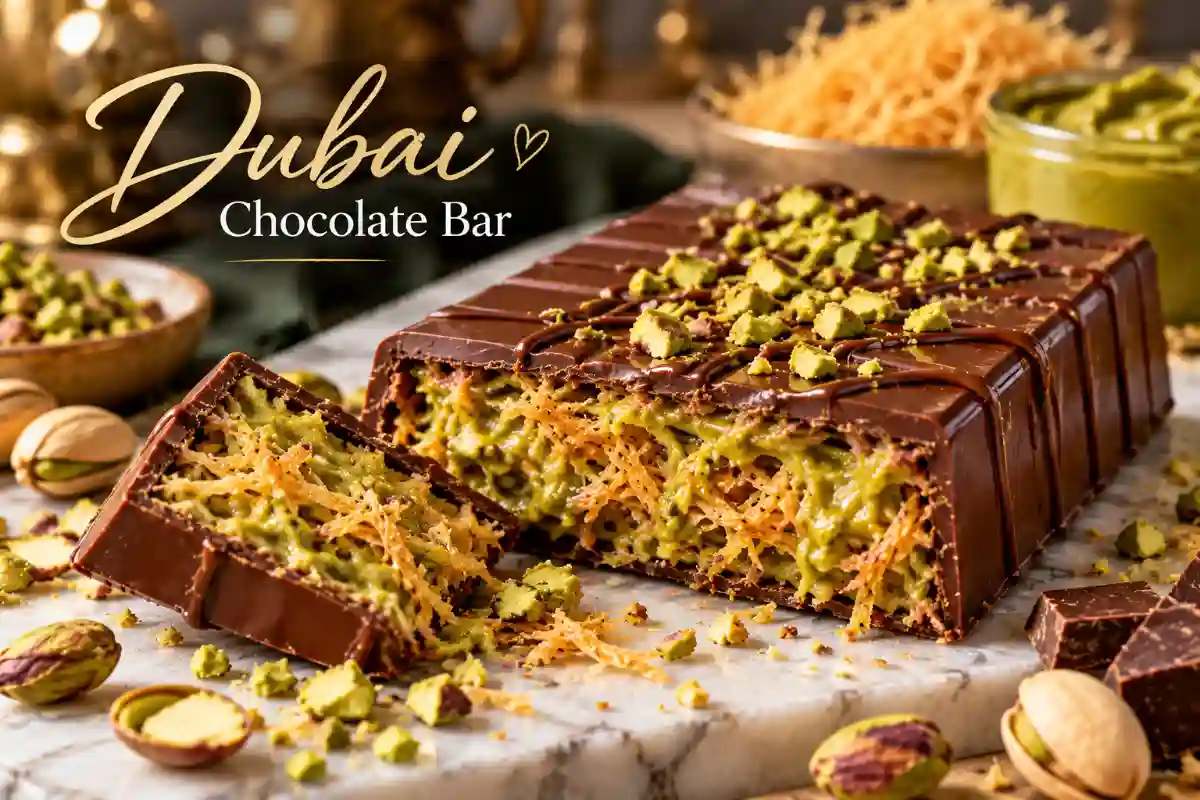

The Dubai chocolate bar combines a crunchy shell of chocolate, then filling it with creamy pistachio, toasted kataifi pastry, and tahini. And this is where the magic lies: a crack snap of the shell, a lush and creamy pistachio center, and delicate, crunchy textures with fine strands of pastry.
You will find that making this viral-esque chocolate at home is actually quite simple when you get into the details. If kataifi is not toasted enough, it can turn soggy; an excess of pistachio cream can overpower the pastry; and a thin shell of chocolate may break off during unmolding.
In this guide, I outline the entire process for you from picking your favourite pistachio cream and chocolate; getting the filling consistency right, tempering the shell, common problem solutions, and storing your finished bars without sacrificing that unmistakable crunch.
| Quick question | Answer |
| What is a Dubai chocolate bar? | Chocolate filled with pistachio cream and crispy kataifi |
| What makes it crunchy? | Toasted kataifi |
| What balances the sweetness? | Tahini |
| Which chocolate can I use? | Milk, semisweet, or dark |
| Is a special mold essential? | No, but it helps |
| Difficulty | Beginner to intermediate |
Read More: Dubai Chocolate Bar
What Is a Dubai Chocolate Bar?
A Dubai chocolate bar is a filled chocolate confection known for its thick chocolate shell and bright pistachio-kataifi center. The filling generally combines pistachio cream, toasted kataifi or kadayif pastry, and tahini.
Its appeal isn’t simply pistachio flavor. It comes from combining several contrasting textures and flavors in the same bite: crisp chocolate, creamy nut filling, delicate toasted pastry, cocoa sweetness, and the roasted sesame character of tahini.
The concept takes inspiration from Middle Eastern dessert flavors, particularly knafeh/kunafa, although the viral chocolate-bar format is a separate confection rather than traditional knafeh covered in chocolate.
What Is Inside a Dubai Chocolate Bar?
The easiest way to understand the bar is as three components:
Chocolate shell → pistachio-tahini filling → toasted kataifi crunch
The chocolate provides structure and cocoa flavor. Pistachio cream gives the center richness and its characteristic nutty taste. Tahini adds roasted sesame depth, while toasted kataifi provides the fine, crispy strands that distinguish the filling from ordinary pistachio chocolates.
A good homemade version preserves all three textures. If the kataifi disappears into a wet pistachio paste, the bar may still taste good, but it loses much of its signature contrast.
Where Did Dubai Chocolate Come From?
The viral style is associated with Dubai-based FIX Dessert Chocolatier, and its Can’t Get Knafeh of It chocolate bar, created by founder Sarah Hamouda. The original concept combined chocolate with pistachio, tahini, and knafeh-inspired crispy pastry.
The idea subsequently became much broader than one product. As versions spread through social media, bakeries, chocolatiers, supermarkets, and home kitchens began producing their own interpretations under the general description “Dubai chocolate.”
For a homemade recipe, the important takeaway isn’t reproducing a commercial product exactly. It is preserving the combination that made the style distinctive: chocolate + pistachio + tahini + crispy kataifi.
Why Did Dubai Chocolate Become So Popular?
The bar is unusually suited to visual food content.
From the outside, it looks like a thick chocolate bar. Break it open, and the dark or milk-colored shell reveals a vivid pistachio center threaded with golden pastry.
The eating experience is equally distinctive—the chocolate cracks first, followed by creamy pistachio and crunchy kataifi.
That combination of dramatic cross-section, contrasting colors, and audible crunch helped the style become highly recognizable online.
Dubai Chocolate Bar Ingredients
This recipe doesn’t require dozens of ingredients. Choosing the right versions of a few core ingredients matters much more.
For a practical homemade batch, you’ll need:
- chocolate;
- kataifi/kadayif pastry;
- sweet pistachio cream;
- tahini;
- unsalted butter;
- optional fine salt;
- optional roasted pistachios.
What Is Kataifi and Where Can You Find It?
Kataifi, sometimes labeled kadayif, is a pastry formed into extremely fine strands. Once toasted in butter or another suitable fat, those strands become crisp and create the filling’s characteristic texture.
U.S. shoppers can look for it in Middle Eastern, Mediterranean, Greek, Turkish, or international grocery stores. Because it is often sold frozen, check the freezer section rather than only the baking aisle. It can also be found through specialty online food retailers.
If frozen, thaw it according to the package instructions before working with it.
Separate dense clumps before toasting. Otherwise, the outside can brown while the pastry trapped inside remains pale and soft.
Shredded coconut is not an equivalent substitute. It may provide crunch, but its flavor and texture are fundamentally different.
Pistachio Cream vs. Pistachio Butter vs. Pistachio Paste
The labels sound interchangeable, but the products can behave very differently.
| Product | Typical characteristics | Usually sweetened? | Best use here |
| Pistachio cream | Smooth dessert-style spread | Yes | Easiest filling base |
| Pistachio butter | Primarily ground pistachios | Usually not | Requires recipe adjustment |
| Pistachio paste | Concentrated pistachio product | Varies | Check formulation first |
Read More: Dubai Chocolate Bar
For this recipe, sweet pistachio cream is the simplest option.
Always read the ingredient label. Product names aren’t perfectly standardized, so two jars labeled “pistachio cream” can differ substantially in sugar, pistachio content, added fats, dairy ingredients, and consistency.
If you substitute unsweetened pistachio butter for sweet pistachio cream, don’t expect identical sweetness or texture.
Is Tahini Necessary?
Tahini is a paste made from sesame seeds. In this filling, it provides roasted sesame flavor and helps offset some of the sweetness from the chocolate and pistachio cream.
You can reduce it if you dislike its flavor. You can also omit it, but the result won’t have the same flavor balance.
Don’t automatically replace omitted tahini with additional pistachio cream. Increasing the wet ingredients can change the pastry-to-cream ratio and reduce the perceived crunch.
What Chocolate Works Best?
Choose chocolate according to the sweetness you want.
| Chocolate | Sweetness | Pistachio contrast | Best for |
| Milk | Higher | Soft and creamy | Sweet dessert-style bar |
| Semisweet | Medium | Balanced | Versatile home version |
| Dark | Lower | Strong | Less-sweet, cocoa-forward result |
Milk chocolate pairs naturally with pistachio, but combining very sweet milk chocolate with a highly sweetened pistachio spread can produce an intensely sweet result.
Semisweet is a useful middle ground.
Dark chocolate provides stronger bitterness and cocoa flavor, which can balance a sweet filling particularly well.
If you’re tempering rather than simply melting the chocolate, couverture is especially useful because it is formulated for applications such as molding and coating.
Equipment You’ll Need
You’ll need:
- chocolate-bar mold;
- wide skillet;
- heatproof bowl;
- silicone spatula;
- spoon or small offset spatula;
- knife or kitchen scissors for kataifi;
- digital kitchen scale;
- optional digital thermometer.
A scale is particularly useful because chocolate and kataifi are more consistently measured by weight than by cups.
Which Chocolate Mold Should You Use?
A deep rectangular mold produces the thick appearance most people associate with this style of bar.
The exact pattern doesn’t matter nearly as much as capacity.
A shallow candy-bar mold might hold only a fraction of the chocolate and filling required by a large, deep mold. That’s why recipe quantities don’t always transfer perfectly between molds.
One useful trick is to fill your empty mold with water and measure the water to estimate its capacity. Afterward, wash and dry the mold completely before chocolate touches it.
If publishing your own tested version of this recipe, record the dimensions and capacity of your mold so readers can scale more accurately.
Can You Make Dubai Chocolate Without a Mold?
Yes.
The easiest alternative is Dubai chocolate bark.
Spread melted chocolate on parchment, let it begin to set, add the pistachio-kataifi filling while leaving a border, then finish with another layer or generous drizzle of chocolate.
The result won’t have the same thick rectangular shape, but you’ll still get the important combination of chocolate, pistachio, tahini, and crispy pastry.
Do You Need a Chocolate Thermometer?
Not for the simplest version.
If you’re only melting chocolate and making a casual home batch, you can work carefully without one.
If you plan to temper real chocolate, use a thermometer. Tempering depends on controlling temperature as chocolate moves through melting, cooling, and working stages.
Professional chocolate guidance also notes that tempering helps couverture set with the shine and structure desirable for molded chocolates.
How to Make a Dubai Chocolate Bar Step by Step
Prepare your ingredients and equipment before melting the chocolate. Once the chocolate is ready for molding, stopping to chop pastry or search for a spatula makes the process unnecessarily difficult.
Step 1 — Prepare and Toast the Kataifi
For the recipe below, start with 5 ounces (140 g) kataifi.
Separate the strands and roughly chop them into shorter lengths.
Melt 2 tablespoons (28 g) unsalted butter in a wide skillet over medium to medium-low heat. Add the kataifi and toast it while stirring and turning frequently.
Don’t judge doneness solely by minutes.
The pastry should become evenly golden, dry, and crisp. If half the strands are golden while the rest remain pale, continue tossing and toasting carefully.
Remove the kataifi from the hot pan once finished so residual heat doesn’t burn the fine strands.
Step 2 — Make the Pistachio-Kataifi Filling
Allow the toasted kataifi to cool slightly.
Fold it together with:
- 7 ounces (200 g) sweet pistachio cream
- 1 tablespoon (15 g) tahini
- small pinch of salt, optional
Don’t aggressively mash the mixture.
You should still be able to identify plenty of individual pastry strands. The cream should coat and bind the kataifi rather than drown it.
If your pistachio spread is unusually thin, add it gradually. Product consistency varies.
Step 3 — Melt or Temper the Chocolate
For the simple method, gently melt 14 ounces (400 g) of chocolate.
Microwave it in short intervals, stirring thoroughly between each one, or melt it in a clean, dry heatproof bowl using gentle indirect heat.
Avoid water or steam entering the chocolate. Valrhona likewise advises keeping water out when melting chocolate.
For a more polished shell, use the tempering method explained later.
Step 4 — Form the Chocolate Shell
Spoon chocolate into your clean, completely dry mold.
Tilt the mold so chocolate coats the base and sides, or use a spoon or brush to guide it into the corners.
Inspect the shell before letting it set.
Very thin spots may crack when unmolded. At the opposite extreme, an excessively thick shell can make the finished bar hard to bite and overwhelm the filling.
Aim for an even layer with particular attention to the corners.
Step 5 — Let the Shell Set
Let the shell become firm enough to hold the filling without smearing.
Don’t rely on one universal setting time. Chocolate type, tempering, shell thickness, mold material, and room temperature all affect how quickly it firms.
Step 6 — Add the Pistachio-Kataifi Filling
Spoon the filling into the shell.
Spread it evenly and press only gently. Compressing it aggressively can destroy some of the airy pastry texture you’ve worked to create.
Leave a small amount of room at the top.
If filling reaches the rim, the final chocolate layer cannot create a strong seal around the perimeter.
Step 7 — Seal the Bar
Cover the filling with the remaining chocolate.
Spread the chocolate all the way to the shell’s edges and level the surface.
Check the perimeter carefully. The final layer needs to join the existing shell rather than simply sit on top of the filling.
Step 8 — Set and Unmold
Allow the bar to become completely firm before unmolding.
Release it gently according to the mold design rather than repeatedly bending or forcing it.
Tempered chocolate is particularly well suited to molding because correct crystallization improves its structure and finish. Valrhona’s professional molding guidance uses tempered couverture for molded chocolate pieces.
Break or slice the finished bar.
A successful cross-section should reveal obvious crispy pastry strands throughout the pistachio filling.
3 Texture Checkpoints for a Better Dubai Chocolate Bar
Recipes often give exact times without explaining what success actually looks like. These three checkpoints are more useful when your stove, ingredients, or mold differ from the recipe writer’s.
Checkpoint 1 — Kataifi Should Be Golden and Crisp
Under-toasted: pale, soft, and flexible.
Partially toasted: browned in some places but pale in others.
Ready: evenly golden, light, dry, and noticeably crisp.
If you’re unsure, take a small piece from the pan, allow it to cool briefly, and check its texture.
Checkpoint 2 — The Filling Should Be Creamy but Textured
Look closely at a spoonful of finished filling.
You should see many separate kataifi strands coated in pistachio cream.
If it resembles a smooth green paste with only occasional pastry pieces, you’ve lost too much of the textural contrast.
This is also why adding more pistachio cream isn’t always an improvement.
Checkpoint 3 — The Shell Should Be Thin but Strong
The shell has two jobs: hold the filling securely and provide a satisfying chocolate layer.
It shouldn’t be paper-thin around the corners, but it also shouldn’t become a thick block of chocolate surrounding a small amount of filling.
For recipe photography, a close-up cross-section is one of the most useful images you can provide because readers can compare their shell-to-filling ratio with yours.
Melted vs. Tempered Chocolate: Which Method Should You Use?
Simple melting prioritizes convenience. Tempering prioritizes finish and structure.
| Feature | Simple melted chocolate | Tempered chocolate |
| Difficulty | Easier | More technical |
| Thermometer | Usually optional | Recommended |
| Gloss | Variable | Better when successful |
| Snap | Variable | Typically firmer |
| Mold performance | Variable | Better suited to molding |
| Best for | Casual home batch | Polished finished bars |
Read More: Dubai Chocolate Bar
Easy Melted-Chocolate Method
Chop chocolate into relatively even pieces.
Microwave it in short bursts, stirring frequently, or melt it carefully with indirect heat.
Stop heating aggressively once only a few small pieces remain. Stirring allows residual heat to finish the job and reduces the chance of overheating.
This method is convenient, but melted chocolate isn’t automatically tempered. The finished bar may be less glossy, softer at room temperature, or more difficult to release depending on the product and cooling conditions.
For a first homemade batch, that may be an acceptable tradeoff.
Tempered-Chocolate Method
Tempering deliberately controls cocoa-butter crystallization.
A practical home technique is seeding: melt most of the chocolate, then introduce unmelted chocolate while stirring and cooling.
Valrhona’s published tempering guidance gives the following general ranges:
| Chocolate | Melt | Cool | Working temperature |
| Dark | 122–131°F (50–55°C) | 82–84°F (28–29°C) | 88–90°F (31–32°C) |
| Milk | 113–122°F (45–50°C) | 81–82°F (27–28°C) | 84–86°F (29–30°C) |
Valrhona’s seeding guidance similarly recommends melting dark chocolate around 50–55°C and milk chocolate around 45–50°C before introducing the remaining chocolate and bringing it to its working range.
Use the temperature curve supplied by your chocolate manufacturer when available because formulations vary.
7 Common Dubai Chocolate Bar Mistakes and How to Fix Them
Most disappointing batches can be traced to texture, ratio, or chocolate handling rather than an inherently difficult recipe.
| Problem | Likely cause | Practical fix |
| Soft kataifi | Under-toasting or moisture | Toast until dry and crisp |
| Soggy filling | Too much cream relative to pastry | Rebalance the ratio |
| Bar is too sweet | Sweet spread + sweet chocolate | Try semisweet or dark chocolate |
| Cracked shell | Thin or uneven coating | Reinforce weak areas |
| Hard, thick shell | Excess chocolate | Apply a thinner coating |
| Dull/streaky chocolate | Crystallization/tempering issue | Improve temperature control |
| Bar sticks to mold | Chocolate hasn’t set correctly | Let it set completely and review tempering |
Read More: Dubai Chocolate Bar
Why Isn’t My Kataifi Crunchy?
Under-toasting is the first thing to check.
Kataifi should be crisp before it meets the pistachio cream. Mixing soft pastry into the filling won’t magically make it crunchy later.
Next, consider your ratio. Even beautifully toasted pastry can seem soft if a small amount is submerged in a large quantity of spread.
Finally, control moisture. Keep the mold and utensils dry, and don’t cover steaming-hot toasted pastry in a way that traps condensation.
Why Is My Pistachio Filling Too Runny?
Check the pistachio product first.
Different brands can range from thick, spoonable spreads to much looser creams.
Instead of automatically using the entire measured quantity, fold in most of the cream and inspect the texture. Add the remainder only if needed.
The correct filling should hold together while still showing substantial pastry structure.
Why Did My Chocolate Shell Crack?
A cracked shell commonly points to:
- thin areas;
- weak corners;
- unmolding before the shell is ready;
- incomplete sealing;
- excessive force during unmolding.
Overfilling can indirectly cause cracks too because there isn’t enough room for a strong final chocolate layer.
Why Does My Chocolate Look Dull?
Dullness or streaking can result from poor chocolate crystallization.
Proper tempering improves the surface and structure of real chocolate. Professional couverture is specifically designed for uses such as coating and molding, where fluidity, shine, and controlled crystallization matter.
If appearance is your priority, use couverture and follow the manufacturer’s tempering curve.
Original Test — Finding the Best Pistachio-to-Kataifi Ratio
This is where a recipe publisher can add information that another generic recipe cannot.
Prepare three small fillings using the same brands and ingredients:
Test A — Kataifi-heavy: more pastry for maximum crunch.
Test B — Balanced: enough cream to coat the pastry while keeping the strands prominent.
Test C — Pistachio-heavy: more cream for maximum richness.
Then score each version.
| Test | Crunch | Pistachio flavor | Sweetness | Ease of filling | Texture after 24 hours |
| Kataifi-heavy | Test and record | Test and record | Test and record | Test and record | Test and record |
| Balanced | Test and record | Test and record | Test and record | Test and record | Test and record |
| Pistachio-heavy | Test and record | Test and record | Test and record | Test and record | Test and record |
Read More: Dubai Chocolate Bar
These fields are intentionally not filled with invented results.
If you’re publishing this recipe commercially, experiment and photograph each cross-section immediately and after 24 hours. Record exact weights.
That creates original evidence about the tradeoff between pistachio intensity and long-lasting crunch rather than simply asserting that one ratio is “perfect.”
How Much Does Homemade Dubai Chocolate Cost?
Prices for pistachio cream, chocolate, and kataifi vary too much across U.S. retailers and brands for one cost figure to remain useful.
Calculate your actual cost instead.
For each ingredient:
Amount used ÷ package quantity × package price = ingredient cost
Then:
Total ingredient costs ÷ number of finished bars = approximate cost per bar
Suppose a 10-ounce jar of pistachio cream costs $12, and your batch uses 5 ounces. The pistachio cream contributes approximately $6 to that batch.
Repeat the calculation for chocolate, kataifi, butter, and tahini.
Don’t forget that leftover ingredients aren’t wasted costs if you will use them in another batch.
Cost-Saving Tips Without Ruining the Recipe
Compare pistachio cream using price per ounce, not just the price printed on the jar.
Check Middle Eastern and Mediterranean grocery stores for kataifi before paying a premium for a small specialty package online.
You also don’t need an expensive decorative mold for your first attempt. Start with a basic food-safe mold or make bark.
Chocolate is one ingredient where buying solely on price can backfire. Since the shell makes up a large part of every bite, choose chocolate that tastes good to you on its own.
How to Store Dubai Chocolate Bars Without Losing the Crunch
The priorities are simple: limit heat, humidity, strong odors, and condensation.
Once the bars are fully set, place them in an airtight container and keep them in a cool, dry location when the ingredients and room conditions allow.
Always check the storage instructions on your pistachio cream too. Products can differ.
Room Temperature vs. Refrigerator
A genuinely cool room can be suitable for chocolate, while a hot kitchen is not.
Refrigeration can protect the bar from excessive heat but introduces another issue: condensation.
If you refrigerate the bars, use an airtight container. When taking them out, allowing the closed container to warm somewhat before opening can help reduce warm, humid air condensing directly on the cold chocolate.
If an ingredient manufacturer’s label specifically requires refrigeration after opening, follow that guidance.
How to Keep Kataifi Crispy
Start with properly toasted pastry.
Let excess heat escape rather than trapping steam around freshly toasted kataifi.
Keep wet utensils away from the filling and store the finished confection airtight.
Also recognize that the filling itself contains moisture and fat. Texture may gradually change during storage, which is why an actual 24-hour and multi-day crunch test would be valuable for a recipe publisher.
Can You Freeze Dubai Chocolate?
Freezing can introduce condensation and potentially affect both chocolate appearance and filling texture.
Unless you have tested the exact recipe after freezing and thawing, cool or refrigerated storage is the simpler recommendation.
If you experiment with freezing, package the bar very thoroughly to minimize moisture exposure and thaw it gradually while still wrapped.
Easy Dubai Chocolate Variations
Once you understand the standard version, variations are easy to make without changing the basic technique.
Dark Chocolate Version
Replace milk or semisweet chocolate with dark chocolate for stronger cocoa flavor and lower perceived sweetness.
This works particularly well when your pistachio cream is very sweet.
If tempering, remember that dark chocolate uses different working temperatures from milk chocolate.
Mini Dubai Chocolate Bars
Use smaller molds for individual portions.
You’ll need less filling per cavity, and the chocolate may set more quickly.
Don’t simply shrink every component visually. Check that each miniature bar still has enough filling for the kataifi texture to be noticeable.
Dubai Chocolate Bark
Spread melted or tempered chocolate on parchment.
Allow it to begin setting, add an even layer of pistachio-kataifi filling while leaving a clean border, then cover or drizzle with more chocolate.
Once firm, break it into pieces.
It’s an excellent first attempt because it eliminates one of the trickier steps: unmolding a deep filled shell.
Extra-Pistachio Version
Add chopped roasted pistachios to the filling for another layer of nutty texture.
Use them as an addition rather than replacing most of the kataifi. Roasted nuts provide a firm crunch, while toasted kataifi provides the delicate crispness that defines the filling.
Dubai Chocolate Bar Recipe Card
Prep time: About 20 minutes
Kataifi toasting: About 8–12 minutes; use appearance and texture as the final test.
Setting time: Approximately 30–60 minutes depending on chocolate and conditions
Approximate total time: 1–1½ hours
Yield: Approximately 2 substantial bars, depending on mold capacity
Difficulty: Beginner to intermediate
Ingredients
- 14 oz (400 g) milk, semisweet, or dark chocolate
- 5 oz (140 g) kataifi pastry
- 2 tbsp (28 g) unsalted butter
- 7 oz (200 g) sweet pistachio cream
- 1 tbsp (15 g) tahini
- Small pinch fine salt, optional
- Chopped roasted pistachios, optional
Equipment
- Chocolate-bar mold
- Wide skillet
- Heatproof bowl
- Silicone spatula
- Spoon or offset spatula
- Digital kitchen scale
- Digital thermometer if tempering
Instructions
- Prepare the mold. Make sure it is completely clean and dry.
- Prepare the kataifi. Separate and roughly chop the pastry strands.
- Toast the pastry. Melt the butter in a wide skillet, add kataifi, and toast over medium to medium-low heat while stirring frequently. Stop when it is evenly golden, dry, and crisp.
- Make the filling. Fold the toasted pastry with pistachio cream, tahini, and optional salt. Keep visible pastry strands rather than crushing everything into a paste.
- Prepare the chocolate. Melt gently for the beginner method or temper according to the manufacturer’s temperature guidance.
- Create the shell. Coat the base, sides, and corners of the mold evenly.
- Let it set. Wait until the shell is firm enough to support the filling.
- Fill the mold. Spread the pistachio-kataifi mixture evenly, leaving room at the top.
- Seal the bar. Cover with the remaining chocolate and connect the final layer securely around the edges.
- Set completely. Don’t rush the unmolding step.
- Unmold and serve. Release gently and break or slice the bar to reveal the textured center.
Recipe Success Checklist
Before unmolding, confirm:
☐ Kataifi was toasted until golden and crisp
☐ Filling still shows individual pastry strands
☐ Mold was completely clean and dry
☐ Chocolate covered the corners evenly
☐ Filling wasn’t packed to the rim
☐ Final layer sealed around the entire perimeter
☐ Chocolate has completely set
Frequently Asked Questions About Dubai Chocolate Bar
What Dubai chocolate is inside?
The classic pistachio version has a chocolate shell and is filled with sweet pistachio cream, crispy roasted kataifi, and tahini. Some recipes have individual variations, like chopped pistachios or decorative chocolate.
What is the crunchy part?
Kataifi or kadayif (Philodaphne) is a fine-stranded pastry that lends its distinctive crunch. The filling should be dry, and you must toast it to the last minute before mixing it with the pistachio mixture.
Is Pistachio Cream the same as Pistachio Butter?
Not necessarily. Pistachio cream is typically a sweet dessert spread including at least pistachios and other ingredients,s whereas pistachio butter usually consists of almost purely ground pistachios with little or only some sugar added. My Recommendations: Always read the ingredient label and not just the product name.
I can leave the kataifi out and still make chocolate Dubai.
We can create a chocolate without kataifi filled with pistachio;o, however, our signature pastry crunch will not be there. Other crunchy ingredients can make for a lovely chocolate bar, but they aren’t quite the same.
How to make Dubai chocolate without using tahini?
Not really; but tahini is what adds some roasted sesame flavor and keeps this room-temp chocolate cream from becoming too sweet or cloying when paired with the sweeter pistachio cream. Disregarding it drastically alters the flavour; taste of the filling before amending anything else.
Raw Chocolate — The Way to Go for Dubai Chocolate Bars
This yields a creamier, sweeter product than milk chocolate. A semisweet results in a middle path; while dark chocolate has more of an intense cocoa profile and can offset (within reason) very sweet pistachio cream.
Do I need to temper chocolate for a Dubai Chocolate Bar?
If it’s for home and making casuals, no; but tempering helps a glossy hard shell with cleaner snap and better mold characteristics. Couverture chocolate is one of the most relevant when it comes to proper tempering.
How to prepare a mold-less Dubai chocolate bar?
Yes. Layer the chocolate and pistachio-kataifi on parchment to make Dubai chocolate bark. It would not be the same thick molded shape, but it could still resemble that flavor and texture combo.
With my Dubai crunchy chocolate filling?
The various problems that seemed to happen most often include kataifi being under-toasted, an overwhelming amount of pistachio cream vs the pastry, or exposure to moisture. Heat the kataifi until really crisp, then drizzle in the cream slowly enough to keep some strands intact.
Storage Of Homemade Dubai Chocolate Bars
Store the bars airtight and away from heat and humidity. If you work in all aspects of the room, however, some things that need to remain cool and dry do well when your conditions require it. If you need to put these in the refrigerator, also make sure that they are sealed up very tightly and minimize condensation as much as possible while they return to room temperature.