Zimbabwe National Cricket Team vs Bangladesh National Cricket Team Timeline: The Complete History

Two cricket nations fought for the same recognition, on the same margins, against the same doubters- and somewhere along the way, became each other’s most important measuring stick. The Zimbabwe national cricket team vs Bangladesh national cricket team timeline stretches back nearly three decades, from a forgotten one-day fixture in Nairobi to a fiercely contested 2026 series that flipped every assumption about who’s actually ahead. This is the complete, data-backed account of how that rivalry was built, broken, and rebuilt again.
What Is the Zimbabwe vs Bangladesh Cricket Rivalry?
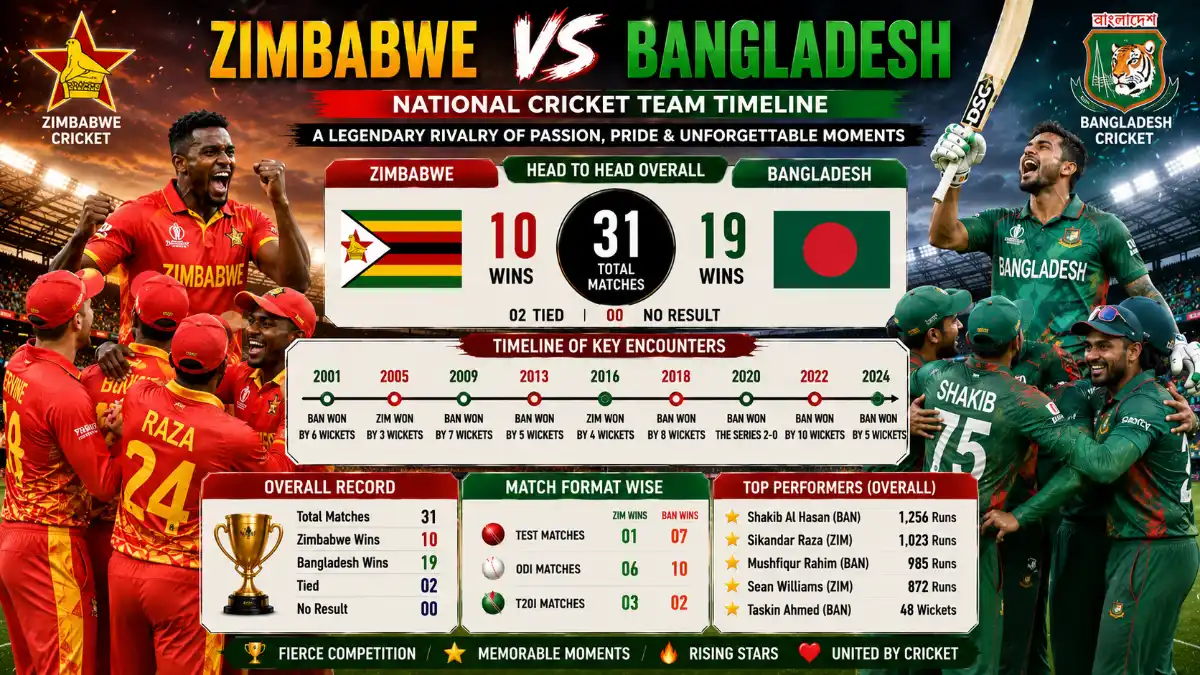
Zimbabwe and Bangladesh have played each other 132 times across Tests, ODIs, and T20Is since 1997, with Bangladesh holding the overall lead 79 wins to Zimbabwe’s 50, plus 3 Test draws. Zimbabwe dominated the early years because of its earlier Test status, but Bangladesh’s rapid domestic development flipped the rivalry decisively after 2009. Recent results from 2025–2026 show Zimbabwe clawing back significant ground, particularly in ODIs and Test cricket.
This single paragraph captures the entire arc- but the real value of the Zimbabwe national cricket team vs Bangladesh national cricket team timeline lies in understanding why each phase happened, not just what the scoreline says.
How the Rivalry Began: The 1990s Foundations
Zimbabwe entered Test cricket in 1992, a full eight years before Bangladesh, and that head start defined the earliest phase of this rivalry completely. Their first-ever meeting came in a one-day fixture at Nairobi’s Gymkhana Club Ground on October 11, 1997, as part of an ICC-organized tri-nation event, at a time when Bangladesh was still an Associate nation trying to prove it belonged on the same field as Full Member sides.
Zimbabwe’s squad in this era featured a genuinely strong core- the Flower brothers, Heath Streak, Alistair Campbell- players with years of first-class and international experience behind them. Bangladesh, by contrast, was assembling a team almost from scratch, with limited exposure to international-standard bowling attacks or professional structures. The early scorelines reflected that gap heavily, and for Bangladesh’s board, these fixtures weren’t really about winning. They were about survival, credibility, and buying time to build a domestic system that could eventually compete.
Why the Early Years Set the Template
- Zimbabwe became the benchmark opponent Bangladesh needed to eventually overtake
- These matches gave Bangladesh’s emerging players rare exposure to disciplined, senior-level bowling.
- The psychological framing of “underdog vs established side” would define the next decade of coverage.e
Bangladesh’s Test Debut and the Breakthrough Win (2001–2005)
Bangladesh achieved Test status in 2000, and its early results against most opponents- including Zimbabwe- were rough by any measure. Zimbabwe won the opening Test series 2-0 in 2000/01, followed that up with another series win in 2001/02, and took a further series in 2003/04, extending an uncomfortable run for Bangladesh’s young Test program.
Everything changed in January 2005. Bangladesh secured its first-ever Test match victory against Zimbabwe in Chittagong, winning by 226 runs after posting 488 in the first innings. That single result mattered far more than the scoreline suggests- it arrived at a moment when critics inside cricket’s governing bodies were openly questioning whether Bangladesh deserved its Test status at all. The win didn’t just end a losing run. It gave Bangladesh’s entire domestic cricket structure a credibility boost it desperately needed at that stage.
Around the same period, Zimbabwe was quietly heading toward crisis. A wave of administrative disputes with Zimbabwe Cricket triggered a mass exodus of senior, experienced players through the mid-2000s, stripping the national side of the depth that had made it competitive throughout the 1990s. Bangladesh was climbing just as Zimbabwe was falling- a coincidence of timing that would define the next fifteen years.
Chittagong 2005: Why It Still Gets Referenced Today
- Silenced calls questioning Bangladesh’s Test status within the ICC
- Marked the first time Bangladesh beat a side with a longer Test history
- Became the reference point for every “underdog breakthrough” story in Bangladeshi cricket since
The Power Shift: 2009 to 2013
This is the stretch where any honest Zimbabwe national cricket team vs Bangladesh national cricket team timeline has to acknowledge a genuine reversal of fortune. Zimbabwe’s talent drain from the mid-2000s left the side fielding inexperienced, rebuilding squads for years afterward, while Bangladesh had by this point developed a core group- Shakib Al Hasan, Tamim Iqbal, Mushfiqur Rahim- capable of closing out matches against comparable-level opposition consistently rather than occasionally.
Bangladesh began treating fixtures against Zimbabwe differently during this window. Rather than survival contests, these series became opportunities to build winning momentum, rotate squad depth, and generate confidence ahead of tougher assignments against higher-ranked teams. That mental shift showed up directly in results: series wins that would once have felt improbable started becoming the expected outcome rather than the surprising one.
Zimbabwe did manage a genuine high point in this window- winning the 2011 Test series in Harare and drawing the 2013 series 1-1- proving the side hadn’t collapsed entirely even amid its administrative turmoil. But the broader trend across formats had clearly turned in Bangladesh’s favor, and it would stay that way for close to a decade.
The Tactical Pattern Behind Bangladesh’s Rise
- Bangladesh’s top order targeted Zimbabwe’s less experienced new-ball bowlers early in the inning.s
- Zimbabwe’s batting leaned heavily on individual performances rather than sustained partnerships.
- Bangladesh’s spin depth exploited batting lineups less accustomed to subcontinent-style turning conditions.s
Zimbabwe’s Struggle for Relevance: 2014 to 2020
Zimbabwe’s cricket board continued facing financial and administrative instability through most of this decade, and it showed directly in player retention, contract disputes, and preparation quality. Bangladesh, meanwhile, used fixtures against Zimbabwe partly as a testing ground for bench strength ahead of tougher tours against top-eight nations, which tells you everything about how the balance of power had settled by this stage.
Bangladesh’s most dominant Test-series stretch against Zimbabwe on record came in this window– a 3-0 sweep in the 2014/15 home series, followed by an outright series win in 2019/20. Zimbabwe did produce individual flashes of quality throughout this period, most notably through Sikandar Raza’s emergence as a genuine all-rounder- arguably Zimbabwe’s first true matchwinner since the Streak-Flower generation faded out. But consistency across a full squad remained the persistent problem that stats alone can’t fully explain, though the numbers make the gap unmistakable.
What the Numbers From This Era Reveal
- Bangladesh won the majority of the bilateral series contested between 2014 and 2020
- Zimbabwe’s win rate against Bangladesh in this window dropped well below its 1990s and early-2000s averages.
- Sikandar Raza’s individual performances became the primary source of Zimbabwe’s competitive moments.
A Rivalry Recalibrated: 2021 to 2026
Recent fixtures tell a noticeably different story than the previous decade, and this is the part of the Zimbabwe national cricket team vs Bangladesh national cricket team timeline that most existing articles miss entirely because they simply haven’t been updated. Zimbabwe has stabilized under a new generation led by Sikandar Raza and Craig Ervine, while Bangladesh has navigated its own transitional period following the retirement and workload management of its long-serving senior core.
The Test results captured this shift clearly- series were drawn 1-1 in both 2018/19 and 2025, and Zimbabwe won the 2026 Test series outright in Harare, a result that would have seemed almost unthinkable during the 2014–2020 stretch. The one-day format showed an even sharper turnaround: Zimbabwe swept a 2-0 ODI series against Bangladesh in Harare in July 2026, winning tight, low-scoring contests that demonstrated genuine tactical discipline rather than one-off form.
T20Is remain the most competitive format overall between these two sides. The most recent series, played across Harare and Bulawayo in July 2026, went the full distance- Zimbabwe won the opener by 32 runs, before Bangladesh responded to close out the series 2-1 with wins in the second and third matches.
Why This Recent Period Matters More Than It Looks
- Zimbabwe’s recovery is real, though still tied closely to board stability and fundi.ng
- Bangladesh’s historical dominance is no longer automatic, the way it was between 2010 and 2018
- T20I cricket has become the genuine battleground format, with margins tighter than at any point in the rivalry’s history
Head-to-Head Records by Format
| Format | Total Matches | Zimbabwe Wins | Bangladesh Wins | Draws | Span |
| Test | 21 | 9 | 9 | 3 | 2001–2026 |
| ODI | 83 | 32 | 51 | 0 | 1997–2026 |
| T20I | 28 | 9 | 19 | 0 | 2006–2026 |
Bangladesh’s advantage is heavily concentrated in white-ball cricket, while Test matches remain evenly split at 9 wins apiece- a statistic that surprises most casual readers who assume Bangladesh dominates across every format equally. It doesn’t. The gap is real, but it’s format-specific.
Complete Test Series Results (2001–2026)
| Season | Host Nation | Series Result | Series Score |
| 2000/01 | Zimbabwe | Zimbabwe won | 2-0 |
| 2001/02 | Bangladesh | Zimbabwe won | 1-0, 1 drawn |
| 2003/04 | Zimbabwe | Zimbabwe won | 1-0, 1 drawn |
| 2004/05 | Bangladesh | Bangladesh won | 1-0, 1 drawn |
| 2011 | Zimbabwe | Zimbabwe won | 1-0 |
| 2013 | Zimbabwe | Series drawn | 1-1 |
| 2014/15 | Bangladesh | Bangladesh won | 3-0 |
| 2018/19 | Bangladesh | Series drawn | 1-1 |
| 2019/20 | Bangladesh | Bangladesh won | 1-0 |
| 2021 | Zimbabwe | Bangladesh won | 1-0 |
| 2025 | Bangladesh | Series drawn | 1-1 |
| 2026 | Zimbabwe | Zimbabwe won | 1-0 |
Bangladesh’s largest Test win margin over Zimbabwe stands at an innings and 106 runs, achieved twice- once in Mirpur in 2020 and again in Chattogram in 2025. Zimbabwe’s biggest win came by 335 runs in Harare back in April 2013, still the most one-sided result of the entire rivalry in either direction.
Biggest Wins and Notable Records
Certain individual results in this rivalry carry more weight than a simple line in a scorecard. A few stand above the rest, whether through statistical scale or historical timing:
- Bangladesh’s first-ever Test victory: 226 runs, Chittagong, January 2005
- Bangladesh’s largest Test win margin: innings and 106 runs (achieved twice, in 2020 and 2025)
- Zimbabwe’s largest Test win margin: 335 runs, Harare, April 2013
- Zimbabwe’s most recent Test win: innings and 85 runs, Harare, June 2026
- Zimbabwe’s ODI series sweep: 2-0 in Harare, July 2026, both matches decided by fewer than 30 runs
Why This Rivalry Matters Beyond the Scoreline
Neither board operates with the financial resources of cricket’s so-called Big Three, and that context matters enormously when interpreting these results. Bilateral fixtures between Zimbabwe and Bangladesh function as essential match volume for both nations- low-pressure opportunities to test emerging talent, rebuild squad confidence after tougher tours elsewhere, and stay competitive in ICC rankings and World Cup qualification pathways.
The real significance of the Zimbabwe national cricket team vs Bangladesh national cricket team timeline isn’t which side dominates at any given moment. It’s that both nations have used each other as development benchmarks at critical points in their growth, and neither team’s current identity makes full sense without understanding how the other one pushed it forward, whether through pressure, embarrassment, or genuine competitive rivalry.
10 Frequently Asked Questions
What is the overall head-to-head record between Zimbabwe and Bangladesh?
Bangladesh leads 79 wins to Zimbabwe’s 50 across all formats combined, with 3 Test draws, through July 2026.
Who won the most recent series between the two teams?
Zimbabwe won the most recent ODI series 2-0 in Harare in July 2026, while Bangladesh won the preceding T20I series 2-1.
When did Bangladesh win its first Test match, and against whom?
Bangladesh’s first Test win came against Zimbabwe in Chittagong in January 2005, by a margin of 226 runs.
How many Test matches have Zimbabwe and Bangladesh played against each other?
They have played 21 Tests since 2001, with the head-to-head tied at 9 wins each and 3 draws.
What is the ODI head-to-head record between the two sides?
Bangladesh leads 51-32 across 83 ODIs played since their first meeting in October 1997.
What is the T20I record between Zimbabwe and Bangladesh?
Bangladesh leads 19-9 in 28 T20Is played since November 2006, though recent series have been far more competitive.
Why did Zimbabwe’s cricket team decline after the mid-2000s?
A mass exodus of senior players tied to disputes with Zimbabwe Cricket’s board disrupted continuity and depth for over a decade afterward.
Is Zimbabwe improving against Bangladesh in recent matches?
Yes. Zimbabwe won a Test series, swept an ODI series 2-0, and won the opening T20I of the most recent 2026 tour, marking a clear recent resurgence.
What was Bangladesh’s biggest Test win margin over Zimbabwe?
An innings and 106 runs, achieved twice- in Mirpur in 2020 and Chattogram in 2025.
Where was the very first Zimbabwe vs Bangladesh match played?
The first-ever ODI between the two nations was played at the Gymkhana Club Ground in Nairobi on October 11, 1997.