India National Cricket Team vs West Indies Cricket Team Match Scorecard: IND Win by 5 Wickets

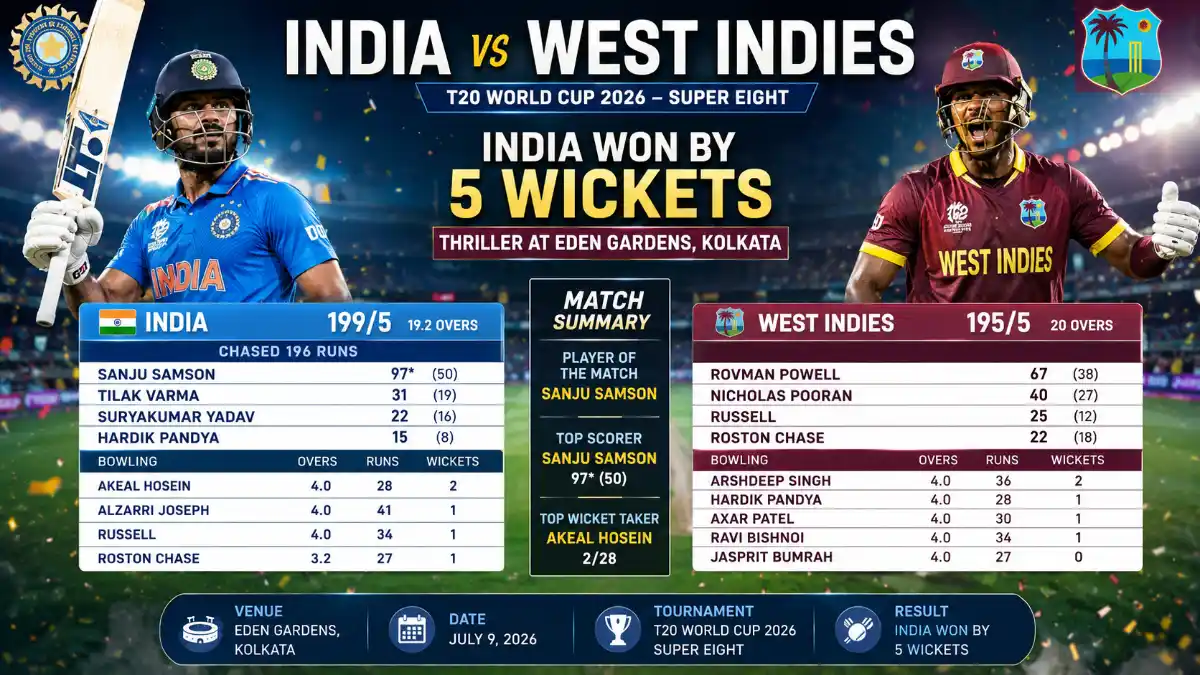
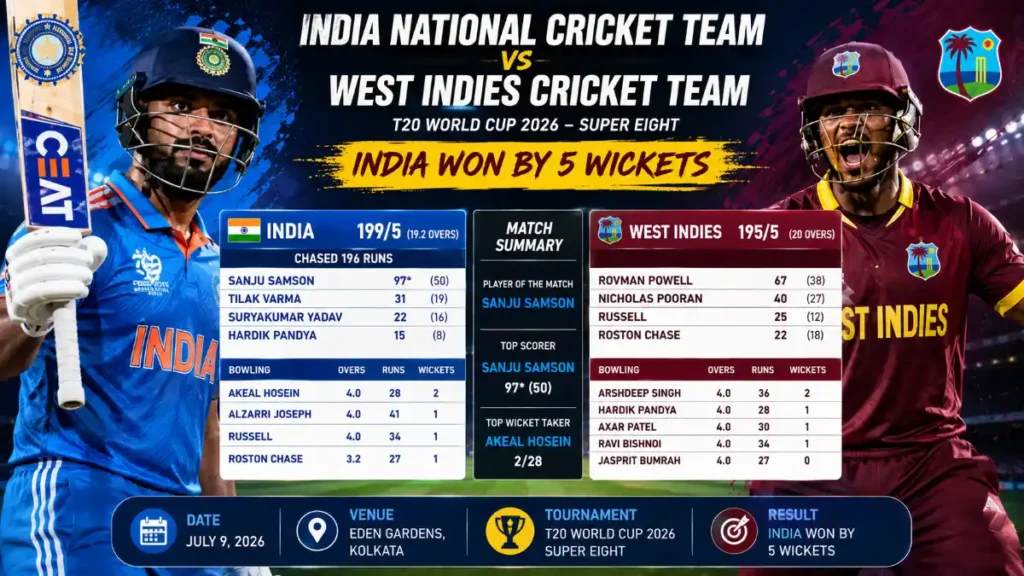
India beat West Indies by 5 wickets at Eden Gardens, Kolkata, chasing down 196 in 19.2 overs during a tense Super Eight clash at the ICC Men’s T20 World Cup 2026. Sanju Samson’s unbeaten 97 off 50 balls anchored the chase and earned him Player of the Match, keeping India’s unbeaten run alive and pushing West Indies to the edge of elimination.
For anyone searching for the India National Cricket Team vs West Indies Cricket Team match scorecard, here’s the complete breakdown- tactical context, batting and bowling figures, momentum shifts, and what this result means for both sides heading into the business end of the tournament.
Quick Result: India vs West Indies Match Scorecard
India won by 5 wickets, chasing West Indies’ 195/4 and finishing on 199/5 in 19.2 overs at Eden Gardens, Kolkata. Billed as a virtual quarter-final within the Super Eight group, the four-ball margin shows how tightly contested the chase became before Samson sealed it. This kind of finish- close on paper but controlled in execution- often says more about a team’s temperament than a comfortable win would.
| Detail | Info |
| Winner | India, by 5 wickets |
| Venue | Eden Gardens, Kolkata |
| Toss | India won, elected to field |
| Player of the Match | Sanju Samson (97* off 50) |
| Match Type | Super Eight, ICC Men’s T20 World Cup 2026 |
| Weather | Clear |
Read more: India National Cricket Team vs West Indies Cricket Team match scorecard.
Why This Fixture Carried Extra Weight
This wasn’t a routine group game- it functioned as a virtual knockout within the Super Eight standings. India’s bowling attack faced scrutiny after an inconsistent start to the group stage, and a loss here would have complicated their semi-final math considerably. For the West Indies, this was close to a must-win scenario, and defeat leaves them needing favorable results elsewhere just to survive into the knockouts.
The context mattered from ball one. Both dressing rooms understood that net run rate and points table positioning were on the line, not just bragging rights. That pressure shaped conservative early batting from both sides before the match opened up in the back half of each innings.
West Indies Innings: Building a Defendable 195/4
West Indies posted a competitive 195/4 in their 20 overs, a total built in two distinct phases- a steady platform through the powerplay and middle overs, followed by an explosive finish in the closing five overs. Shai Hope’s patient 32 off 33 balls and Roston Chase’s aggressive 40 off 25 gave the innings early structure, before a late flurry from Jason Holder and Rovman Powell added crucial firepower that changed the complexion of the total entirely.
| Batter | Runs | Balls | 4s | 6s | SR |
| Shai Hope | 32 | 33 | 3 | 1 | 96.96 |
| Roston Chase | 40 | 25 | 5 | 1 | 160.00 |
| Shimron Hetmyer | 27 | 12 | 1 | 2 | 225.00 |
| Sherfane Rutherford | 14 | 9 | 0 | 1 | 155.55 |
| Rovman Powell* | 34 | 19 | 3 | 2 | 178.94 |
| Jason Holder* | 37 | 22 | 2 | 3 | 168.18 |
Bowling Breakdown: Bumrah’s Twin Strikes
Jasprit Bumrah stood out with figures of 2/36 in four overs, removing both Hetmyer and Chase in the middle overs at a stage when West Indies looked capable of running away with the innings. His dismissal of Hetmyer- caught attempting to clear the ropes- arrested a rapid acceleration and forced West Indies to rebuild rather than continue attacking freely. That single breakthrough shifted the tempo of the innings for nearly four overs.
Varun Chakaravarthy (1/40) and Hardik Pandya (1/40) added support wickets in the middle overs, showing India’s spin-pace combination working in tandem. But the death-overs execution wasn’t flawless. Arshdeep Singh conceded 43 runs without a wicket, and Axar Patel went for 35 in his four overs- a pattern that has followed India’s bowling attack through parts of this tournament, where strong middle-overs control gets undone by expensive finishing overs. It’s a tactical weakness that opposition batting units have started targeting deliberately.
The Powell-Holder Stand: West Indies’ Turning Point
The most decisive stretch of the innings was the unbroken 50-run fifth-wicket partnership between Rovman Powell and Jason Holder, scored off just 20 balls. This burst took West Indies from a modest 145 to a defendable 195, and included a dropped catch off Powell on 27 that proved costly for India. Without this late acceleration, the West Indies would likely have finished 20-25 runs short of a competitive total, which would have changed the entire complexion of the chase and taken the pressure off India’s top order completely.
This partnership also illustrated a broader trend in modern T20 cricket- totals are increasingly decided in the final five overs, not the first fifteen. Teams that can find even one explosive finishing pair often outscore sides with more consistent but less explosive top orders.
India’s Chase: Sanju Samson’s Career-Defining Innings
Sanju Samson scored an unbeaten 97 off just 50 balls, striking 12 fours and 4 sixes at a strike rate of 194, and guided India home with four balls remaining. This was his fourth T20I half-century, reached in a rapid 26 balls, and the innings carried India through two early setbacks and a wobbly middle order that could easily have derailed the chase under less composed hands.
| Batter | Runs | Balls | 4s | 6s | SR |
| Abhishek Sharma | 10 | 11 | 2 | 0 | 90.90 |
| Sanju Samson* | 97 | 50 | 12 | 4 | 194.00 |
| Ishan Kishan | 10 | 6 | 2 | 0 | 166.66 |
| Suryakumar Yadav | 18 | 16 | 1 | 1 | 112.50 |
| Tilak Varma | 27 | 15 | 4 | 1 | 180.00 |
| Hardik Pandya | 17 | 14 | 2 | 0 | 121.42 |
Why India’s Chase Nearly Unraveled
India slipped to 41/2 inside the powerplay, losing both Abhishek Sharma and Ishan Kishan cheaply against the new ball on a pitch offering early movement under lights. From there, Samson and Suryakumar Yadav stitched together a 50-run third-wicket partnership off just 27 balls, restoring the required run rate and settling the innings’ rhythm at a critical juncture.
But wickets continued falling around Samson- Yadav, Tilak Varma, and Hardik Pandya were all dismissed between the 10th and 19th overs- and each time, Samson responded by finding the next boundary rather than allowing the required rate to escape India’s control. This is the mark of a genuine match-winning innings: composure under repeated pressure, not just a fast start with the field spread. Captains often talk about batters who “bat the situation,” and Samson’s innings was a textbook example- accelerating when partners fell, then settling again once new batters found their feet.
West Indies’ Bowling Fightback: Holder and Joseph
Jason Holder (2/38) and Shamar Joseph (2/42) kept West Indies alive deep into the chase, striking at moments that could have shifted momentum entirely had India’s middle order faltered further. Akeal Hosein removed Abhishek Sharma early with a well-disguised slower ball, but the remaining attack- Matthew Forde, Gudakesh Motie, and Romario Shepherd- went wicketless, unable to sustain pressure once Samson took control of the tempo in the back half of the innings.
Fall of Wickets Summary
West Indies: 68/1 (Hope, 8.5 ov), 102/2 (Hetmyer, 11.3 ov), 103/3 (Chase, 11.5 ov), 119/4 (Rutherford, 14.1 ov).
India: 29/1 (Sharma, 3.0 ov), 41/2 (Kishan, 4.3 ov), 99/3 (Yadav, 10.2 ov), 141/4 (Varma, 14.4 ov), 179/5 (Pandya, 18.2 ov).
Tactical Analysis: What Decided the Match
Three factors defined this India vs West Indies encounter beyond the raw numbers. India’s decision to bowl first paid off by exposing West Indies to variable bounce under lights, though the death-overs execution let some of that early advantage slip away in the final five overs. Samson’s role-flexibility– anchoring the innings rather than chasing a boundary-a-ball approach early- proved the difference between a rushed collapse and a controlled chase that always had a foundation to build from.
West Indies’ inability to close out the powerplay with wickets after early success meant India’s recovery always had oxygen, even during the middle-overs wobble. Had West Indies picked up a third wicket inside the first six overs, the pressure on Samson to play differently would have been far greater, and the outcome could easily have swung the other way. Captaincy decisions in the field- including the choice to hold back the spin threat of Motie until the 12th over- also drew scrutiny, as an earlier introduction might have disrupted the Samson-Yadav partnership before it gathered momentum.
Match Impact: What This Result Means
India’s five-wicket win keeps their unbeaten Super Eight campaign intact and strengthens their position for a semi-final berth, while West Indies now face a virtual must-win scenario in their remaining group fixture to stay in contention for the knockouts. Samson’s innings also reinforces his growing reputation as India’s most dependable middle-order finisher this tournament- a factor that could influence team selection and batting order decisions heading into the knockout stage.
For the West Indies, the tournament now hinges on net run rate scenarios and results elsewhere in the group, a position few would have predicted after their strong start to the Super Eight phase. The margin of defeat, while narrow on the scoreboard, exposed a real gap in their death-bowling depth once Holder and Joseph’s overs were exhausted- an issue their team management will need to address quickly if they’re to have any realistic path back into contention.
Frequently Asked Questions
Who won the India vs West Indies match?
India won by 5 wickets, successfully chasing 196 in 19.2 overs at Eden Gardens, Kolkata.
What was the venue for this India vs West Indies match?
The match was played at Eden Gardens, Kolkata, during the Super Eight stage of the T20 World Cup 2026.
Who won the toss in the India vs West Indies match?
India won the toss and elected to field first.
Who was named Player of the Match?
Sanju Samson was named Player of the Match for his unbeaten 97 off 50 balls.
What total did the West Indies post?
West Indies scored 195/4 in their 20 overs.
What was India’s final chase total?
India reached 199/5 in 19.2 overs to win the match.
How many boundaries did Sanju Samson hit?
Samson struck 12 fours and 4 sixes during his match-winning 97-run innings.
Who was the leading wicket-taker for India?
Jasprit Bumrah led India’s bowling attack with figures of 2/36 in four overs.
Q9: What was the biggest partnership of the match?
What was the biggest partnership of the match?
The unbroken 50-run fifth-wicket stand between Rovman Powell and Jason Holder for West Indies was the standout partnership.
What does this result mean for the tournament?
The win keeps India’s Super Eight campaign unbeaten and boosts their semi-final qualification hopes, while West Indies now face a near must-win situation in their final group match.