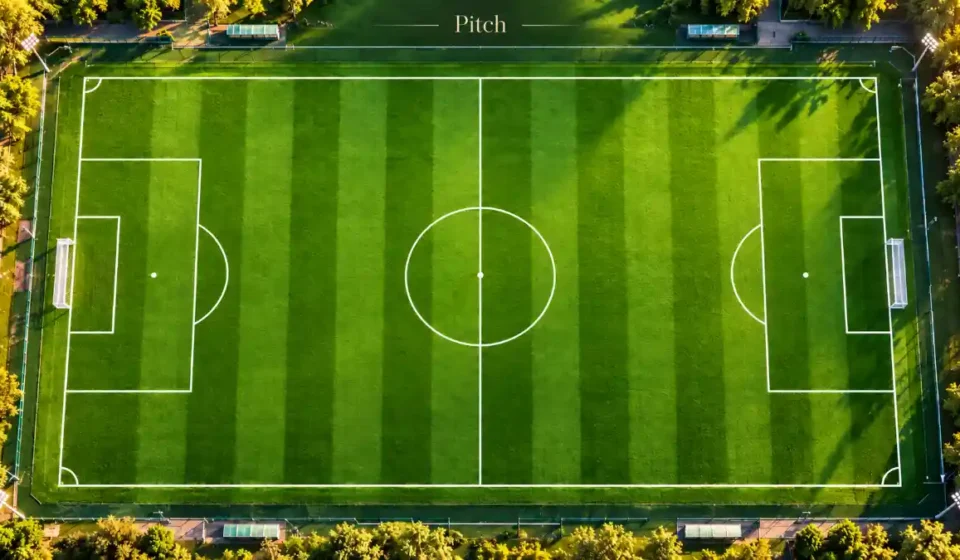

A football field is a rectangular playing area for the game of association football (known in most countries as simply football, or soccer to Americans). It is not entirely deterministic in size. What a standard field is long and wide (the perimeters of the field, according to the Laws of the Game today, cover roughly 100–130 yards long for standard fields; international matches have a narrower permitted range in width).
For more major stadiums, FIFA measures a rectangle of 105 × 68 meters (115 × 74 yards) between the two lines. That is a standard at high-level venues, but it shouldn’t be mistaken as the only sanctioned pitch size.
One note on terminology for U.S. readers: in this guide, whenever the term football field is used, it is for an association football or soccer field, not an NFL or American football field.
Dimensions, lines on a field, penalty boxes, goals, surfaces of play, and measuring methods are all explained in this guide, along with how to set up or construct the working surface area around the field. Youth-field considerations and hands-on mistakes to suit novices round off many sections.
Football Field Dimensions at a Glance
The International Football Association Board, or IFAB, establishes the permitted dimensions of the playing field. Individual competitions may select more specific dimensions within those limits.
| Feature | Metric | U.S./Imperial |
| General field length | 90–120 m | 100–130 yd |
| General field width | 45–90 m | 50–100 yd |
| International length | 100–110 m | 110–120 yd |
| International width | 64–75 m | 70–80 yd |
| FIFA recommended stadium field | 105 × 68 m | About 115 × 74 yd |
| Center-circle radius | 9.15 m | 10 yd |
| Penalty-area depth | 16.5 m | 18 yd |
| Goal-area depth | 5.5 m | 6 yd |
| Penalty-mark distance | 11 m | 12 yd |
| Corner-arc radius | 1 m | 1 yd |
| Maximum line width | 12 cm | 5 in |
The longer boundary must be the touchline, meaning a legal field cannot be wider than it is long.
How Long Is a Football Field?
For standard matches, the touchline can measure 100 to 130 yards, or 90 to 120 meters.
For international matches, the allowable range is narrower:
- 110 to 120 yards
- 100 to 110 meters
That means a field measuring about 115 yards long is common, but 115 yards is not a universal requirement.
The two long sides of the playing area are called touchlines. When the entire ball crosses a touchline, play restarts with a throw-in.
How Wide Is a Football Field?
For ordinary matches, the goal line can measure between:
- 50 and 100 yards
- 45 and 90 meters
For international matches, the permitted width is:
- 70 to 80 yards
- 64 to 75 meters
The shorter boundaries are called goal lines.
Because those ranges overlap mathematically, IFAB adds an important requirement: the touchline must always be longer than the goal line.
Why Is 105 × 68 Meters So Common?
A common misconception is that every professional soccer field must measure exactly 105 × 68 meters.
That is not what the Laws of the Game say.
IFAB establishes a legal international range of 100–110 meters in length and 64–75 meters in width. FIFA’s stadium guidance separately recommends 105 × 68 meters for the field of play.
Rule vs. recommendation
| Standard | Dimension |
| IFAB international permitted range | 100–110 × 64–75 m |
| FIFA recommended stadium field | 105 × 68 m |
The distinction matters when comparing stadiums, laying out a community field, or checking whether an existing pitch is legal.
Football Field Diagram and Layout
A soccer field looks simple from the stands, but every important line has a specific purpose.
A useful field diagram should label:
- touchlines
- goal lines
- halfway line
- center mark
- center circle
- penalty areas
- goal areas
- penalty marks
- penalty arcs
- corner arcs
- corner flags
- goals
A top-down diagram is especially useful because the penalty and goal areas can otherwise look similar to beginners.
Touchlines and Goal Lines
The touchlines run along the long sides.
The goal lines run across the two short ends.
When the whole ball crosses a touchline, a throw-in is awarded to the opposing team of the player who last touched it.
When it crosses a goal line outside the goal, the restart will normally be either a goal kick or corner kick depending on which team last touched the ball.
If the whole ball passes over the goal line between the posts and beneath the crossbar, subject to the Laws of the Game, a goal is scored.
Halfway Line, Center Mark and Center Circle
The halfway line connects the midpoint of one touchline to the midpoint of the other and divides the field into two halves.
A center mark sits in the middle of that line.
Around it is a circle with a 10-yard (9.15 m) radius.
That detail is often described incorrectly. The center circle is not 10 yards “wide.”
Its:
- radius is 10 yards
- diameter is 20 yards
The circle helps maintain the required opponent distance during kickoffs.
Penalty Area, Goal Area and Penalty Mark
The goal end contains several markings that are easy to confuse. The penalty area, goal area, penalty mark, and penalty arc each have a different function.
Penalty Area Dimensions
The penalty area is commonly called the 18-yard box.
To create it, two lines are drawn at right angles to the goal line from points 18 yards (16.5 m) from the inside of each goalpost. Those lines extend 18 yards into the field and are joined by a line parallel to the goal line.
The area matters because:
- the goalkeeper has special handling privileges inside their own penalty area
- certain direct-free-kick fouls committed by defenders inside it can result in a penalty kick
- special restart and positioning rules apply in several situations
Calling it simply “18 yards wide” would be inaccurate. The 18-yard measurement describes its depth and the location of each sideline relative to the goalposts.
Goal Area Dimensions
Inside the penalty area is the smaller goal area, often called the six-yard box.
Its lines start 6 yards (5.5 m) from the inside of each goalpost and extend 6 yards into the field before being connected by a line parallel to the goal line.
The goal area is used in several restart rules, most notably goal kicks and certain indirect free kicks.
How Far Is the Penalty Spot From the Goal?
The penalty mark is positioned 12 yards (11 m) from the midpoint between the two goalposts.
There is also a useful measurement detail that many basic field guides omit.
IFAB specifies that the penalty mark is measured from the center of the mark to the back edge of the goal line.
That distinction is important when laying out a new field rather than simply estimating the location.
What Is the Penalty Arc For?
The curved line immediately outside the penalty box is the penalty arc.
It forms part of a circle with a radius of 10 yards (9.15 m) centered on the penalty mark.
Its purpose is practical: during a penalty kick, players other than the kicker and goalkeeper must maintain the required distance from the penalty mark. The arc helps officials judge that distance outside the penalty area.
Corner Arcs and Corner Flags
Each of the four corners includes two regulated elements: a corner arc and a flagpost.
Corner Arc Dimensions
A quarter-circle with a radius of 1 yard (1 meter) is marked inside the field at each corner.
When a corner kick is taken, the ball is placed within the relevant corner area.
Corner Flag Height
A flagpost must be installed at each corner.
Under IFAB Law 1, each corner flagpost must:
- be at least 5 ft (1.5 m) high
- have a non-pointed top
- carry a flag.
That rule helps make the boundary visible while reducing avoidable safety risks.
Football Goal Dimensions
The goal itself has standardized senior dimensions even though the overall field can vary.
How Wide and Tall Is a Regulation Soccer Goal?
A full-size senior goal measures:
- 8 yards (7.32 m) wide
- 8 ft (2.44 m) high
The width is measured between the inside edges of the posts. Height is measured from the ground to the lower edge of the crossbar.
| Goal measurement | Imperial | Metric |
| Width | 8 yd | 7.32 m |
| Height | 8 ft | 2.44 m |
This is one reason yards and feet are both useful when explaining soccer dimensions to U.S. readers.
Goalposts, Crossbar and Nets
The posts and crossbar must be made from approved material and cannot create a danger to players. Both goals must use the same approved shape.
The posts and crossbar must also be white and have the same width and depth, with neither exceeding 5 inches (12 cm).
Nets may be attached to the goals and ground provided they are properly supported and do not interfere with the goalkeeper.
Secure anchoring is critical. A correctly sized goal is not safe if it can tip or shift.
Why Aren’t All Football Fields the Same Size?
Soccer differs from many major U.S. sports because its laws deliberately permit a range of field dimensions.
That flexibility accommodates different stadiums, older grounds, community facilities, and competition requirements.
IFAB Allows a Range of Legal Sizes
For ordinary matches:
- length: 100–130 yd
- width: 50–100 yd
For international matches:
- length: 110–120 yd
- width: 70–80 yd.
A field can therefore be fully legal without matching the familiar 105 × 68 m professional recommendation.
Competition Rules Can Be More Specific
IFAB allows competitions to determine the length and width within the permitted limits.
A professional league, tournament, college organization, youth association, or local competition may therefore impose tighter specifications.
If you are preparing a field for organized play, the competition’s current rules should take priority over a generic online measurement chart.
Can Field Size Affect How a Team Plays?
Within legal limits, field dimensions can influence the amount and location of usable space.
A relatively wide field may:
- create more room near the touchlines
- increase lateral distances for defenders
- give wide players more space to receive the ball
A narrower layout can:
- compress horizontal space
- place players closer together
- reduce some wide passing angles
A longer pitch can create additional vertical space between lines.
These effects are tactical possibilities, not guarantees. Team shape, pressing strategy, player quality, game state, and opponent behavior usually matter more than a few yards of difference alone.
How Big Is a Football Field in Acres and Square Feet?
There is no single acreage for every soccer field because legal dimensions vary.
However, the FIFA-recommended 105 × 68 m stadium field makes a useful example.
Its playing area is:
- 7,140 square meters
- about 76,855 square feet
- about 1.76 acres
- 0.714 hectares
These figures apply to the playing rectangle only. They do not include player runoff, benches, advertising areas, walkways, fencing, spectator separation, or other facility infrastructure.
Football Field Area Formula
The calculation is simple:
Field area = length × width
For a 105 × 68 m field:
105 × 68 = 7,140 m²
For a 110 × 70 yd field:
110 × 70 = 7,700 yd²
A useful online calculator for this topic could allow readers to enter a length and width in either yards or meters and automatically return:
- square yards
- square feet
- square meters
- acres
- hectares
That is especially useful for estimating turf quantities, irrigation coverage, maintenance area, or site requirements.
Football Field vs. American Football Field
In the United States, the phrase “football field” usually refers to American football. Internationally, however, “football” usually means association football.
The two playing surfaces are very different.
| Feature | Soccer / Association Football | American Football |
| Common U.S. name | Soccer field | Football field |
| Overall dimensions | Can vary within legal ranges | 120 yd long × 53⅓ yd wide including end zones in the NFL |
| Main markings | Touchlines, boxes, center circle | Yard lines, hash marks, end zones |
| Goals | Rectangular net goals | Uprights |
| Playing direction | Continuous in both directions | Organized by downs and yardage |
| Penalty area | Yes | No |
| End zones | No | Yes |
An NFL field measures 360 ft long by 160 ft wide, equivalent to 120 by 53⅓ yards including the two 10-yard end zones.
The sports can sometimes share multipurpose stadiums, but their line layouts and required equipment are not interchangeable.
Types of Football Field Surfaces
IFAB permits natural playing surfaces and, when competition rules allow them, artificial or integrated hybrid systems. Artificial surfaces used in certain FIFA-affiliated international competitions must meet applicable quality requirements.
Natural Grass
Natural grass remains the traditional surface for soccer.
Its strengths include:
- familiar ball and foot interaction
- cooler surface temperatures than many synthetic systems in hot sunlight
- repair options through seeding, sod replacement, and turf management
- traditional appearance and feel
Its main challenge is maintenance.
A heavily used natural field may require regular:
- mowing
- irrigation
- fertilization
- aeration
- overseeding
- divot repair
- drainage management
Poor drainage or excessive traffic can quickly damage high-wear areas such as goalmouths and the center corridor.
Artificial Turf
Artificial turf can be useful where a facility needs to accommodate many hours of play.
Common advantages include:
- high usage capacity
- fewer recovery periods between events
- consistent coverage
- less mowing and irrigation
However, “artificial” does not mean maintenance-free.
Facilities still need to manage:
- debris
- brushing or grooming
- infill condition where applicable
- seams
- drainage
- surface wear
- temperature
- periodic inspection
Surface certification also matters at higher levels of competition.
Hybrid Grass
A hybrid system combines natural turf with synthetic reinforcement.
The goal is usually to retain many characteristics of natural grass while improving durability under intensive use.
Hybrid systems are common candidates for professional stadiums and training facilities, but they require specialized installation and maintenance and can cost substantially more than a basic natural surface.
| Surface | Best suited for | Main advantage | Main limitation |
| Natural grass | Match-focused fields | Traditional natural playing surface | Maintenance and recovery |
| Artificial turf | High-use facilities | Heavy usage capacity | Heat and different surface characteristics |
| Hybrid grass | Stadiums/training centers | Natural turf with extra durability | Cost and complexity |
How to Choose the Right Football Field Surface
The right surface depends less on appearance and more on how the facility will actually be used.
Consider Weekly Playing Hours
A professional stadium that hosts one major game each week has different needs from a community complex running practices and matches throughout the day.
If weekly usage is very high, recovery time becomes a central consideration.
Ask:
- How many teams will use the field?
- Will practices and matches happen on the same surface?
- How much downtime is available?
- Will other sports or events use the area?
Consider Climate and Drainage
Climate can determine whether an otherwise good surface performs poorly.
Consider:
- annual rainfall
- summer heat
- freeze-thaw cycles
- shade
- soil drainage
- irrigation availability
- stormwater handling
Excellent turf installed over a poorly planned drainage system can still produce an unreliable playing surface.
Consider Maintenance Resources
Evaluate what the facility can realistically maintain year after year.
Before selecting a surface, check:
- intended competition level
- weekly playing hours
- climate
- drainage conditions
- mowing capability
- irrigation
- aeration requirements
- turf-repair resources
- artificial-turf grooming equipment
- available maintenance staff
- installation budget
- long-term replacement budget
- governing-body requirements
The cheapest installation is not necessarily the lowest-cost option over the life of the field.
How Football Field Measurements Are Taken
Knowing the dimensions is only half the job. You also need to know exactly where measurements begin and end.
This is where field-layout errors often happen.
Do the Painted Lines Count as Part of the Field?
Yes.
The Laws of the Game state that field lines belong to the areas they define. IFAB therefore measures dimensions from the outside of the lines.
For example, if you are setting the outside dimensions of a penalty area, measuring from the wrong edge of a 4- or 5-inch line can introduce an error.
The same principle applies to the overall boundaries.
How Is the Penalty Mark Measured?
The penalty mark has a specific measurement convention.
Its distance is measured from the center of the penalty mark to the back edge of the goal line.
That is more precise than simply measuring 12 yards forward from whichever visible edge of paint seems closest.
Why Measurement Technique Matters
A small error early in the setup can affect several other markings.
For example, a misplaced goal line can alter:
- penalty-mark position
- goal-area alignment
- penalty-area alignment
- goal placement
- total field length
For permanent or competition fields, measure from fixed reference points rather than relying on existing faded paint.
How to Mark Out a Football Field Step by Step
Laying out a field becomes much easier when you establish the outside rectangle correctly before adding internal markings.
Step 1 — Confirm the Required Field Size
Do not automatically choose 105 × 68 m.
First identify:
- governing organization
- competition rules
- player age group
- game format
- available site dimensions
- required goal size
Youth and small-sided fields may use substantially different dimensions.
Step 2 — Establish the First Touchline
Choose one long straight baseline.
Useful equipment includes:
- stakes
- strong string
- long measuring tape
- marking pins
- field paint
- line-marking machine
Stretch a string between the two end points so the first touchline remains straight.
Avoid following an existing fence unless you know the fence itself is properly aligned.
Step 3 — Create 90-Degree Corners
A simple way to establish a right angle is the 3-4-5 triangle method.
For a larger, easier-to-check version:
- Measure 30 ft along your established touchline.
- Measure approximately 40 ft outward toward the planned goal line.
- Measure the diagonal between those two points.
- Adjust the second line until that diagonal measures 50 ft.
Because 30² + 40² = 50², the lines form a 90-degree corner.
Step 4 — Check Both Field Diagonals
After all four corners are positioned, measure from one corner to the opposite corner in both directions.
For a true rectangle, the two diagonals should match.
A 105 × 68 m rectangle has a diagonal of about 125.1 m.
If one diagonal is longer than the other, the field is skewed even if each sideline looks straight.
Correct this before painting permanent lines.
Step 5 — Mark the Halfway Line and Center
Measure the exact midpoint of both touchlines.
Connect those points to create the halfway line.
Then mark its midpoint and use a 10-yard radius to create the center circle.
Step 6 — Mark the Goal and Penalty Areas
Position the goals first or accurately establish where the goalposts will sit.
For each penalty area:
- measure 18 yards from the inside of each post
- extend the two lines 18 yards into the field
- join them with a parallel line
For the goal area:
- measure 6 yards from the inside of each post
- extend the lines 6 yards
- connect them.
Step 7 — Add Penalty Marks, Arcs and Corner Arcs
Add:
- penalty mark at 12 yards
- penalty arc using a 10-yard radius from the penalty mark
- 1-yard corner arcs.
Check each measurement before painting.
Step 8 — Paint and Recheck Every Measurement
Before opening the field for play, verify:
- overall length
- overall width
- both diagonals
- halfway-line position
- center mark
- center-circle radius
- penalty areas
- goal areas
- penalty marks
- corner arcs
- goal alignment
- line width
A second measurement takes much less time than repainting a wrongly positioned box.
Football Field Setup Checklist
Use this checklist before competition or after laying out a new field:
- Required competition dimensions confirmed
- Field is rectangular
- Both diagonals match
- Lines are continuous and clearly visible
- Line width meets applicable rules
- Goals are centered on the goal lines
- Goals are securely anchored
- Penalty areas are correctly positioned
- Goal areas are correctly positioned
- Penalty marks are measured correctly
- Center mark is accurate
- Center-circle radius is correct
- Corner arcs are present
- Corner flags are installed
- Playing surface is level enough for safe play
- Holes, exposed objects, and other hazards are removed
- Runoff areas are clear
- Competition-specific requirements have been checked
How Much Space Do You Need Around a Football Field?
The field of play and the total facility footprint are not the same thing.
A 105 × 68 m rectangle tells you the size of the playing surface, not the total land needed for a stadium or sports complex.
FIFA’s stadium guidance distinguishes the field of play from the wider grassed area and the overall pitch area extending toward spectator zones.
Field of Play vs. Total Pitch Area
Beyond the boundary lines, a facility may need space for:
- player runoff
- assistant referees
- team benches
- technical areas
- substitute warm-up
- photographers
- advertising boards
- maintenance access
- emergency access
- spectator separation
FIFA recommends that the field-of-play surface continue for at least 1 meter beyond the touchlines and 2 meters beyond the goal lines, and its stadium guidance provides larger benchmark clearances depending on venue size and use.
Therefore, someone planning a full-size facility should never buy or prepare a parcel based solely on the 105 × 68 m playing dimensions.
Why Runoff Space Matters
Players regularly sprint beyond a touchline or slide past a goal line.
If a hard wall, advertising board, fence, drain, curb, bench, or abrupt surface transition sits immediately outside the boundary, the collision risk increases.
FIFA’s guidance specifically emphasizes sufficient space before perimeter advertising and recommends avoiding an immediate change from natural grass to artificial turf directly outside the playing boundary.
Runoff should be treated as a safety feature, not leftover space.
Youth and Small-Sided Football Field Sizes
Adult 11v11 dimensions should not automatically be applied to children or small-sided games.
National associations and competitions can modify field dimensions for youth, grassroots, veterans, and disability football.
11v11 vs. 9v9, 7v7 and Smaller Fields
As player numbers decrease, fields are generally made smaller so that players can remain involved in play and develop appropriate technical skills.
Common formats include:
- 11v11
- 9v9
- 7v7
- 5v5
- Smaller introductory formats
Goal dimensions may also change.
There is no single worldwide field-size chart that applies to every youth organization.
Why U.S. Youth Dimensions Can Vary
In the United States, exact requirements can vary by:
- league
- club
- state association
- tournament
- age group
- local facility
- applicable U.S. Soccer guidance
Before painting a youth field, obtain the current competition specifications instead of shrinking a professional field by guesswork.
The same advice applies when ordering goals. A smaller field often uses a smaller goal, but the exact size should come from the competition rules.
Basic Football Field Construction
Building a reliable field is more involved than leveling ground and laying turf.
Site conditions, drainage, usage, surface choice, and maintenance resources all influence long-term performance.
Site Survey and Grading
Start by evaluating:
- available dimensions
- existing slope
- soil conditions
- drainage direction
- underground utilities
- vehicle and equipment access
- surrounding property
- planned spectator or facility areas
The field should be designed as a complete site rather than an isolated rectangle.
Drainage and Base Preparation
Drainage is one of the most important construction considerations.
Depending on site conditions, a project may require:
- surface grading
- subsurface drainage
- engineered soil profiles
- drainage stone or base materials
- collection pipes
- outlets or stormwater systems
The appropriate solution depends heavily on local soil and climate.
A specification that works in a dry region may perform poorly on a site with heavy clay and frequent rainfall.
Turf Installation
Natural fields may be established using:
- seed
- sod
- specialized sports-turf systems
Artificial fields typically require an engineered base before rolls or panels of turf are installed, seamed, and finished according to the chosen system.
Hybrid fields use more specialized construction methods because natural turf must work together with synthetic reinforcement.
Goals, Lighting and Supporting Infrastructure
A complete facility may also need:
- goals
- corner flags
- irrigation
- drainage outlets
- fencing
- player benches
- technical areas
- lighting
- paths
- maintenance gates
- equipment storage
- spectator facilities
Plan these before finishing the turf so later construction does not damage the playing surface.
Football Field Maintenance Basics
A good playing surface depends on regular maintenance regardless of whether it is natural or synthetic.
Natural-Grass Maintenance
A natural field may require:
- mowing at an appropriate height
- irrigation
- fertilization based on soil testing
- aeration
- overseeding
- divot repair
- goalmouth repair
- pest and weed management
- drainage inspection
- traffic rotation when possible
High-wear zones deserve extra attention.
Goal areas and central corridors often deteriorate before less-used portions of the field.
Artificial-Turf Maintenance
Artificial surfaces also need routine care.
Typical tasks include:
- removing debris
- brushing fibers
- redistributing or managing infill where used
- checking seams
- inspecting high-wear zones
- removing contamination
- maintaining drainage
- arranging periodic professional inspections
A neglected synthetic field can become uneven, compacted, damaged, or unsafe.
Line-Marking Maintenance
Painted lines must remain visible, correctly located, and appropriately sized.
Avoid gradually widening the lines each time they are repainted.
Where possible, use fixed reference points so staff can periodically recheck important dimensions rather than tracing old paint indefinitely.
Common Football Field Mistakes to Avoid
Several errors appear repeatedly when people plan or mark fields.
- Treating 105 × 68 m as the only legal size. It is a FIFA recommendation for stadium fields, while IFAB permits ranges.
- Confusing association football with American football. Their dimensions, goals, markings, and rules are completely different.
- Measuring from the wrong edge of painted lines. IFAB measurements use the outside of lines because the lines belong to the areas they enclose.
- Starting penalty-area measurements from the wrong point. The 18- and 6-yard offsets originate from the inside of each goalpost.
- Failing to square the corners. A field can have correct side lengths and still be skewed.
- Skipping diagonal checks. Equal diagonals are a simple way to validate a rectangular layout.
- Assuming playing dimensions equal total land needs. Runoff, benches, access, and safety zones require more space.
- Ignoring the area beyond the boundary. Safe runoff space matters because players frequently leave the field at speed.
- Assuming artificial turf requires no maintenance. It still needs inspection, cleaning, grooming, and repair.
- Using full-size professional dimensions for youth games without checking the rules. Youth and small-sided formats commonly use modified fields.
Read More: Football Field
Quick Football Field Measurement Reference
For U.S. readers, this table provides the main measurements in the units most likely to be used during field setup.
| Component | Measurement |
| General length | 100–130 yd |
| General width | 50–100 yd |
| International length | 110–120 yd |
| International width | 70–80 yd |
| FIFA recommended field | About 115 × 74 yd |
| Regulation senior goal | 8 yd wide × 8 ft high |
| Penalty-area depth | 18 yd |
| Goal-area depth | 6 yd |
| Penalty mark | 12 yd |
| Center-circle radius | 10 yd |
| Penalty-arc radius | 10 yd |
| Corner-arc radius | 1 yd |
| Corner flag minimum height | 5 ft |
| Maximum line width | 5 in |
These regulated measurements are set out in IFAB Law 1.
Frequently Asked Questions About Football Fields
How Large Is A Football Field?
Every soccer field does not need to be the same size, as there is no mandatory minimum or maximum. According to Federation rules, general fields can be 100–130 yards long and 50–100 yards wide. International games are based in a smaller range: 110- 1200 yards long and 70- 80 yards wide. For stadium fields, FIFA suggests a size of 105 × 68 m (115 yd × 74 yd).
What is the length of a football field in yards?
It could be a pitch about 100–130 yards in length for association football. In international games, it falls between 110 and 120 yards.
What Is the Length of a Football Field in Yards?
General fields can be as wide as 50–100 yards. The present Laws of the Game say International fields have to be 70–80 yards wide.
How Many Acres In A Soccer Field?
This depends on the size of the field in dimensions. The playing area is a 105 × 68 m (171,000 sq ft; 1.76 acres) field. That number doesn’t include space for runoffs, benches, fencing, or other parts of the facilities.
Why do pro football fields have different dimensions?
Definitely not a single universal dimension, with the Laws of the Game allowing for a range. The ranges can then be honed for individual competitions, and stadium architecture and site conditions balance construction complexities with usability to arrive at field dimensions.
Penalty Box: The penalty box is one of the most well-known areas on a football field.
The 18 yards extending into the field form the penalty area. Its sidelines extend 18 yards from the inner edge of each goal post, giving it a width wider than just 36 yards — since the width of a goal is also included between those reference points.
How Many Meters from the Goal Is the Penalty Spot?
12 yards or 11 meters away from its halfway point between the goalposts is where a penalty mark is located. The International Football Association Board, or IFAB, measures from the middle of the mark to the back edge of the goal line.
What is the Difference Between a Football Field and an American Football Field?
Touchlines, penalty areas, center circles, and rectangular net goals are used in soccer fields,s while American Football fields have yard lines, hash marks, end zones, es and upright goals. What are the length and dimensions of an NFL field?
A football field with artificial turf?
Yes. Artificial surfaces are allowed by IFAB only if competition rules allow. Artificial surfaces must fulfill the pertinent FIFA quality requirements unless a recognized exception is applicable, in some levels of international and FIFA-affiliated competition.
Youth Soccer Fields: How do youth soccer fields compare to professional ones?
No. Smaller fields and goals are used by youth and small-sided formats regularly. Although the precise dimensions vary based on age and competition, it is advisable to check local regulations before marking out the pitch.