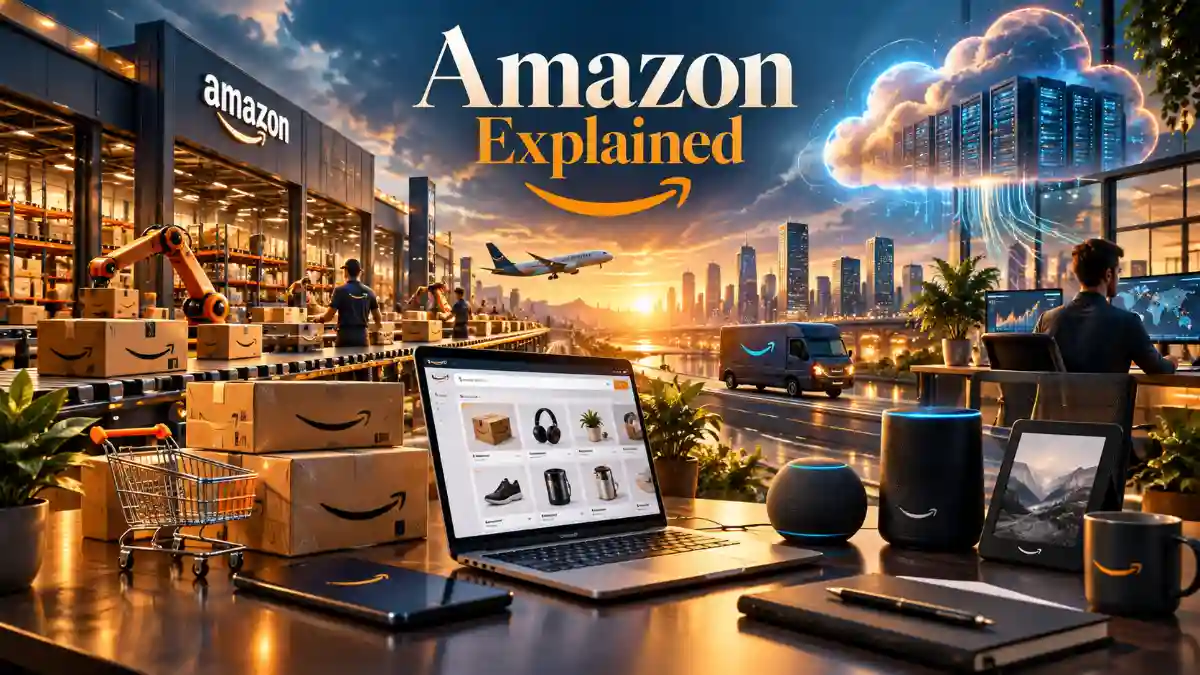

Amazon started as a bookstore in 1994, but that description barely makes sense of what the company is now. It is now a sprawling ecosystem that encompasses online and physical retail, a third-party marketplace, cloud computing, advertising and subscriptions to entertainment services, logistics, as well as devices including voice-activated artificial intelligence and business procurement.
For American consumers, it might seem like a big shopping site. For independent merchants, it could serve as a marketplace and fulfillment network. Amazon Web Services (AWS) is a cloud infrastructure for companies and developers. They are what will illuminate the real operation of the business.
This breakdown walks through its history, current organization, top services offered,d its revenue model, el Marketplace sellers, AWS AI investments, and logistics network.ork
What Is Amazon?
Amazon.com, Inc. is a publicly traded U.S. commerce and technology company. Although online shopping remains its most visible consumer business, describing it solely as an online retailer misses much of the picture.
The company operates consumer stores, third-party seller services, cloud infrastructure, digital advertising, subscription programs, streaming entertainment, devices, logistics services, and business purchasing platforms.
Amazon at a Glance
| Fact | Detail |
| Company | Amazon.com, Inc. |
| Founded | 1994 |
| Founder | Jeff Bezos |
| Web store launched | July 1995 |
| Headquarters | Seattle, Washington |
| CEO | Andy Jassy |
| Stock ticker | AMZN |
| Original business | Online bookselling |
| Major businesses | Stores, Marketplace, AWS, advertising, subscriptions, logistics, and entertainment |
| 2025 net sales | $716.9 billion |
| 2025 AWS sales | $128.7 billion |
| 2025 net income | $77.7 billion |
Read More: Amazon
Andy Jassy remains President and CEO and serves on the company’s board. Before becoming CEO in 2021, he founded and led AWS.
The company’s 2025 Form 10-K reports $716.924 billion in consolidated net sales and $77.670 billion in net income.
Is Amazon a Retailer or a Technology Company?
It is both—and several other things at the same time.
A useful way to understand the business is by looking at who each operation serves:
| Business | Main customer | How it generally earns money |
| Retail stores | Shoppers | Product sales |
| Marketplace | Independent sellers and shoppers | Seller and fulfillment fees |
| Prime | Consumers | Membership fees |
| AWS | Companies and developers | Cloud-service usage |
| Advertising | Sellers and brands | Advertising fees |
| Entertainment | Consumers | Subscriptions, advertising and content-related revenue |
| Logistics | Sellers and businesses | Fulfillment and shipping services |
| Amazon Business | Organizations | Business purchasing ecosystem |
This structure is why a discussion focused only on packages arriving at people’s homes misses important parts of the company.
How Did Amazon Start?
The business was founded by Jeff Bezos in 1994 and opened its website to customers in July 1995.
Why Amazon Started With Books
Books made sense for an early internet retailer because the category contained an enormous number of individual titles. A physical bookstore could stock only a limited selection, while an online catalog could make many more titles searchable without requiring every book to sit on a customer-facing shelf.
Books also had standardized identifying information, which made them relatively suitable for searchable online listings.
The importance of the decision was not simply that books sold well online. It demonstrated one of the internet’s central retail advantages: a digital storefront could display a selection far beyond what could fit inside an ordinary store.
From Online Bookstore to Broad Marketplace
The company gradually expanded beyond books into products such as music, video, electronics, toys, home goods, and many other categories.
An even more important shift came as third-party businesses gained the ability to sell through the platform.
That changed the model. Instead of relying only on merchandise purchased and resold directly by the retailer, the website could connect outside merchants with its customer base.
Later developments—including Prime, Kindle, AWS, digital advertising, streaming, devices, grocery, and logistics—made the organization progressively less dependent on one type of business.
Amazon’s IPO and Expansion
The company went public in 1997. Access to public capital accompanied years of investment in technology, fulfillment infrastructure, product selection, and international expansion.
Over time, management repeatedly invested in capabilities that were not obvious extensions of bookselling. Cloud computing is the clearest example: AWS eventually became a major business in its own right rather than merely infrastructure supporting the shopping website.
Amazon History Timeline
The timeline below focuses on developments that materially changed the company’s business model.
| Year | Development | Why it mattered |
| 1994 | Company founded | Beginning of the business |
| 1995 | Website opens to customers | Commercial online operations begin |
| 1997 | IPO | Public-market access supports expansion |
| Early 2000s | Third-party Marketplace grows | Outside merchants become central to selection |
| 2005 | Prime launches | Membership becomes part of the customer ecosystem |
| 2006 | AWS launches major cloud services | Cloud computing develops into a separate business |
| 2007 | Kindle launches | Expands digital books and devices |
| 2008 | Audible acquisition completed | Expands digital spoken-word content |
| 2014 | Twitch acquisition announced | Adds major live-streaming presence |
| 2017 | Whole Foods acquisition closes | Expands physical grocery operations |
| 2021 | Andy Jassy becomes CEO | Leadership transitions from Bezos |
| 2022 | MGM acquisition closes | Expands film and TV assets |
| 2020s | Cloud and AI investments accelerate | Technology infrastructure grows in importance |
Audible became a wholly owned subsidiary in March 2008. The Twitch deal was announced in August 2014, the Whole Foods transaction closed in August 2017, and MGM joined Prime Video and Amazon Studios in March 2022.
How Does Amazon Work?
The easiest way to understand the platform is to separate its direct retail operation from the services it provides to other sellers and businesses.
Amazon’s Retail Business
In traditional retail transactions, the company purchases or otherwise holds merchandise as inventory and sells it directly to the customer.
A shopper may therefore see an item where the seller and shipper are both the retailer itself.
That model resembles other large retailers: merchandise is acquired, stored, marketed, sold, and delivered to consumers.
But it is only one type of transaction available on the website.
Amazon Marketplace
Marketplace allows independent businesses to list products in the same shopping environment used for first-party retail inventory.
This gives consumers access to a broader selection while giving merchants access to a large customer base.
The important point for shoppers is that seeing a product on the website does not automatically mean the company itself is the seller.
Check the product page for the “Sold by” and “Ships from” information.
Those two fields tell you much more about who is responsible for the transaction and fulfillment.
What Is Fulfillment by Amazon?
Fulfillment by Amazon, usually called FBA, lets qualifying sellers use the company’s logistics infrastructure.
A simplified flow looks like this:
Seller sends inventory → inventory is stored in fulfillment facilities → customer orders → item is picked and packed → order is shipped → fulfillment-related customer service and returns may be handled through the program
The merchant is still the seller of the merchandise. FBA refers primarily to fulfillment rather than ownership of every product.
The company’s SEC filings classify third-party seller commissions and related fulfillment and shipping fees within service sales.
What Is Amazon Prime?
Prime is a paid membership ecosystem rather than simply a free-shipping program.
In the United States, benefits can include eligible shipping options, Prime Video, shopping-related benefits, and other services depending on current terms.
Because membership pricing, eligibility requirements, and included benefits can change, readers deciding whether Prime is worthwhile should check the current U.S. membership page rather than relying on an old price quoted in an evergreen article.
The important business-model point is that Prime can connect shopping, entertainment, and other services through a recurring membership.
What Is Amazon Business?
Amazon Business is designed for organizational purchasing rather than ordinary household shopping.
It provides business-oriented buying features such as organizational accounts, approval workflows, procurement integrations, business pricing, and purchasing controls.
In July 2026, the company said the service had surpassed $60 billion in annualized gross sales and served more than 11 million organizations worldwide, including small businesses, schools, hospitals, hotels, and major corporations.
It should not be confused with AWS. Amazon Business helps organizations buy goods and manage procurement; AWS provides cloud technology infrastructure.
Does Amazon Sell Everything Listed on Amazon.com?
No. Products listed on the website may be sold directly by the retailer or by independent third-party merchants.
This distinction matters because the seller and the company fulfilling the order can be different organizations.
Sold and Shipped by Amazon
When both fields identify the retailer, the company is generally acting as both seller and fulfiller for that transaction.
For shoppers, this is the most straightforward first-party retail scenario.
Sold by a Third Party, Fulfilled by Amazon
A listing can be owned and sold by an independent merchant while inventory is stored and shipped through FBA.
For example:
Sold by: Example Electronics LLC
Ships from: Amazon
The merchant remains the seller. The logistics network handles fulfillment.
Sold and Shipped by a Third-Party Seller
Some outside sellers handle both the sale and fulfillment themselves.
In that situation, you should pay particular attention to the merchant’s recent feedback, expected delivery timing, return conditions, and total price.
| Product page indicates | Seller | Usually handles fulfillment |
| Sold by Amazon / Ships from Amazon | Retailer itself | Retailer itself |
| Sold by Seller X / Ships from Amazon | Third party | FBA network |
| Sold by Seller X / Ships from Seller X | Third party | Third-party seller |
Read More: Amazon
Before buying from a listing:
- Check who is listed under Sold by.
- Check the Ships from field.
- Review the estimated delivery date.
- Read the applicable return terms.
- Inspect recent seller feedback when relevant.
- Compare the total checkout price, not merely the headline product price.
This quick check helps answer a question that company histories often overlook: who are you actually buying from?
What Is Amazon Web Services (AWS)?
AWS is the company’s cloud-computing business. It provides computing infrastructure and software services that organizations can use without owning all of the underlying physical hardware themselves.
How AWS Began
AWS launched publicly in 2006 and developed from infrastructure capabilities into a broad commercial cloud platform.
Instead of every company purchasing, installing, and maintaining its own servers for every workload, cloud customers can rent computing and related resources according to their needs.
What Does AWS Actually Provide?
Its services cover areas including:
- computing
- data storage
- databases
- networking
- security
- analytics
- machine learning
- generative AI
- developer tools
- custom cloud hardware
A simple example is a startup launching a new app.
Traditionally, the startup might have needed to buy servers before knowing how much demand the app would receive. Cloud services allow it to provision resources as required and expand or reduce capacity as workloads change.
Why AWS Is So Important to Amazon
AWS is important not merely because it generates substantial revenue, but because its economics differ significantly from those of the retail segments.
In 2025:
| Measure | Amount |
| AWS net sales | $128.7B |
| AWS operating income | $45.6B |
| Consolidated operating income | $80.0B |
AWS represented about 18% of consolidated 2025 sales, yet its reported operating income accounted for more than half of consolidated operating income.
That does not mean AWS produced more than half of every form of company profit. Operating income is a specific accounting measure and should not be confused with net income or cash flow.
Still, the comparison shows why treating the business as merely an online store creates an incomplete financial picture.
How Does Amazon Make Money?
The organization earns money through several major streams rather than a single retail margin.
Online and Physical Store Sales
One source is straightforward retail: products are sold directly to consumers through online or physical stores.
In these transactions, sales revenue reflects merchandise for which the company records product revenue.
Third-Party Seller Services
Independent merchants can pay various fees associated with selling through the platform.
Depending on the services used, these can include:
- selling commissions
- fulfillment charges
- shipping-related fees
- other seller services
The 2025 annual filing identifies third-party seller fees—including related fulfillment and shipping fees—as part of service sales.
AWS
Cloud customers pay for infrastructure and services such as computing, storage, databases, AI tooling, and related capabilities.
This creates a business-to-business revenue stream that operates very differently from consumer retail.
Advertising
Brands and merchants can pay to promote products or reach audiences across the company’s properties and services.
The company’s reporting describes advertising services as including sponsored, display, and video advertising.
Advertising is strategically interesting because people browsing a retail site may already have strong purchase intent.
Subscription Services
Recurring membership and certain digital subscriptions provide another stream of service revenue.
Prime membership is the best-known consumer example.
Other Services
The broader ecosystem also includes areas such as logistics, business purchasing tools, healthcare-related offerings, digital content, and licensing.
Not every service is reported as a separate financial segment, so readers should avoid assuming that every recognizable brand has a standalone revenue number available.
How Big Is Amazon?
The most useful way to measure scale is to use dated financial figures rather than vague labels such as “huge” or “dominant.”
2025 Revenue by Segment
For the year ended December 31, 2025:
| Segment | Net sales |
| North America | $426.3B |
| International | $161.9B |
| AWS | $128.7B |
| Total | $716.9B |
The reported segment totals come directly from the company’s 2025 Form 10-K.
2025 Operating Income by Segment
| Segment | Operating income |
| North America | $29.6B |
| International | $4.8B |
| AWS | $45.6B |
| Total | $80.0B |
Read More: Amazon
These are segment operating-income figures, not profit attributed to individual products or services.
What Has Happened in 2026?
Growth continued during the first half of 2026.
For the second quarter alone, net sales reached $200.6 billion, up 20% year over year. AWS quarterly sales rose 37% to $42.2 billion.
For the six months ended June 30, 2026, consolidated sales were approximately $382.1 billion, including roughly $220.3 billion from North America, $82.0 billion internationally, and $79.8 billion from AWS.
Financial data updated: September 2026
2025 figures represent the latest completed fiscal year.
2026 figures above are interim results and should not be presented as full-year totals.
Keeping those periods separate prevents a common comparison error.
Amazon’s Business Model Explained Simply
A list of revenue streams explains where money comes from. It does not fully explain why the businesses reinforce one another.
The Amazon Flywheel
A simplified retail flywheel can be understood like this:
More selection → stronger customer experience → more shoppers → more seller interest → greater selection and scale
Other services can reinforce parts of that cycle.
Prime can deepen membership engagement. FBA can make fulfillment easier for merchants. Advertising gives brands ways to pay for visibility. Logistics supports the movement of inventory and packages.
AWS should not be forced into the same retail loop. It has developed into its own large cloud and AI ecosystem serving organizations outside the retail platform.
Why Scale Matters
Scale can matter in several ways:
Selection: A large Marketplace can bring many independent merchants and products into one shopping environment.
Fulfillment: A large logistics network can position inventory closer to demand.
Customer traffic: More shoppers can make the platform more attractive to merchants and advertisers.
Technology infrastructure: Large computing requirements helped produce expertise that became relevant to AWS.
Delivery density: More packages moving through a network can support investment in warehouses, sorting facilities, delivery stations, and technology.
Scale does not automatically mean every service is cheaper or better for every user, but it helps explain why the organization’s various systems can reinforce one another.
Why Amazon Operates Multiple Businesses
Each major operation solves a different problem.
Marketplace increases available selection. FBA provides logistics to merchants. Prime connects membership benefits. Advertising monetizes commercial traffic. AWS sells technology infrastructure to outside organizations.
The result is better understood as an ecosystem than as one giant store.
What Products and Services Does Amazon Operate?
Here is a simple map of major services:
| Service | Main purpose | Typical user |
| Amazon.com | Online shopping | Consumers |
| Marketplace | Third-party commerce | Sellers and shoppers |
| FBA | Fulfillment | Sellers |
| Prime | Membership | Consumers |
| Prime Video | Streaming | Viewers |
| AWS | Cloud infrastructure | Businesses and developers |
| Amazon Business | Procurement | Organizations |
| Amazon Ads | Advertising | Brands and merchants |
| Kindle | E-books and reading devices | Readers |
| Audible | Audiobooks and audio | Listeners |
| Twitch | Live streaming | Viewers and creators |
| Alexa | Voice/AI assistant ecosystem | Consumers |
Read More: Amazon
This is not an exhaustive product directory. It highlights the services most useful for understanding the company’s structure.
How Is Amazon Using AI?
Artificial intelligence is now relevant across shopping, cloud infrastructure, devices, fulfillment, and custom hardware.
AI in Amazon Shopping
Recommendation systems have long been used to help customers discover products.
More recently, generative AI has become part of the shopping interface. In May 2026, the company renamed its Rufus shopping assistant Alexa for Shopping, combining conversational and agentic shopping capabilities.
These tools can help shoppers research products, compare options, answer questions, and navigate purchasing decisions.
For U.S. shoppers, another practical addition is price-history information on eligible product pages. The company says shoppers can view up to 365 days of history for supported items, giving additional context around whether a displayed deal is unusually low.
AI Through AWS
AWS provides infrastructure and services used by businesses building AI applications.
That includes computing resources, managed model services, development tools, and hardware designed to handle demanding AI workloads.
The important distinction is that the company is not only adding AI features to its own shopping experience; it is also selling infrastructure that lets outside organizations build and run AI systems.
Amazon’s Custom AI Chips
The company has invested heavily in custom silicon, including:
- Trainium, designed for AI training and inference workloads
- Graviton, designed for general-purpose cloud computing
- supporting infrastructure such as the Nitro system
By Q2 2026, the company said its chips business had exceeded a $25 billion annual revenue run rate.
That wording matters. An annualized run rate is not the same as audited full-year revenue. It extrapolates the recent pace and should be described precisely rather than presented as completed annual sales.
AI and Amazon’s Fulfillment Network
AI and machine learning can also be used behind the scenes in areas such as:
- forecasting demand
- positioning inventory
- helping optimize fulfillment
- robotics
- identifying efficient movement through facilities
Consumers may never directly see these systems, yet they can affect how inventory is stored and moved.
How Does Amazon Deliver So Many Orders?
The shopping interface is the visible layer. Behind it sits a large physical logistics system.
Fulfillment Centers
Fulfillment facilities receive and store inventory and prepare products for customer orders.
A simplified workflow includes:
- Inventory arrives.
- Products are stored.
- An order is received.
- Items are picked.
- Items are packed.
- Packages move into the delivery network.
Individual orders can follow different routes depending on the product, seller, location, inventory, and shipping method.
Sortation and Last-Mile Delivery
After fulfillment, packages may move through sorting and delivery facilities before reaching customers.
A simplified illustration is:
Seller or vendor → fulfillment facility → sortation network → delivery station → customer
Not every shipment follows exactly that sequence. Some sellers ship directly, while other orders may use different carriers or network arrangements.
Why Amazon Logistics Matters Beyond Amazon.com
The infrastructure is increasingly relevant to independent sellers and businesses, not merely merchandise sold directly by the retailer.
FBA already allows merchants to use fulfillment capabilities, while additional supply-chain and delivery offerings extend parts of the logistics network to outside businesses.
That makes logistics a service capability as well as a cost center supporting online retail.
What Companies Does Amazon Own?
The company has completed many acquisitions, but four are especially useful for understanding its expansion beyond retail.
Whole Foods Market
The Whole Foods transaction closed in August 2017 after a deal valued at roughly $13.7 billion, including net debt.
The acquisition gave the company a major physical grocery-store network and created opportunities to connect Prime, grocery shopping, physical stores, and delivery.
Twitch
The company agreed to acquire Twitch in 2014 for approximately $970 million in cash, subject to adjustments.
Twitch provided a major position in live streaming, particularly around gaming and creator communities.
Audible
The Audible acquisition was completed in March 2008, bringing a major audiobook and spoken-word platform into the digital-media ecosystem.
The connection is logical: a business that began with printed books eventually expanded into e-books through Kindle and spoken-word content through Audible.
MGM and Amazon MGM Studios
MGM joined Prime Video and Amazon Studios in March 2022 after an agreed purchase price of $8.45 billion. Its catalog included thousands of films and television episodes.
The transaction strengthened the company’s entertainment catalog and production capabilities.
| Business | Sector | Approximate acquisition period | Strategic relevance |
| Audible | Audio | 2008 | Audiobooks and spoken content |
| Twitch | Live streaming | 2014 | Gaming and creator media |
| Whole Foods Market | Grocery | 2017 | Physical grocery retail |
| MGM | Entertainment | 2022 | Film and television content |
Who Competes With Amazon?
There is no single competitor that mirrors every part of the organization.
Competition changes depending on the business being discussed.
Amazon vs Walmart
In U.S. retail, Walmart is a major comparison because both companies operate large commerce businesses, online marketplaces, grocery operations, fulfillment networks, and membership-related services.
Their historical strengths differ: Walmart grew from a vast physical store network, while its online rival began on the web and later expanded further into physical retail.
A meaningful comparison should therefore look at the specific task—online selection, local grocery access, delivery, seller services, or in-store availability—rather than declaring one company universally better.
AWS vs Microsoft Azure and Google Cloud
In cloud computing, the competitive set changes completely.
AWS competes with platforms such as Microsoft Azure and Google Cloud across areas including:
- computing infrastructure
- databases
- storage
- enterprise services
- developer tools
- AI infrastructure
Businesses choosing among cloud providers typically consider technical requirements, existing systems, pricing models, geographic availability, developer expertise, and specific services rather than relying on brand familiarity alone.
Prime Video vs Netflix and Disney+
Prime Video operates within a streaming market that also includes Netflix, Disney+, and other entertainment services.
The structural distinction is that Prime Video is connected to a broader membership ecosystem rather than existing solely as a standalone streaming business.
For consumers, the best service depends mainly on current content, pricing, household preferences, and bundled benefits.
Amazon Ads vs Google and Meta
Digital advertising puts the company in competition with large platforms such as Google and Meta.
A distinctive characteristic of retail advertising is context: people viewing products or searching a commerce site may already be considering a purchase.
That makes sponsored product listings particularly relevant to brands and Marketplace sellers.
| Business area | Major comparison set |
| Retail | Walmart, Target |
| Marketplace | Walmart Marketplace, eBay |
| Cloud | Microsoft Azure, Google Cloud |
| Streaming | Netflix, Disney+ |
| Digital advertising | Google, Meta |
| Smart devices | Google, Apple |
How Has Amazon Changed Online Shopping?
The company’s influence on digital commerce is broader than simply selling a large number of products.
Its growth helped normalize several expectations that U.S. shoppers now encounter across many retail websites.
These include:
Large searchable selection. Online retail demonstrated how digital catalogs could offer far more choice than a typical physical store.
Customer reviews. Reviews became an important part of evaluating products before purchasing.
Personalized recommendations. Shopping platforms increasingly use past behavior and product relationships to help customers discover relevant items.
Third-party marketplaces. Retail websites became platforms where many independent merchants could reach consumers.
Fast fulfillment. Delivery speed became an increasingly visible competitive feature.
Membership benefits. Prime helped establish the idea that recurring memberships could combine shipping and digital services.
Friction reduction. Saved payment information, streamlined checkout, tracking, returns, and purchasing tools have all contributed to consumer expectations around convenience.
Not every one of these concepts originated with one company, but its scale helped make them highly visible parts of modern U.S. e-commerce.
Which Amazon Service Do You Actually Need?
With so many similarly named offerings, the simplest approach is to start with what you are trying to accomplish.
| You want to… | Start with |
| Buy ordinary consumer products | Amazon.com |
| Get membership benefits | Prime |
| Sell products to shoppers | Marketplace |
| Outsource order fulfillment | FBA |
| Buy goods for an organization | Amazon Business |
| Run applications or cloud workloads | AWS |
| Advertise products | Amazon Ads |
| Stream films and shows | Prime Video |
| Read digital books | Kindle |
Read More: Amazon
If You’re a Shopper
Before placing an order:
- Identify the seller.
- Check who ships the item.
- Compare the full price.
- Review the delivery estimate.
- Read return terms.
- Check seller feedback when buying from an unfamiliar merchant.
- Use available price-history information when evaluating certain deals.
That process is more useful than assuming every listing receives identical handling.
If You Want to Sell on Amazon
A beginner workflow looks roughly like this:
Choose a product → create an eligible seller account → build a listing → choose fulfillment → manage inventory → set pricing → receive orders → handle customer obligations
The major early decision is fulfillment.
A seller may handle shipping independently or use FBA for eligible inventory. The better choice depends on product size, margins, storage needs, sales volume, fees, and how much of the logistics process the business wants to manage itself.
If You Run a Business
First identify whether you have a procurement problem or a technology problem.
Need office equipment, supplies, approval workflows, or organizational purchasing? Amazon Business is the relevant service.
Need servers, databases, storage, AI infrastructure, or software-development services? AWS is the relevant platform.
They share a corporate parent but solve very different problems.
If You’re Researching Amazon as a Company
Use primary sources whenever possible.
The most useful sources include:
- annual Form 10-K filings
- quarterly Form 10-Q filings
- Investor Relations earnings releases
- shareholder letters
- official company announcements
SEC filings are particularly valuable for financial data because they clarify reporting periods, accounting definitions, segment results, and risk disclosures.
What Criticism Has Amazon Faced?
A complete company profile should cover disputes and regulatory scrutiny as well as products and growth.
Labor and Working Conditions
The company has faced long-running criticism and disputes concerning warehouse working conditions, productivity expectations, workplace monitoring, and organizing efforts.
These issues should be covered carefully because different claims may involve different facilities, periods, lawsuits, regulators, or labor organizations.
A well-sourced article should distinguish among documented regulatory findings, allegations by workers or unions, company responses, and cases that remain unresolved.
Competition and Antitrust Scrutiny
Regulators have scrutinized Marketplace practices and the company’s role as both a platform operator and competitor within areas of commerce.
When covering antitrust disputes, wording matters.
Use formulations such as “regulators alleged” when discussing unresolved allegations rather than treating accusations as judicial findings.
The company’s 2025 results also disclose a $2.5 billion Q3 charge related to settlement of an FTC lawsuit, illustrating why readers should identify the particular case rather than treating “antitrust” or “FTC case” as one single dispute.
Privacy Concerns
Connected devices, voice assistants, personalized shopping, and advertising can generate questions about how data is collected and used.
Readers concerned about privacy should review current device and account controls because settings and product capabilities can change over time.
Specific privacy cases should be sourced to current regulatory filings or official decisions rather than summarized from outdated headlines.
Environmental Impact
Environmental discussion commonly focuses on:
- packaging
- transportation and delivery emissions
- energy use
- data centers
- renewable energy
- corporate climate commitments
Company-reported targets should be identified as such, while progress or criticism from independent sources should be clearly distinguished from corporate statements.
Amazon Explained Beyond the History Books
The most important facts about the company are often not historical dates but distinctions that change how consumers and businesses understand it.
Amazon Doesn’t Sell Everything Itself
A listing can belong to an independent seller.
The easiest way to check is to look at Sold by and Ships from before purchasing.
That small detail tells you more about a transaction than simply seeing the product on the website.
Retail Generates More Revenue, but AWS Has Different Economics
North America generated far more sales than AWS in 2025: $426.3 billion compared with $128.7 billion.
Yet AWS reported $45.6 billion in operating income compared with $29.6 billion for North America.
The lesson is not that cloud computing is “more important” than retail. It is that revenue and operating income measure different things, and the company’s businesses have very different economic profiles.
Amazon Business and AWS Are Completely Different Services
The names can confuse new users.
Amazon Business helps organizations purchase products and manage procurement.
AWS helps organizations run computing workloads and technology infrastructure.
A school purchasing printers and cleaning supplies may use the first. A software company hosting an application may use the second.
Amazon Is Becoming an AI Infrastructure Company Too
Custom chips, AWS AI services, Bedrock, Trainium, Graviton, Alexa, shopping assistants, and robotics show how deeply AI is becoming embedded in the technology side of the business.
AWS reported 37% year-over-year sales growth in Q2 2026, while the company said its custom-chip operation had passed a $25 billion annualized revenue run rate.
That makes AI infrastructure an important part of a modern company profile, even though it was largely absent from older histories.
Amazon Is an Ecosystem, Not One Business
A simplified consumer-commerce ecosystem looks like this:
Shopping → Marketplace sellers → fulfillment → Prime → advertising → logistics
Beside it sits a major technology ecosystem:
AWS → cloud infrastructure → databases → AI → custom chips → enterprise customers
Entertainment, devices, grocery, healthcare, and business procurement add further layers.
That mental model is more useful than thinking of the organization as one enormous online shop.
Common Myths About Amazon
| Misconception | More accurate explanation |
| Every product is sold by the retailer itself | Many listings belong to independent merchants |
| Prime is only a shipping plan | It combines several membership benefits |
| AWS exists only to run the shopping website | Outside organizations purchase AWS cloud services |
| The company is only a retailer | It also operates cloud, ads, media, logistics, AI, and other businesses |
| Revenue means profit | Revenue, operating income, and net income are different measures |
| Amazon Business is another name for AWS | Business handles procurement; AWS provides technology infrastructure |
Read More: Amazon
Understanding these differences makes many other facts about the organization much easier to interpret.
Frequently Asked Questions About Amazon
What is Amazon?
It is a publicly traded commerce & technology company operating in the U.S. It groups together online retail, a third-party marketplace, cloud services through AWS, advertising, subscriptions, entertainment, devices, and logistics and purchasing on behalf of organizations.
Who founded Amazon?
The company was founded in 1994 by Jeff Bezos. Your online store opened to customers in July 1995.
Who owns Amazon?
One person does not own the entire company. Amazon. AMZN is the ticker for Amazon (AMZN) on Nasdaq, which means ownership ofthe companym, Inc.
Who is the CEO of Amazon?
As of September 2026, President and Chief Executive Officer. He was the founder and head of AWS, and became the company CEO in 2021.
What did Amazon originally sell?
Originally, the company was a book-oriented business. It initially focused on e-commerce, originally selling books, but later diversified into a variety of other product categories, third-party marketplace sales, digital media, cloud computing services, devices such as Alexa and Kindles, advertising services, video games including streaming video games, groceries, and at the time of writing, still others.
How does Amazon make money?
The significant sources are direct product sales, third-party seller fees, AWS cloud services, advertising, Prime membership,p along with some other subscription or digital options. It records both its product and service sales as “Revenue” in SEC filings.
Is everything sold on Amazon.com?
No, they are all sold by Independent Marketplace merchants. By looking at these two fields in the right panel, you can easily identify who the seller is and who handles fulfillment.
What is Amazon Marketplace?
Marketplace — the designated section of the shopping platform where certified third-party merchants will be able to sell their products directly to consumers. Sellers can ship orders on their own or use FBA or other services.
What does AWS do and why does Amazon have it?
Amazon has its roots in aerospace and drone development as part of Amazon Web Services (AWS), which involves selling infrastructure and technology at the intersection of business, developers, government, and beyond. It evolved from the tech know-how of the company, but is now run as a huge independent commercial venture.
The difference between Amazon and what is called Amazon Prime.
Amazon. Consumer shopping site, mainly revolves around key. Prime: Amazon Prime is a consumer subscription that may have qualifying perks like shipping and entertainment. With tools meant for business purchasing, Amazon Business is aimed at organizational procurement.