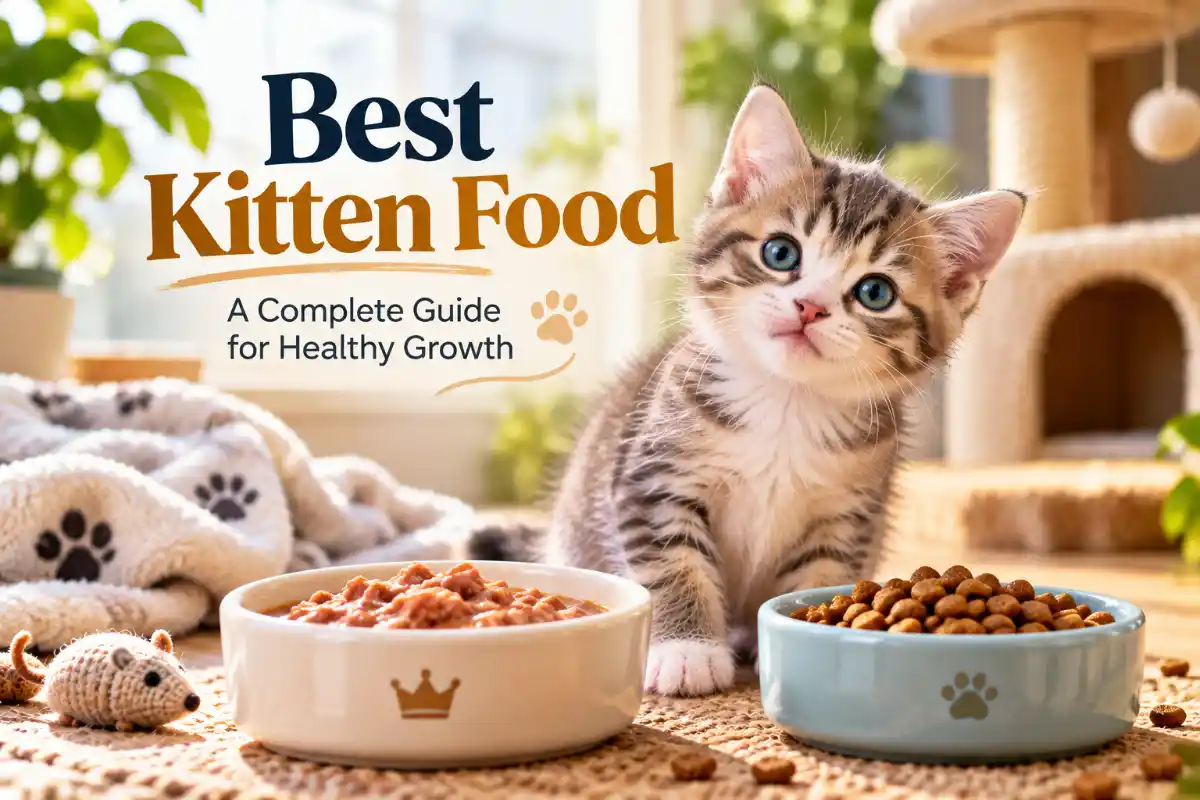
The best kitten food is nutritionally complete and balanced, appropriate for growth over your kitten’s life stage, fits your cat’s age, shape, size, and calorie needs as well as its health status, habits, preferences,s behavior, or other feeding practices! No kitten automatically pans out as the best food or brand.
As U.S. shoppers, one of the best places to start is with the nutritional adequacy statement found on the package (rather than just looking at the ingredients displayed front and center). Growth is classified by AAFCO as a nutritional life stage, and kittens certainly have different nutrient and energy needs than adult cats.
This guide provides all the information you need regarding how to ascertain kitten food quality on your own, compares wet and dry kitten foods, provides feeding recommendations, talks about reading kitten food labels, switching foods safely, as well as tells you whether or not what you are feeding your kittens really is working.
What Is the Best Kitten Food?
For a healthy kitten, look for food that provides complete, balanced nutrition appropriate for growth, includes clear calorie and feeding information, comes from a manufacturer that can answer meaningful nutrition and quality-control questions, and works well for your individual kitten.
AAFCO explains that “complete” means a food contains all required nutrients, while “balanced” means those nutrients are supplied in appropriate ratios. Growth, maintenance, gestation/lactation, and all life stages are recognized nutritional life stages.
Price, packaging, a long list of fashionable ingredients, or a “premium” description should not replace those fundamentals.
Read More: Best Kitten Food
Quick Checklist for Choosing Kitten Food
Before buying a food, check whether:
- It is nutritionally appropriate for growth.
- It is labeled complete and balanced.
- The nutritional adequacy statement is easy to identify.
- Calories are clearly stated.
- Feeding instructions are provided.
- The texture and format suit your kitten.
- The manufacturer provides useful nutritional information.
- You can consistently afford to feed the required quantity.
- Your kitten willingly eats and tolerates it.
If several of these answers are unclear, investigate further before making the food your kitten’s main diet.
Why Kittens Need Different Food Than Adult Cats
A kitten isn’t simply a small adult cat. During the first year, the body is developing rapidly, and nutritional needs change substantially as growth progresses.
AAHA reports that a growing kitten at 10 weeks may require about 200 kcal/kg of body weight per day, compared with about 80 kcal/kg/day at 10 months. Those figures illustrate why feeding needs can change dramatically within the kitten stage.
Protein and Essential Amino Acids
Protein supplies amino acids used for developing muscles, organs, enzymes and other tissues. Cats also have particular nutritional requirements, including taurine and other essential amino acids.
However, don’t automatically choose whichever package advertises the highest crude-protein percentage.
A kitten needs an appropriately formulated overall diet. Protein quantity, protein sources, amino-acid balance, digestibility, calories, minerals, vitamins and other nutrients work together.
Fat, Calories and Essential Fatty Acids
Fat provides concentrated energy and essential fatty acids. This is particularly relevant during rapid growth, when kittens require substantial energy relative to their small body size.
Certain growth formulations also provide nutrients such as DHA, an omega-3 fatty acid. Its presence can be useful, but a single highlighted nutrient doesn’t prove that one food is nutritionally superior to another.
Look at the complete formulation and nutritional adequacy rather than choosing a food because one ingredient or nutrient appears prominently on the package.
Calcium, Phosphorus, Vitamins and Minerals
Developing bones and tissues require appropriate amounts and ratios of minerals and vitamins.
More isn’t necessarily better.
If a commercial kitten food is already complete and balanced, don’t casually add calcium powders, multivitamins, or other supplements. Changing the nutrient balance can create problems rather than improve the diet.
How to Choose the Best Kitten Food in 7 Steps
The easiest way to shop is to evaluate foods in a consistent order instead of comparing dozens of ingredient lists.
Step 1 — Find the Nutritional Adequacy Statement
Turn the package around.
AAFCO describes the nutritional adequacy statement as perhaps the most important section of a pet-food label because it identifies whether a food provides complete and balanced nutrition and for which life stage. It is commonly found in small print on the back or side of the package.
Look for wording indicating that the food provides complete and balanced nutrition for growth or an appropriate all-life-stages formulation.
Be cautious when the product is described only as a:
- treat
- topper
- snack
- supplement
- food for intermittent or supplemental feeding
Those products may have a useful role, but they aren’t automatically appropriate as the kitten’s main diet.
Step 2 — Make Sure the Food Matches the Life Stage
Check the exact life stage rather than relying solely on a kitten photograph on the package.
A food labeled for adult maintenance is designed around adult maintenance requirements, not growth.
A growth-appropriate food is intended for developing kittens. An “all life stages” food can also be nutritionally adequate for growth when its adequacy statement indicates this, although the feeding instructions and calorie needs still need to be appropriate for your kitten.
Step 3 — Check Calories and Feeding Directions
Find the calorie statement.
On U.S. pet-food labels, calorie content should be expressed as kilocalories per kilogram and per familiar household unit, such as kcal per cup or kcal per can.
For example:
- Food A: 420 kcal per cup
- Food B: 330 kcal per cup
One cup of each doesn’t deliver the same amount of energy.
Next, check the feeding chart for your kitten’s weight and life stage. Treat this as a starting estimate, because actual needs vary with age, growth, body condition, activity, and other individual factors. AAFCO likewise notes that label feeding directions may need adjustment according to an individual animal’s condition.
Step 4 — Don’t Judge Food Only by the First Ingredient
Ingredient lists are useful, but they are frequently overinterpreted.
Ingredients are listed by weight as they go into the formulation. That doesn’t mean the first ingredient alone determines the nutritional quality of the finished food.
Consider two hypothetical foods:
Food A: Chicken is the first ingredient.
Food B: Uses several different animal-derived ingredients.
You cannot reliably declare Food A nutritionally superior from those facts alone.
WSAVA specifically cautions that ingredient lists don’t provide information about ingredient quality and can be misleading when used to judge the overall quality of a food.
Ask a more useful question: Does the finished food provide appropriate, complete and balanced nutrition for my kitten?
Step 5 — Research the Manufacturer
A polished bag tells you little about how a food was developed.
WSAVA’s pet-food selection guidance encourages consumers to look deeper into who formulates a diet, the expertise involved, quality-control processes, finished-product analysis, and nutrition research.
Useful questions include:
- Who formulates the diet?
- What nutritional qualifications or expertise do they have?
- Where is the food manufactured?
- What quality-control testing is performed?
- Does the company test finished products?
- Can it provide detailed nutrient and calorie information?
- Does it conduct or support relevant nutrition research?
A transparent company should be able to provide meaningful answers.
Step 6 — Consider Your Kitten’s Individual Needs
Two healthy kittens of the same age may not need the same portions or feeding setup.
Consider your kitten’s:
- age
- current weight
- body condition
- growth rate
- activity level
- spay/neuter status
- health history
- appetite
- texture preferences
- digestive tolerance
AAHA recommends considering factors including age, reproductive status, body and muscle condition, activity, and health when developing an individual feeding plan.
Persistent vomiting, diarrhea, poor growth, weight loss, or refusal to eat calls for veterinary guidance rather than repeated experimentation with foods.
Step 7 — Consider Cost Per Day, Not Just Package Price
Sticker price can be misleading.
Suppose one dry food costs $25 and another costs $40. If the more expensive bag lasts considerably longer at your kitten’s appropriate daily portion, the difference in daily cost may be small.
For dry food, calculate:
Daily cost = package price ÷ approximate number of feeding days
For canned food:
Daily cost = number of cans used daily × price per can
Then calculate a monthly estimate:
30-day food cost = daily cost × 30
Compare cost only after confirming that the products you’re considering are nutritionally appropriate. A cheap food isn’t a bargain if it doesn’t meet your kitten’s needs, while the most expensive food isn’t automatically the best.
Wet vs. Dry Kitten Food: Which Is Better?
Both wet and dry foods can be appropriate when they provide complete and balanced nutrition for the correct life stage.
The better format depends on your kitten and household rather than a universal wet-versus-dry winner.
Wet Kitten Food
Wet food has a high moisture content and soft texture. Cornell notes that canned cat foods are typically about 70–80% water.
Potential advantages include greater dietary moisture, easy portioning, and a texture some kittens readily accept.
The trade-offs are cost, refrigeration after opening, and less convenience when food needs to remain available for extended periods.
Dry Kitten Food
Dry food is convenient to measure and store and is generally more calorie-dense by volume.
It can also work well with food puzzles and feeding toys. AAHA recommends feeding enrichment such as hiding small portions or using food puzzles when appropriate for the kitten.
Because dry food can be energy-dense, portions should still be measured instead of repeatedly topping up a bowl without tracking intake.
Can Kittens Eat Wet and Dry Food Together?
Yes. Mixed feeding can work well when both products are appropriate, and you account for the calories coming from each.
Don’t give the full recommended daily quantity of dry food plus the full daily quantity of wet food. That can unintentionally turn two appropriate portions into overfeeding.
| Factor | Wet Food | Dry Food | Mixed Feeding |
| Moisture | High | Low | Higher than dry alone |
| Convenience | Moderate | High | Moderate |
| Storage after opening | Refrigeration needed | Easy | Moderate |
| Portion tracking | Straightforward | Straightforward | Requires combining calories |
| Texture | Soft | Crunchy | Provides variety |
| Typical cost per day | Often higher | Often lower | Variable |
Read More: Best Kitten Food
Fresh water should always be available regardless of food format.
Best Kitten Food by Age and Growth Stage
The appropriate feeding strategy changes rapidly during the first year.
Birth to About 4 Weeks
Very young kittens normally obtain nutrition from their mother.
An orphaned or inadequately nursing neonatal kitten needs an appropriate kitten milk replacer and careful feeding management—not ordinary cow’s milk or regular solid cat food.
Very young orphaned kittens can require hands-on care beyond choosing a commercial food, so veterinary guidance is especially valuable.
About 4–8 Weeks
Weaning generally occurs gradually rather than overnight.
AAHA states that kittens can begin weaning onto commercially balanced kitten food at around 3–5 weeks of age.
Softened kitten food or an appropriate wet kitten formula can make the texture easier for a young kitten learning to eat independently.
As solid-food intake increases, dependence on milk decreases.
2–6 Months
This is a period of rapid growth.
Young kittens need sufficient calories and nutrients without simply being encouraged to eat unlimited amounts indefinitely.
Cornell says kittens generally do well with three meals per day until about six months of age.
Measure food, monitor growth, and adjust portions as the kitten changes.
6–12 Months
Growth continues, but energy requirements relative to body weight decline.
Cornell notes that between six months and one year, twice-daily feeding is generally appropriate. Individual circumstances can still justify a different schedule.
This is an important period for monitoring body condition, especially after spaying or neutering.
When Should You Switch to Adult Cat Food?
For most cats, a diet appropriate for growth is generally used until around one year of age, when skeletal maturity is typically reached.
Don’t make the switch simply because the kitten looks nearly full-sized at seven or eight months.
Your veterinarian may recommend a different transition point based on growth, body condition, or medical needs.
How Much Food Should a Kitten Eat?
There is no accurate universal answer such as “every kitten needs half a cup.”
The correct quantity depends on:
- age
- body weight
- growth rate
- calorie density of the food
- activity
- body condition
- spay/neuter status
- health
This is why feeding by calories and condition is more informative than comparing cup measurements between unrelated foods.
How to Read Calories per Cup or Can
Find the “Calorie Content” section of the package.
You might see something such as:
400 kcal/cup
or:
100 kcal/can
The numbers above are hypothetical examples.
They tell you how much energy a measurable portion provides.
Example Kitten Feeding Calculation
Suppose your veterinarian or an appropriate feeding recommendation gives your kitten a hypothetical target of 250 kcal per day, and the selected wet food contains 100 kcal per can.
The calculation would be:
250 ÷ 100 = 2.5 cans per day
If that daily amount were divided across three meals:
2.5 ÷ 3 ≈ 0.83 can per meal
This is an example of the calculation method, not a calorie prescription for your kitten.
Start with the feeding instructions for the appropriate life stage and adjust with your veterinarian based on growth and body condition.
How Often Should You Feed a Kitten?
A practical starting framework is:
| Life Stage | Feeding Approach |
| Weaning | Gradually introduce appropriate solid kitten food |
| Up to ~6 months | Often about 3 meals daily |
| ~6–12 months | Often about 2 meals daily |
| Near adulthood | Reassess portions and body condition |
Cornell supports approximately three daily meals until six months and generally twice-daily feeding from six months to one year.
How to Read a Kitten Food Label
Don’t let the front of the package decide for you. Turn it around and examine the information that actually describes the food.
Nutritional Adequacy Statement
Check this first.
You want an adequacy statement appropriate for your kitten’s growth stage. AAFCO notes that recognized life stages include growth, maintenance, gestation/lactation, and all life stages.
If the product says it is only for intermittent or supplemental feeding, don’t assume it can replace a complete everyday diet.
Guaranteed Analysis
The guaranteed analysis typically provides minimum or maximum values for nutrients such as:
- crude protein
- crude fat
- crude fiber
- moisture
These values provide useful information but don’t constitute a complete quality ranking.
Moisture differences also make direct percentage comparisons between canned and dry food potentially misleading.
Ingredient List
Ingredients are listed in descending order by weight as formulated.
Use the list to understand what’s in a food, identify ingredients you specifically need to avoid when medically indicated, and compare formulations.
Don’t use the first ingredient as your sole quality test.
Calorie Content
Look for both:
- kcal/kg
- kcal per cup, can, or another familiar unit
The familiar-unit figure is usually the most convenient for everyday portion calculations.
Feeding Directions
Use feeding directions as your initial reference point.
Then monitor the kitten.
If growth or body condition moves in an undesirable direction, portions may need adjustment. Feeding directions describe an average starting point rather than predicting every individual kitten’s metabolism.
Manufacturer and Lot Information
Keep the original packaging or at least photograph important information such as:
- product name
- manufacturer
- lot number
- UPC
- best-by date
FDA recommends retaining this information because it can be important when reporting a defect, illness,s or recall-related concern.
Kitten Food Marketing Claims: What Actually Matters?
Pet-food packaging is designed to attract shoppers. Nutritional suitability requires looking past the front panel.
Does “Premium” Automatically Mean Better?
No single marketing word should determine your choice.
Instead, look for verifiable information: nutritional adequacy, appropriate life stage, calorie disclosure, manufacturer expertise, quality control,ol and how the food performs for your kitten.
Is Grain-Free Kitten Food Better?
“Grain-free” describes an ingredient characteristic. By itself, it doesn’t tell you whether a diet is nutritionally superior.
Unless your veterinarian has identified a reason to avoid a particular ingredient, prioritize the complete formulation over whether the front of the package emphasizes the absence of grains.
Does Meat Have to Be the First Ingredient?
The first ingredient provides information about formulation by weight, but it isn’t a standalone quality score.
WSAVA cautions against relying heavily on ingredient lists when judging overall food quality.
Life-stage adequacy and the finished nutrient profile matter more than winning a first-ingredient contest.
Does “High Protein” Mean Better?
Kittens need appropriate protein, but the largest number on a package isn’t automatically the best choice.
The goal is adequate, balanced nutrition that supports growth—not maximizing one nutrient independently.
| Marketing Feature | More Useful Question |
| “Premium” | Is it complete and balanced for growth? |
| “Grain-free” | Is there a nutritional reason my kitten needs this? |
| “Chicken #1” | Is the overall diet nutritionally appropriate? |
| “High protein” | Does the complete formulation meet growth needs? |
| Attractive natural imagery | What does the adequacy statement say? |
| Expensive price | What is the cost per day and evidence behind the formulation? |
Read More: Best Kitten Food
How to Switch to a New Kitten Food
Changing food too quickly can contribute to digestive upset or food refusal.
AAHA’s feline life-stage guidance describes gradual dietary transitions over approximately 7–10 days, while also emphasizing clinical discretion. Some cats may require longer.
A Simple 7–10 Day Transition Plan
Use this as a flexible example:
| Period | Old Food | New Food |
| Days 1–2 | ~75% | ~25% |
| Days 3–4 | ~50% | ~50% |
| Days 5–7 | ~25% | ~75% |
| Days 8–10 | 0% | 100% |
If your kitten is reluctant or develops mild digestive upset, slowing the transition may be more appropriate than forcing the schedule.
What to Monitor During the Transition
Watch:
- appetite
- stool consistency
- vomiting
- energy
- willingness to eat
- body weight
Changing both the brand and texture simultaneously may also be harder for a texture-sensitive kitten.
When to Contact Your Veterinarian
Don’t assume every symptom is a normal food transition.
Contact your veterinarian if your kitten has persistent vomiting or diarrhea, significant lethargy, weight loss, poor growth, or refuses food—particularly if the kitten is very young.
Cornell notes that a cat refusing food and losing weight should be examined by a veterinarian.
How to Know Whether Your Kitten’s Food Is Working
The buying decision doesn’t end when you open the bag or can.
Evaluate what happens afterward.
Track Growth and Body Condition
Weigh your kitten regularly and discuss growth during veterinary visits.
Body-condition scoring adds useful context to scale weight. On a nine-point system, Cornell describes 5/9 as ideal, characterized by a proportionate body, a visible waist behind the ribs, ribs that can be felt under a slight fat covering, and a minimal abdominal fat pad.
The objective isn’t simply to make a kitten gain weight as quickly as possible.
Monitor Appetite and Digestion
Keep track of:
- how eagerly the kitten eats
- persistent loose stool
- constipation
- vomiting
- major changes in appetite
A single unusual stool isn’t necessarily evidence that a food is unsuitable, but a persistent pattern deserves attention.
Look at Energy, Coat and Overall Condition
Normal activity, development and overall appearance provide additional clues about how a kitten is doing.
However, a shiny coat or high energy doesn’t prove that a diet is nutritionally complete. Use these observations alongside weight, body condition, stool, appetite and veterinary assessments.
A simple 14-day tracker can help:
| Date | Food/Amount | Appetite | Stool | Vomiting | Weight | Notes |
| Day 1 | ||||||
| Day 7 | ||||||
| Day 14 |
Patterns are usually more informative than trying to remember what happened two weeks earlier.
Feeding a Kitten After Spaying or Neutering
Spaying or neutering doesn’t automatically mean your kitten should immediately switch to adult maintenance food.
Growth requirements still matter.
However, this is an important time to reassess portions and body condition. AAHA notes that neutering is associated with weight gain and recommends evaluating nutrition and obesity-prevention strategies at this stage.
After the procedure:
- continue using an appropriate growth diet unless your veterinarian advises otherwise
- measure portions rather than automatically refilling the bowl
- monitor weight and body condition
- reassess calorie intake as growth slows
- discuss unexpected weight gain with your veterinarian
The goal is supporting continued development without creating chronic excess calorie intake.
Kitten Feeding Mistakes to Avoid
Several mistakes can turn an otherwise reasonable food choice into a poor feeding plan:
- Using adult maintenance food as the default diet: It may not be formulated to meet growth requirements.
- Choosing food only by ingredient order: The ingredient list doesn’t reveal the complete nutritional picture.
- Leaving unlimited food out without monitoring intake: Some cats regulate intake reasonably; others overeat. Cornell notes that free feeding can contribute to inappropriate weight gain in some cats.
- Switching foods abruptly: A gradual transition is usually easier on the digestive system.
- Using too many treats or toppers: They can displace nutritionally complete food and add untracked calories.
- Adding supplements unnecessarily: More nutrients aren’t automatically healthier.
- Assuming expensive means better: Price isn’t a nutritional adequacy test.
- Ignoring body condition: The package can’t see your kitten; you can.
- Feeding solely by volume: Different foods provide different calories per cup or can.
- Changing foods every time your kitten has one unusual stool: Look for patterns and seek veterinary guidance when problems persist.
Raw, Homemade and Alternative Kitten Diets
Growing kittens have little room for nutritional guesswork because they need appropriate nutrients and ratios during development.
Raw Kitten Food
Raw feeding introduces food-safety concerns for both the kitten and household.
FDA states that raw pet food is more likely than processed food to contain harmful bacteria such as Salmonella and Listeria monocytogenes and considers raw pet food a significant health risk to pets and owners.
AAHA/AAFP guidelines likewise do not advocate feeding raw or dehydrated non-sterilized animal-origin foods.
Homemade Kitten Food
“Chicken, rice and vegetables” may sound wholesome, but wholesome ingredients don’t automatically produce complete kitten nutrition.
A properly formulated diet has to supply nutrients in suitable quantities and ratios. This is particularly important during growth.
If you want to feed a homemade diet, have the recipe formulated specifically for your kitten by an appropriately qualified veterinary nutrition professional rather than relying on an internet recipe.
Treats, Toppers and Supplements
Check whether a product is intended to be a complete diet.
AAFCO notes that treats and supplements generally aren’t complete feeds and may instead be labeled for intermittent or supplemental feeding.
Use toppers and treats as additions—not automatic replacements for nutritionally complete food.
How to Store Kitten Food Safely
Good food can still be handled poorly.
FDA recommends washing food bowls and measuring utensils after use, keeping dry food in a cool and dry place, and retaining the original bag so important product information remains available. Dry food should generally be stored below 80°F.
For opened wet food, promptly refrigerate or discard leftovers. FDA recommends keeping refrigerated pet food tightly covered at 40°F or below.
Also:
- don’t buy badly damaged cans, pouches or bags
- use a dedicated clean scoop rather than the food bowl
- wash your hands before and after handling pet food
- keep food somewhere your kitten cannot break into the entire supply
- retain lot and best-by information
If food smells abnormal, packaging swells, or leaks, or your kitten becomes sick after eating it, stop using the product and contact your veterinarian.
The 60-Second Best Kitten Food Decision Checklist
You don’t need to decode every claim on the package while standing in the pet-food aisle.
Run through these questions instead:
1. Is the food nutritionally appropriate for growth?
If no, keep looking.
2. Is it complete and balanced?
Don’t make a supplemental product the primary diet.
3. Can you identify its calorie content?
You need this to understand portions.
4. Can the manufacturer answer meaningful questions?
Look for transparency around formulation, nutrition, and quality control.
5. Does the format fit your kitten?
Wet, dry, or mixed can all be workable choices.
6. Can you feed the required quantity consistently?
Consider cost per day rather than package price.
7. Is your kitten doing well on it?
Monitor growth, body condition, appetite, stool and overall health.
| Check | Good Sign | Investigate Further |
| Life stage | Appropriate for growth | Adult maintenance |
| Nutritional adequacy | Complete and balanced | Supplemental/intermittent only |
| Calories | Clearly disclosed | Difficult to identify |
| Feeding directions | Useful starting portions | Vague information |
| Manufacturer | Transparent about nutrition and QC | Important answers unavailable |
| Practicality | Affordable and manageable | Unsustainable long term |
| Kitten response | Appropriate growth and tolerance | Persistent appetite/GI problems |
Read More: Best Kitten Food
That framework is more useful than choosing whichever package has the longest ingredient list or most impressive front-label claims.
Best Kitten Food FAQs
Which food is best for the kitten?
Healthy kittens: For healthy kittens, breastfeeding kittens should be fed a whole food feeding model up to October 2023. Next, examine the calorie density of the food, how familiar you are with the manufacturer, whether it’s a wet or dry option, affordability,y and individual kitten tolerance.
No brand or recipe is healthiest just because it has been cooked, and no kitten is healthiest due to a specific aspect of their diet.
Which is better for kittens: Dry Food or Wet Food
Either can be appropriate when it is nutritionally adequate and developmentally appropriate for growth. Dry food is practical, easy to store, and more affordable; wet food contains much higher water levels. Some owners use both.
What matters is nutritional adequacy, total calories served, and your individual kitten’s needs.
Are kittens on wet or dry processed food?
Yes. Combination feeding is a sensible choice.
The solution is to sum up total food consumption instead of giving the entire recommended quantity of wet food plus the full recommended quantity of dry food. Consuming both adds to the calorie count for the day.
Now let us answer how much a kitten should eat per day?
One amount does not fit all kittens!
Age, weight, growth rate, activity level, body condition score, and neuter status all impact daily needs as well as the calorie density of food (calories per gram). Follow the growth-stage feeding directions on your food’s manufacturer and re-adjust with the guidance of your veterinarian as your kitten develops.
How many meals a day should a kitten eat?
Before six months, kittens typically do best with three meals a day, says Cornell. Feeding twice a day is normally suitable from 6 months to a functional age of one year.
A different schedule may apply for individual kittens.
When can kittens eat solid food?
Partial weaning can start relatively early—when the kittens are still quite young. According to AAHA, kittens can start the transition to commercially balanced kitten foods as early as 3–5 weeks of age.
Instead, the transitional period should be professionals only release ever-so-slightly more slippery: for instance, if he is getting rid of a Carpet cleaner product at ages 1-2 or any older system and you use an appropriate texture.
Is adult cat food safe for kittens?
Kittens have different nutritional needs, and adult-maintenance food should not generally be the sole diet of a growing kitten.
Check the nutritional adequacy statement. Select a product that is suitable for growth or an appropriate all-life-stages diet.
At what point should I stop selling kitten food?
It is indicated that most cats should be fed a growth-appropriate diet until about one year of age, which is when they usually reach skeletal maturity.
Your vet might also suggest a different schedule based on your cat’s development, body condition, or health.
Why grain-free food for kittens?
This is not just because it is grain-free.
Just because a food is grain-free does not mean it is automatically healthy or good for you. Start with getting all-people nutrition for growth, balanced, and energy appropriate to your kitten’s most effective and cleanest system; quantity can be adjusted to desires of your kitten always.
How can I tell if kitten food is complete and nutritionally balanced?
Get the information about its nutritional adequacy from the package.
This tells you whether the food is complete and balanced nutrition, and for what life stage it is intended according to AAFCO. An appropriate growth-stage designation for a kitten.