Two cricketing nations shaped by resilience and rapid transformation have built one of the most tactically fascinating bilateral rivalries in modern international cricket. The Afghanistan national cricket team vs Zimbabwe national cricket team timeline stretches back more than a decade, spanning Test cricket, ODIs, and T20Is, and it tells a story of shifting power, conditions-based dominance, and genuine upsets that casual fans routinely overlook.
Afghanistan holds a decisive overall lead in this rivalry, particularly in white-ball cricket, having won at least 20 of 31 ODIs and 16 of 18 completed T20Is against Zimbabwe through their most recent full series. Test cricket remains far more balanced, with the two sides splitting their four completed Tests 2-2 before Zimbabwe added a fifth, dominant win in October 2025. This guide breaks down every major series chronologically, explains the tactical reasons behind each momentum shift, and gives you the complete statistical picture rather than a bare scorecard dump.
Afghanistan vs Zimbabwe: The Overall Head-to-Head Record
Afghanistan has comfortably outperformed Zimbabwe across white-ball formats, winning roughly two-thirds of all ODIs and nearly 90 percent of completed T20Is, while Test matches between the two sides remain genuinely competitive.
The scale of Afghanistan’s white-ball dominance surprises many fans who assume Zimbabwe’s longer Test history and greater institutional experience would translate into closer contests across all formats. That assumption doesn’t hold up once you look closely at the actual numbers.
Read more: Afghanistan National Cricket Team vs Zimbabwe National Cricket Team Timeline
Format-Wise Breakdown
| Format | Matches Played | Afghanistan Won | Zimbabwe Won | Drawn/No Result |
| Test Matches | 5 | 2 | 2 | 1 |
| ODI Matches | 31 | ~20 | 10 | 1 |
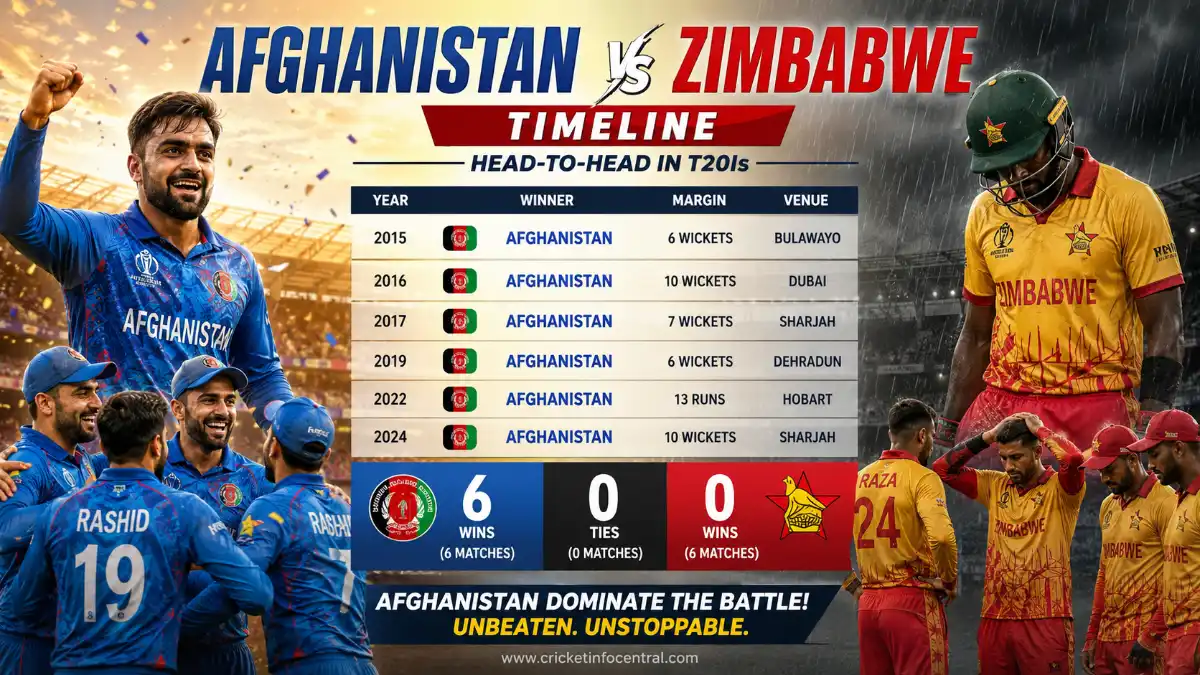
| T20I Matches | 18+ | 16 | 2 | 0 |
Data compiled from ESPNcricinfo head-to-head records and mykhel statistics.
Zimbabwe’s only realistic path to beating Afghanistan consistently runs through Test cricket, specifically on home soil. Every other format tells a story of near-total Afghan control, driven by explosive batting depth and a spin-heavy bowling attack that Zimbabwe’s batting order has historically struggled to read.
Why the Test Record Looks So Different
Test cricket between these two sides began in Abu Dhabi in March 2021, played away from either nation’s home conditions due to travel restrictions at the time. Zimbabwe won the first Test by 10 wickets, an emphatic statement that immediately challenged assumptions about Afghanistan’s readiness for the longest format. Afghanistan responded within days, winning the second Test by 6 wickets to level that maiden series 1-1.
That pattern of rapid retaliation has defined every subsequent phase of this rivalry: neither side has ever let a heavy defeat sit unanswered for long.
Complete Match-by-Match Timeline: 2015 to 2026
The Afghanistan-Zimbabwe rivalry has unfolded across four distinct phases – the early Sharjah and Bulawayo T20I meetings from 2015-2018, the 2021 Abu Dhabi Test introduction, the landmark December 2024 multi-format tour, and the most recent 2025-26 series that included a historic Test result and a white-ball sweep.
Understanding this afghanistan national cricket team vs Zimbabwe national cricket team timeline properly requires walking through each phase in order, because the tactical lessons from earlier series directly shaped later team selections and captaincy decisions.
Phase 1: The Early T20I Meetings (2015-2019)
Afghanistan’s white-ball dominance over Zimbabwe was established early and never seriously challenged for nearly a decade. In their first meetings in Bulawayo in October 2015, Afghanistan won both T20Is by 5 and 6 wickets respectively. That set the tone for a stretch running through Sharjah in January 2016, where Afghanistan added two more wins by 5 runs and 81 runs.
The pattern held in Sharjah again in February 2018, with Afghanistan sweeping both matches by 5 wickets and 17 runs, and continuing through fixtures in Bangladesh later that year. Zimbabwe managed just one win in this entire stretch, a 7-wicket victory in Chattogram in September 2019, breaking a long losing streak but doing little to change the overall trajectory.
By the end of 2019, Afghanistan had already established itself as the clearly superior T20I side in this matchup, a gap that has only widened since.
Phase 2: The 2021 Abu Dhabi Test Series
March 2021 marked genuinely new territory for both teams – their first-ever Test series against each other, played in Abu Dhabi due to pandemic-era travel constraints. Zimbabwe struck first, bowling Afghanistan out cheaply and completing a 10-wicket win in the opening Test on March 2-3, 2021.
Afghanistan’s response came just days later. In the second Test, starting March 10, they turned the tables completely, winning by 6 wickets to square the series. Around the same window, the two teams also played a T20I series in Abu Dhabi, with Afghanistan sweeping all three matches by margins of 47, 45, and 48 runs, reinforcing just how differently the sides performed depending on format.
Phase 3: The 2022 Harare Series
Afghanistan toured Zimbabwe again in June 2022 for a series that further cemented their white-ball superiority. They won three consecutive T20Is in Harare by margins of 6 wickets, 21 runs, and 35 runs, followed by an ODI leg where they won by 60 runs, 8 wickets, and 4 wickets.
This tour is significant because it showed Afghanistan’s dominance wasn’t dependent on neutral venues like Sharjah or Abu Dhabi – they were now winning comfortably even in Zimbabwe’s own conditions in white-ball cricket, a shift that changed how touring sides approached series planning against Afghanistan.
Phase 4: The Landmark December 2024 Multi-Format Tour
December 2024 brought the most ambitious chapter in this rivalry -a full tour covering three T20Is, three ODIs, and two Test matches, almost entirely hosted at Harare and Bulawayo.
T20I leg (December 11-14, 2024): Zimbabwe won the series opener by 4 wickets on December 11. Afghanistan answered immediately, winning the second match by 50 runs on December 13, then closing out a tense decider by 3 wickets on December 14 to take the series 2-1.
ODI leg (December 17-21, 2024): The opening match was abandoned without a result. Afghanistan then delivered one of the most complete team performances of the entire rivalry in the second ODI, winning by a massive 232 runs on December 19. Scoring records from the series show Afghanistan posting 286/6 in that innings while restricting Zimbabwe to just 54 all out in 17.5 overs, one of the most one-sided results in the rivalry’s history. The series closed with an 8-wicket Afghan win on December 21.
Test leg (December 26, 2024 – January 6, 2025): This is where the timeline gets genuinely compelling. The first Test at Bulawayo, starting December 26, ended in a hard-fought draw after Afghanistan posted a massive first-innings reply. Zimbabwe’s tail-order batting held out for the draw despite Afghanistan dominating large stretches of the match. The second Test, starting January 2, 2025, saw Afghanistan complete the job, winning by 72 runs to close the tour on a decisive high.
Phase 5: Zimbabwe’s Historic Response (October-November 2025)
Zimbabwe finally got its revenge in the format that has always suited it best. In a one-off Test starting October 20, 2025, Zimbabwe posted a commanding total and bowled Afghanistan out twice, sealing a crushing innings-and-73-run victory – their biggest winning margin against Afghanistan in any format. Cricbuzz’s series coverage explicitly described it as Zimbabwe’s most significant Test win over Afghanistan to date.
But the response in white-ball cricket told a completely different story. Afghanistan won the following T20I series comfortably, described by Cricbuzz as Afghanistan “sweeping the three-match contest” after the Test defeat. Individual results included a 53-run win on October 29 and a tight 9-run win on November 2, where Afghanistan chased down Zimbabwe’s 201 to post 210/3.
This single tour perfectly captures the entire rivalry in miniature, Zimbabwe dominant with the red ball at home, Afghanistan immediately reasserting control once the format shifted to white-ball cricket.
Phase 6: Continuing Into 2026
The rivalry extended into July 2026 with a further three-match T20I series, played on July 15, 17, and 19. This series formed part of Afghanistan’s broader T20I career total, which ESPNcricinfo records show sits at 163 wins across their full international history through this point, underlining just how central white-ball cricket has become to Afghanistan’s overall cricketing identity.
Why Momentum Shifts So Dramatically Between Formats
Momentum in the Afghanistan-Zimbabwe rivalry shifts almost entirely based on conditions and format-Zimbabwe’s seam-friendly home Test pitches favor the hosts, while Afghanistan’s spin depth and aggressive batting take firm control in white-ball cricket.
This isn’t random variance from match to match. It’s a tactical pattern that has repeated across nearly every series played since 2015.
The Bulawayo and Harare Seam Factor
Test venues in Zimbabwe, particularly Queens Sports Club in Bulawayo, typically offer more seam movement and bounce than the drier, slower surfaces Afghanistan encounters at home in Sharjah or Greater Noida. Afghanistan’s bowling attack, historically built around frontline spin options, loses a meaningful chunk of its effectiveness on tracks like these. That single factor explains why Zimbabwe’s two Test wins in this rivalry – the 10-wicket win in 2021 and the innings-and-73-run win in 2025-both came in home conditions that specifically neutralized Afghanistan’s spin threat.
Afghanistan’s White-Ball Blueprint
In T20Is and ODIs, Afghanistan’s batting depth consistently overwhelms Zimbabwe’s bowling attack. The 232-run ODI win in December 2024 is the clearest possible example. Once Afghanistan’s top order built a platform past 280, Zimbabwe’s bowlers simply had no answer, eventually collapsing to 54 all out in the chase. This kind of batting-first dominance has been the defining feature of Afghanistan’s approach to white-ball cricket against Zimbabwe for close to a decade.
Biggest Wins and Statistical Milestones
Zimbabwe’s biggest win in the rivalry is their innings-and-73-run Test victory in October 2025, while Afghanistan’s most dominant result is their 232-run ODI win in December 2024.
- Zimbabwe’s largest margin of victory: Innings and 73 runs (Test, October 2025)
- Afghanistan’s largest margin of victory: 232 runs (ODI, December 2024)
- Closest T20I finish: 3-wicket Afghanistan win in the December 2024 series decider
- Closest recent finish: 9-run Afghanistan win in Harare, November 2025
- Format Afghanistan dominates most: T20Is, with 16 wins from 18 completed matches through their 2024 tour alone
These numbers shape more than bragging rights-they directly influence team selection. Afghanistan’s team management has reportedly prioritized additional seam-bowling cover specifically for tours to Zimbabwe following the pattern established across the 2021 and 2025 Test defeats.
Captaincy and Tactical Decisions That Defined the Rivalry

Afghanistan’s leadership group has generally favored aggressive, front-foot batting approaches in white-ball cricket, trusting their top order to build unreachable totals rather than playing conservatively. That approach paid off directly in the 232-run ODI demolition in December 2024, where Afghanistan batted first and never allowed Zimbabwe’s bowlers back into the contest.
Zimbabwe’s captaincy, by contrast, has leaned into patient, seam-bowling-first strategies specifically in Test cricket, favoring venues and conditions that limit Afghanistan’s spin options. The October 2025 Test win at home stands as the clearest validation of that approach working exactly as designed.
What This Timeline Tells Us Going Forward
The broader trend across the Afghanistan national cricket team vs Zimbabwe national cricket team timeline points to a rivalry where format, not overall team quality, decides outcomes. Afghanistan’s rise since gaining Full Member status has been unusually fast in white-ball cricket, specifically, built on aggressive batting depth and world-class spin bowling that translates poorly to seam-friendly Test surfaces. Zimbabwe, despite a longer institutional Test history, has consistently struggled to match Afghanistan’s batting firepower in shorter formats, even as they’ve shown genuine improvement with the red ball at home.
Future series are likely to follow the same script: expect close, seam-influenced Test contests whenever the two sides meet in Zimbabwe, and expect Afghanistan’s batting depth to dominate whenever the format shifts to white-ball cricket, regardless of venue.
Frequently Asked Questions
What is the overall head-to-head record between Afghanistan and Zimbabwe?
Afghanistan leads decisively in white-ball formats, winning roughly 20 of 31 ODIs and 16 of 18 completed T20Is, while Test matches remain closely contested at 2-2 with one draw across the first four meetings.
Who has won more Test matches between Afghanistan and Zimbabwe?
The Test record was tied at 2-2 with one draw through January 2025, before Zimbabwe added a dominant fifth win in October 2025.
What is Zimbabwe’s biggest win over Afghanistan?
Zimbabwe’s biggest win is an innings-and-73-run victory in a one-off Test played in October 2025.
What is Afghanistan’s biggest win over Zimbabwe?
Afghanistan’s largest margin of victory is a 232-run win in an ODI played on December 19, 2024.
Which format does Afghanistan dominate most against Zimbabwe?
Afghanistan dominates T20Is most heavily, winning 16 of 18 completed matches against Zimbabwe through their December 2024 tour.
Where does Zimbabwe have the best chance of beating Afghanistan?
Zimbabwe performs best in Test matches played on home soil, where seam-friendly conditions at venues like Bulawayo neutralize Afghanistan’s spin attack.
When did Afghanistan and Zimbabwe play their biggest multi-format tour?
The most extensive tour took place from December 2024 to January 2025, covering three T20Is, three ODIs, and two Test matches, mostly in Harare and Bulawayo.
How many ODIs have Afghanistan and Zimbabwe played against each other?
The two teams have played 31 ODIs, with Afghanistan winning around 20 and Zimbabwe winning 10, plus one no-result.
Did Afghanistan or Zimbabwe win more recently in 2025-26?
Zimbabwe won the Test leg of their October 2025 series, but Afghanistan immediately responded by sweeping the following three-match T20I series.
Why does the Afghanistan vs Zimbabwe rivalry swing so much between formats?
Momentum swings primarily due to pitch conditions-Zimbabwe’s seam-friendly home surfaces favor the hosts in Tests, while Afghanistan’s spin depth and aggressive batting dominate white-ball cricket.