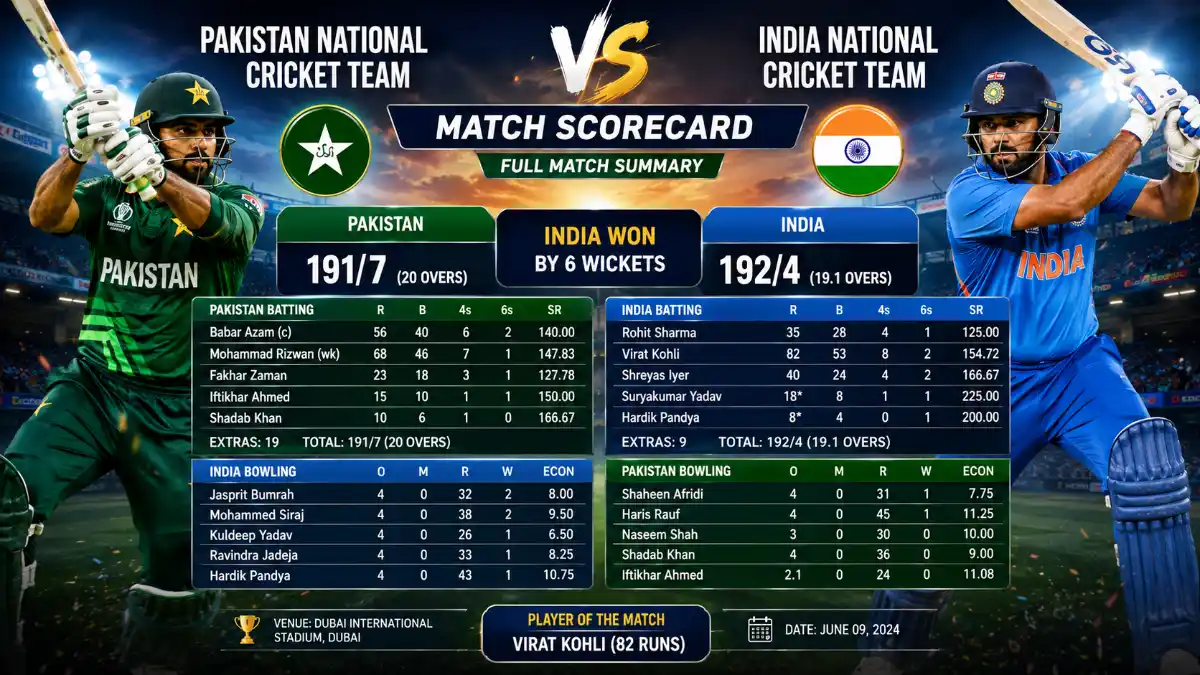
When Ishan Kishan walked out to open the innings against Pakistan at the R. Premadasa Stadium, few expected the contest to end as one of the most lopsided results in the history of this fixture. India’s 61-run win over Pakistan didn’t just settle a group-stage match -it rewrote the record books for the biggest winning margin in the rivalry’s T20I history, and this detailed Pakistan National Cricket Team vs India National Cricket Team match scorecard breaks down exactly how it happened, ball by ball, number by number.
Quick answer for readers in a hurry: India scored 175/7 in 20 overs, restricted Pakistan to 114/10 in 18 overs, and won by 61 runs at Colombo on February 15, 2026, with Ishan Kishan’s 77 off 40 balls as the standout performance of the match.
India vs Pakistan Match Result and Overview
India defeated Pakistan by 61 runs in the ICC Men’s T20 World Cup 2026 group-stage encounter, posting 175/7 batting first before bowling Pakistan out for 114 in 18 overs at the R. Premadasa Stadium, Colombo.
This result matters far beyond a single group match. It marks the widest run-margin victory either side has recorded against the other in T20 International cricket, pushing India’s head-to-head tally against Pakistan in T20 World Cups to a dominant 8-1. For a fixture that regularly draws record television audiences and stadium sellouts across South Asia, an India National Cricket Team vs Pakistan National Cricket Team match scorecard with this kind of gap between the two totals is rare -most editions of this rivalry are tight, low-margin affairs decided in the final over.
Pakistan skipper Salman Agha won the toss and opted to bowl first, banking on early bounce and seam movement off the Premadasa surface to trouble India’s top order. That decision backfired within the opening six overs, and the match essentially tilted in India’s favor before either team had batted for even a third of their innings.
Read more: Pakistan National Cricket Team vs India National Cricket Team Match Scorecard.
Toss, Venue, and Match Conditions
Direct answer: The match was played at the R. Premadasa Stadium in Colombo, Sri Lanka, with Pakistan winning the toss and electing to field first on a pitch initially described as pacy and later assessed as slow and spin-friendly as the game progressed.
The surface behaved unpredictably through the innings -quick and bouncy for the opening bowlers, then noticeably slower for the chasing side, a common characteristic of Premadasa pitches once dew and wear set in during evening matches. This shift in conditions is part of why Pakistan’s bowling plans, built around early pace, struggled to adapt once India’s batters got their eye in.
Full India Batting and Bowling Scorecard
India posted 175 for 7 in 20 overs, powered by Ishan Kishan’s explosive 77 off 40 balls, Suryakumar Yadav’s 32, and useful late contributions from Shivam Dube and Rinku Singh.
The innings had two distinct phases: an aggressive powerplay led almost single-handedly by Kishan, followed by a middle order that manufactured just enough acceleration to reach a total that eventually proved unassailable.
India Batting Card
| Batter | Dismissal | Runs | Balls | 4s | 6s | Strike Rate |
| Ishan Kishan | b Saim Ayub | 77 | 40 | 10 | 3 | 192.50 |
| Abhishek Sharma | c Afridi b Agha | 0 | 4 | 0 | 0 | 0.00 |
| Tilak Varma | lbw b Saim Ayub | 25 | 24 | 2 | 1 | 104.17 |
| Suryakumar Yadav | c Ayub b Tariq | 32 | 29 | 3 | 0 | 110.34 |
| Hardik Pandya | c Azam b Ayub | 0 | 1 | 0 | 0 | 0.00 |
| Shivam Dube | run out | 27 | 17 | 3 | 1 | 158.82 |
| Rinku Singh | not out | 11 | 4 | 1 | 1 | 275.00 |
| Axar Patel | c Ayub b Afridi | 0 | 1 | 0 | 0 | 0.00 |
Extras: 3 | Total: 175/7 in 20 overs
Three batters were dismissed for scores of zero, which normally signals a fragile innings, yet the middle-order failures barely mattered because Kishan’s contribution alone accounted for 44 percent of India’s final total. This is an important statistical detail often missing from standard match reports -a single innings carrying almost half the team score is a rare occurrence even in T20 cricket, where totals are typically spread across four or five contributors.
Pakistan Bowling Figures Against India
Saim Ayub was Pakistan’s most successful bowler with figures of 3 for 25 in 4 overs, while frontline spinner Abrar Ahmed finished wicketless, conceding 38 runs in his 3 overs.
| Bowler | Overs | Maidens | Runs | Wickets | Economy |
| Salman Agha | 2 | 0 | 10 | 1 | 5.00 |
| Shaheen Afridi | 2 | 0 | 31 | 1 | 15.50 |
| Saim Ayub | 4 | 0 | 25 | 3 | 6.25 |
| Abrar Ahmed | 3 | 0 | 38 | 0 | 12.67 |
| Shadab Khan | 1 | 0 | 17 | 0 | 17.00 |
| Mohammad Nawaz | 4 | 0 | 28 | 0 | 7.00 |
| Usman Tariq | 4 | 0 | 24 | 1 | 6.00 |
Pakistan’s decision to bring on their premium spin option, Abrar Ahmed, only after the 12th over meant he entered the attack once Kishan had already crossed fifty and the innings had gathered irreversible momentum. This sequencing issue is a tactical, not just statistical, story -it reflects a bowling plan that misjudged when India’s dangerous phase of batting would actually occur.
Full Pakistan Batting and Bowling Scorecard
Chasing 176 to win, Pakistan collapsed to 38 for 4 inside the powerplay and were eventually bowled out for 114 in 18 overs, with Usman Khan’s 44 the only substantial score of the innings.
The chase never found any rhythm. Once the top order fell inside the first six overs, the required run rate climbed past 11 an over -an almost impossible ask against a bowling attack that had four different wicket-takers rotating through spells.
Pakistan Batting Card
| Batter | Dismissal | Runs | Balls | 4s | 6s | Strike Rate |
| Sahibzada Farhan | c Rinku b Pandya | 0 | 4 | 0 | 0 | 0.00 |
| Saim Ayub | lbw b Bumrah | 6 | 2 | 0 | 1 | 300.00 |
| Salman Agha | c Pandya b Bumrah | 4 | 4 | 1 | 0 | 100.00 |
| Babar Azam | b Axar Patel | 5 | 7 | 0 | 0 | 71.43 |
| Usman Khan | st Kishan b Axar Patel | 44 | 34 | 6 | 1 | 129.41 |
| Shadab Khan | c Dube b Tilak Varma | 14 | 15 | 1 | 0 | 93.33 |
| Mohammad Nawaz | c Dube b Kuldeep | 4 | 5 | 1 | 0 | 80.00 |
| Faheem Ashraf | c Rinku b Chakaravarthy | 10 | 14 | 1 | 0 | 71.43 |
| Shaheen Afridi | not out | 23 | 19 | 2 | 1 | 121.05 |
| Abrar Ahmed | lbw b Chakaravarthy | 0 | 1 | 0 | 0 | 0.00 |
| Usman Tariq | b Pandya | 0 | 3 | 0 | 0 | 0.00 |
Extras: 4 | Total: 114/10 in 18 overs
Six of Pakistan’s eleven batters failed to reach double figures -a collapse pattern that shows this wasn’t a case of one dismissal triggering a domino effect, but a genuine team-wide struggle against disciplined bowling. Usman Khan’s innings of 44 was the lone bright spot, briefly threatening a recovery before wickets at the other end kept undoing his effort.
India Bowling Figures Against Pakistan
India’s bowling attack shared the workload evenly, with Hardik Pandya, Jasprit Bumrah, Axar Patel, and Varun Chakaravarthy each claiming two wickets to dismantle Pakistan’s batting order.
| Bowler | Overs | Maidens | Runs | Wickets | Economy |
| Hardik Pandya | 3 | 1 | 16 | 2 | 5.33 |
| Jasprit Bumrah | 2 | 0 | 17 | 2 | 8.50 |
| Axar Patel | 4 | 0 | 29 | 2 | 7.25 |
| Varun Chakaravarthy | 3 | 0 | 17 | 2 | 5.67 |
| Kuldeep Yadav | 3 | 0 | 14 | 1 | 4.67 |
| Tilak Varma | 2 | 0 | 11 | 1 | 5.50 |
| Rinku Singh | 1 | 0 | 9 | 0 | 9.00 |
Kuldeep Yadav’s economy of 4.67 was the most disciplined spell of the innings, and he was the only bowler on either side to concede fewer than 5 runs an over across three or more overs. This kind of pressure-building spell rarely gets highlighted in standard scorecards, but it played a direct role in strangling any hope of a Pakistan recovery in the middle overs.
Powerplay Comparison and the Match-Deciding Swing
India scored 52 for 1 in their powerplay, while Pakistan managed only 38 for 4 in reply -a 14-run and three-wicket swing that effectively decided the outcome before either innings reached the halfway stage.
Powerplay performance in T20 cricket is consistently one of the strongest predictors of the eventual result, and this match followed that pattern precisely. Kishan’s aggression against both pace and spin inside the first six overs gave India a platform that Pakistan’s top order simply couldn’t match when their turn came.
Why Pakistan’s Top-Order Collapse Was Fatal
Pakistan’s batting order fell apart in a way that statistically eliminates almost any realistic chance of a comeback. Teams chasing totals above 170 in T20 cricket after losing four wickets inside the powerplay convert those chases into wins only in exceptional circumstances -and Pakistan’s batting lineup, without their top four intact, had no platform left to build from. Every subsequent partnership became a repair job rather than a genuine chase, which explains why the required run rate kept climbing rather than settling.
Key Partnerships and Statistical Breakdown
The 87-run second-wicket stand between Ishan Kishan and Tilak Varma was the largest partnership of the match, accounting for exactly half of India’s final total, while Pakistan’s best stand -39 runs between Usman Khan and Shadab Khan -came only after four wickets had already fallen.
This gap in partnership quality is one of the clearest indicators of how differently the two innings unfolded. India built a dominant stand early and cruised afterward, while Pakistan never had the platform to construct anything comparable.
Boundary Percentage and Dot Ball Comparison
India’s total of 175 included 112 runs scored in boundaries alone, or 64 percent of their innings, compared to Pakistan’s 66 boundary runs, which made up 58 percent of their total. Pakistan also played a noticeably higher number of dot balls in the first ten overs than India did, a sign that their batters struggled to rotate strike even when boundaries weren’t available -a subtle but important detail that a plain scorecard doesn’t reveal on its own.
Records Broken in This India vs Pakistan Encounter
India’s 61-run win is the largest margin of victory recorded between India and Pakistan in T20 International cricket, and it extended India’s head-to-head lead over Pakistan in T20 World Cups to 8-1.
- Biggest T20I win margin between the two sides at 61 runs
- India’s head-to-head record in T20 World Cups against Pakistan now stands at 8-1
- Ishan Kishan’s 77 ranks among the highest individual scores recorded in this fixture’s T20I history
- Pakistan’s 38/4 powerplay is among their worst starts in a match against India on record
Match Details and Officials
Venue: R. Premadasa Stadium, Colombo, Sri Lanka. Toss: Pakistan, elected to field. Result: India won by 61 runs. Tournament stage: Group A, ICC Men’s T20 World Cup 2026. This win confirmed India’s qualification for the Super Eight stage of the tournament, according to match coverage from ESPNcricinfo.
What This Result Means for Both Teams
For India, the win builds momentum heading into the knockout stages and reinforces their status as defending champions With a psychological edge over their biggest rivals. For Pakistan, the defeat puts additional pressure on their remaining fixtures, since net run rate and morale both take a hit after a loss of this magnitude against a fierce competitor. The Pakistan National Cricket Team vs India National Cricket Team match scorecard from this game will likely be referenced for years as one of the most lopsided results in the rivalry’s tournament history, similar to how past Cricbuzz and ESPN Cricinfo archives track record-breaking margins in bilateral and multilateral cricket.
Frequently Asked Questions
What was the final score in the India vs Pakistan T20 World Cup 2026 match?
India scored 175 for 7 in 20 overs, and Pakistan were bowled out for 114 in 18 overs, with India winning by 61 runs.
Who was the top scorer in this India vs Pakistan scorecard?
Ishan Kishan top-scored with 77 runs off 40 balls, hitting 10 fours and 3 sixes at a strike rate of 192.50.
Who took the most wickets for India in this match?
Four bowlers shared the wickets equally -Hardik Pandya, Jasprit Bumrah, Axar Patel, and Varun Chakaravarthy each finished with 2 wickets.
Where was the India vs Pakistan match played?
The match was played at the R. Premadasa Stadium in Colombo, Sri Lanka.
Who won the toss in the India vs Pakistan clash?
Pakistan won the toss and chose to field first, a decision that did not pay off given the eventual result.
What was Pakistan’s highest individual score in their chase?
Usman Khan scored 44 off 34 balls, the highest score for Pakistan while chasing India’s total of 176.
Which bowler had the best economy rate in the match?
Kuldeep Yadav had the most economical spell among bowlers with three or more overs, conceding just 14 runs at an economy of 4.67.
What is India’s head-to-head record against Pakistan in T20 World Cups after this result?
India now leads Pakistan 8-1 in T20 World Cup meetings between the two sides.
What was the biggest partnership of the match?
The 87-run second-wicket stand between Ishan Kishan and Tilak Varma was the largest partnership, contributing exactly half of India’s total.
Did this win help India qualify for the Super Eights?
Yes, the 61-run win confirmed India’s place in the Super Eight stage of the T20 World Cup 2026.