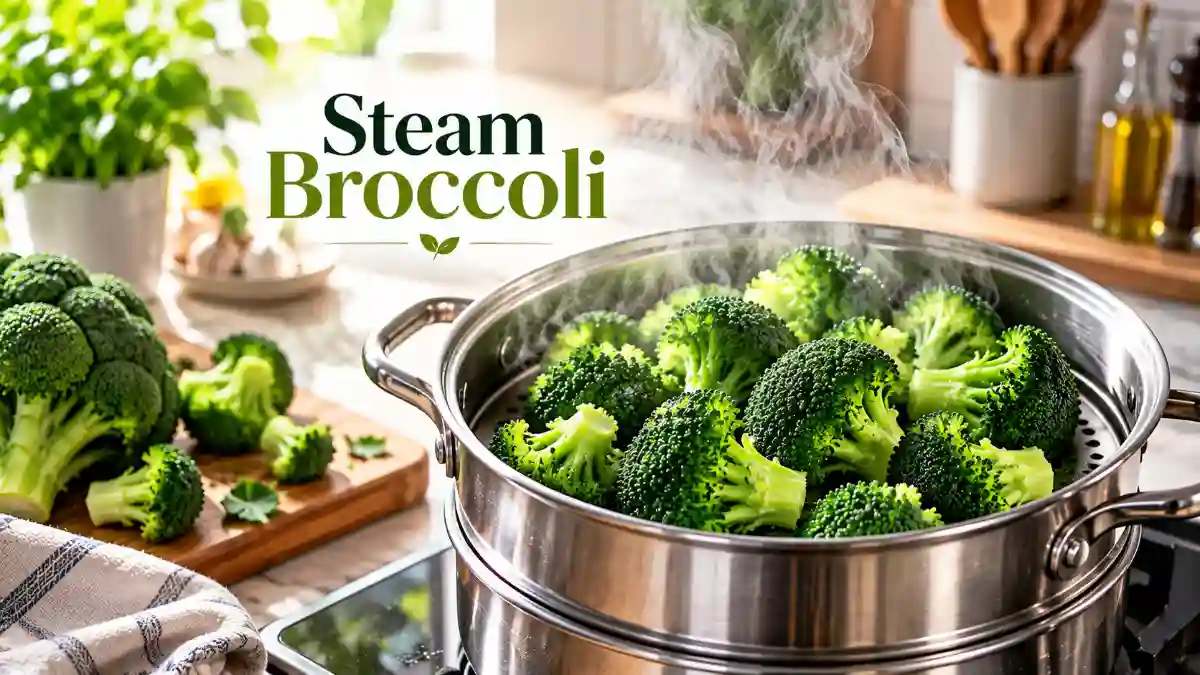
Cooking broccoli is simple, but nailing that texture can be surprisingly difficult. If you are not careful, an extra few minutes can turn firm, bright-green florets into a mushy, watery side-dish.
The trick is to slice the vegetable evenly, using sufficient water to produce consistent steam and to test the thickest stems before they become too tender.
How do I steam broccoli, you ask? Well,l the easiest version is steaming fresh, medium-size florets for about 4–6 minutes of active steaming. Tight fitting lid and a steamer basket (you can use an Instant Pot).
Don’t have a basket? Alternatively, you can use a covered skillet or microwave-safe bowl.
This guide outlines the primary techniques of cooking, adjustments to make in time, fixes for failures, and ways to add flavor without obscuring the recipe.
Quick Answer: How to Steam Broccoli in 6 Steps
For a straightforward stovetop method:
- Wash the broccoli and cut it into evenly sized florets.
- Add approximately 1 inch of water to a saucepan.
- Bring the water to a boil and position a steamer basket above it.
- Add the florets and cover with a fitted lid.
- Steam for approximately 4–6 minutes, checking tenderness with a fork.
- Remove immediately, drain excess moisture, and season.
The broccoli is ready when a fork enters the thickest part of a stem with slight resistance.
| Recipe details | Information |
| Preparation time | 5 minutes |
| Cooking time | 4–6 minutes |
| Total time | Approximately 10–12 minutes |
| Yield | About 4 side-dish servings |
| Main ingredient | 1 pound fresh broccoli |
| Difficulty | Beginner-friendly |
| Equipment | Saucepan, lid, steamer basket |
Read More: How to Steam Broccoli
Timing note: Start counting when steam is actively circulating the broccoli, not when you first turn on the burner.
Ingredients and Equipment
You only need fresh broccoli and water for the basic recipe. Optional seasonings add flavor after cooking.
Ingredients for Four Servings
- 1 large head of broccoli, approximately 1 pound
- About 1 inch of water for the saucepan
- 1 tablespoon olive oil or unsalted butter, optional
- ¼ teaspoon salt, adjusted to taste
- 1–2 teaspoons fresh lemon juice, optional
- Freshly ground black pepper, optional
You can also use garlic, Parmesan cheese, sesame oil, or fresh herbs.
Equipment
For traditional steaming, you’ll need a saucepan, fitted lid, steamer basket, knife, cutting board, fork, and heat-resistant utensils.
A covered skillet is an alternative if you don’t have a basket.
How to Prepare Broccoli Before Steaming
Preparation is important because pieces of different sizes cook at different rates.
Choose Fresh Broccoli
Look for tightly clustered florets and firm stalks.
Fresh broccoli is usually deep green, although some varieties have purple-green coloring.
Avoid heads with extensive yellowing, mold, sliminess, or an unpleasant smell.
Wash the Vegetable
Rinse the head thoroughly under cool running water.
Separate the florets if necessary to help remove dirt from the spaces between them.
Do not use soap or household cleaning products on fresh produce.
Cut Evenly
Cut the broccoli into florets approximately 1–2 inches wide.
Keep the pieces similar in size so they cook more consistently.
The stalk is edible, too. Trim any particularly tough outer skin and slice the tender interior into thin pieces.
Add thick stalk sections a minute or two before the florets if needed.
How to Steam Broccoli on the Stove
The stovetop basket method gives you control over cooking time and tenderness.
Step 1: Add Water to the Saucepan
Pour approximately 1 inch of water into a saucepan.
Check that the water will remain below the steamer basket.
The florets should cook in hot vapor rather than sit directly in boiling water.
Step 2: Bring the Water to a Boil
Place the saucepan over medium-high heat.
Bring the water to a boil, then position the steamer basket securely inside.
Step 3: Add the Broccoli
Arrange the prepared florets in the basket.
Spread them relatively evenly and avoid packing them tightly.
For a particularly large quantity, cook in batches if your equipment is too small.
Step 4: Cover and Cook
Place the lid on the saucepan.
Adjust the heat to maintain steady steam without allowing the water to boil away.
Begin checking medium-sized florets after approximately four minutes.
Step 5: Check Tenderness
Carefully lift the lid away from your face.
Insert a fork into the thickest stem.
For a tender-crisp result, the fork should enter with slight resistance.
If the stem remains too firm, cover and cook for another 30–60 seconds before checking again.
Step 6: Remove and Season
Carefully lift out the basket using heat-resistant utensils.
Transfer the broccoli to a serving bowl.
Drain any excess water and add your preferred seasonings.
Don’t leave the cooked florets inside the covered saucepan. Residual heat can continue softening them.
How Long to Steam Broccoli? Cooking Time Chart
The correct cooking time depends on floret size, batch quantity, equipment, and preferred texture.
Use the following estimates as a starting point.
| Broccoli type | Approximate time | Expected texture |
| Small fresh florets | 3–4 minutes | Firm-tender |
| Medium fresh florets | 4–6 minutes | Tender-crisp |
| Large fresh florets | 6–8 minutes | Tender |
| Thinly sliced stalks | 5–7 minutes | Fork-tender |
| Frozen florets | 5–8 minutes | Tender |
| Fresh broccoli in microwave | 3–5 minutes | Varies with wattage |
Read More: How to Steam Broccoli
Stovetop times begin once active steaming starts. Microwave times begin when the appliance starts cooking.
These are approximate ranges, not guaranteed results.
How to Recognize Different Textures
| Texture | What it feels like | Suitable uses |
| Firm-tender | Noticeable resistance when pierced | Salads and grain bowls |
| Tender-crisp | Fork enters with slight resistance | Everyday side dishes |
| Soft | Fork slides in easily | Soups and mashed dishes |
| Overcooked | Florets collapse or become watery | Blended sauces or soups |
For a firmer result, begin checking early.
If you prefer softer vegetables, extend cooking gradually instead of adding several minutes at once.
Does Batch Size Change the Cooking Time?
Yes. Adding a large quantity can temporarily reduce the temperature inside the saucepan, and a crowded basket can interfere with even steam circulation.
When preparing more than one large head, use a sufficiently large steamer or divide the broccoli into batches.
Check florets from different areas of the basket before serving.
Doubling the amount does not automatically mean doubling the cooking time.
How to Steam Broccoli Without a Steamer Basket
You don’t need specialized equipment to prepare this vegetable.
A covered skillet works well when a traditional steamer basket isn’t available.
Method 1: Covered Skillet
- Place the prepared florets in a wide skillet.
- Add approximately ¼ cup of water.
- Cover with a fitted lid.
- Heat until the water produces steam.
- Cook for approximately 4–6 minutes, checking tenderness.
- Remove the lid and allow excess moisture to evaporate briefly.
If the skillet becomes dry before the broccoli is ready, carefully add a little more water.
Because some pieces may touch the water, this method combines steaming with shallow-water cooking.
Method 2: Heatproof Metal Colander
A metal colander can work if it fits securely above a saucepan.
Make sure it remains stable and doesn’t touch the boiling water.
Add the broccoli, cover with a suitable heatproof lid, and steam until tender.
Avoid plastic colanders, unstable setups, and handles that could melt or become dangerously hot.
If your equipment doesn’t fit safely, use the covered-skillet method instead.
How to Steam Broccoli in the Microwave
Microwave steaming is convenient for small portions and quick meals.
However, wattage, batch size, and container shape affect cooking time.
For approximately 12–16 ounces of fresh broccoli:
- Place the florets in a microwave-safe glass or ceramic bowl.
- Add 2–3 tablespoons of water.
- Cover with a microwave-safe lid or plate that allows steam to vent.
- Microwave on high for approximately 3 minutes.
- Check the thickest stems.
- Continue in 30-second intervals until the desired tenderness is reached.
Let the bowl stand briefly before uncovering it.
Drain excess water and season.
Adjusting for Microwave Power
A higher-powered microwave may cook the broccoli faster than a lower-powered appliance.
For small portions, begin checking before the suggested three-minute starting point.
For larger batches, rearrange the florets between intervals to promote even heating.
Never seal the container airtight. Use oven mitts and lift the cover away from your face to avoid escaping steam.
How to Steam Frozen Broccoli Without Making It Mushy
Frozen broccoli is convenient because it’s already cleaned and cut.
Most commercially frozen broccoli is briefly blanched before freezing. Its texture may therefore become softer than fresh broccoli after cooking.
You generally don’t need to thaw it first.
Stovetop Instructions
Bring water to a boil and position a steamer basket above it.
Add the frozen florets directly to the basket.
Cover and steam for approximately 5–8 minutes, checking regularly.
Follow the package instructions when available.
Remove the vegetable as soon as it is tender and heated throughout.
Microwave Instructions
Place frozen broccoli in a microwave-safe bowl.
Add a small amount of water if necessary and cover with a vented microwave-safe lid.
Follow the package directions when available.
Otherwise, cook in short intervals, rearranging the pieces until they are heated throughout.
Why Frozen Broccoli Can Become Watery
Freezing and thawing can change the vegetable’s cellular structure, allowing moisture to escape.
Excessive cooking can make the texture even softer.
Avoid unnecessary thawing, use minimal added water, and drain thoroughly after cooking.
If the broccoli becomes too soft for a side dish, use it in soup, pasta sauce, or a casserole.
Seven Tips for Perfectly Steamed Broccoli
These practical adjustments can improve consistency.
1. Cut Florets Evenly
Similar-sized pieces finish cooking at approximately the same time.
Slice thick stalk sections into smaller pieces.
2. Keep the Water Below the Basket
For traditional steaming, the broccoli should sit above the water.
Check the level before heating the saucepan.
3. Use a Fitted Lid
A properly covered saucepan retains steam and helps maintain consistent cooking conditions.
Avoid lifting the lid repeatedly unless you’re checking tenderness.
4. Don’t Overcrowd
Large quantities can cook unevenly.
Spread the florets across the basket or prepare them in batches.
5. Check Before the Expected Finish Time
Cooking times are estimates.
Test the thickest stems early and extend cooking in short intervals.
6. Remove the Broccoli Promptly
Residual heat continues softening vegetables after the burner is turned off.
Transfer the florets to a serving dish as soon as they’re ready.
7. Season After Draining
Excess water can dilute sauces and seasonings.
Drain the broccoli before adding butter, olive oil, citrus, cheese, or herbs.
What If the Saucepan Runs Out of Water?
A saucepan can run dry if it contains too little water, the heat is excessive, or cooking continues longer than expected.
If steam stops, check the water level carefully.
If the pan is merely low on water and hasn’t overheated, carefully add a little hot water and resume cooking.
If the pan is extremely hot, smells burnt, or shows signs of damage, turn off the heat and allow it to cool safely.
Don’t pour cold water into an extremely hot, empty saucepan. Sudden temperature changes may damage cookware and cause dangerous splattering.
Monitor the water level when cooking larger batches.
Best Seasonings for Steamed Broccoli
Broccoli’s mild flavor pairs well with citrus, garlic, herbs, cheese, and savory sauces.
| Flavor combination | Ingredients | Suggested pairing |
| Lemon and olive oil | Lemon juice, zest, olive oil | Fish or chicken |
| Garlic butter | Butter and gently cooked garlic | Potatoes or steak |
| Parmesan pepper | Parmesan and black pepper | Pasta |
| Sesame soy | Sesame oil, soy sauce, sesame seeds | Rice or tofu |
| Chili lemon | Chili flakes, olive oil, lemon | Grain bowls |
Read More: How to Steam Broccoli
Easy Lemon-Garlic Broccoli
For approximately 1 pound of cooked broccoli, combine:
- 1 tablespoon olive oil
- 1 teaspoon fresh lemon juice
- 1 small garlic clove, minced and gently cooked
- Salt and black pepper to taste
Toss the warm, drained broccoli with the mixture and serve.
If using soy sauce or Parmesan, taste before adding additional salt.
Common Mistakes and How to Fix Them
| Problem | Likely cause | Solution |
| Mushy florets | Excessive cooking | Check earlier |
| Hard stems | Thick pieces | Slice thinner or cook stalks first |
| Uneven texture | Different-sized pieces | Cut evenly |
| Watery result | Excess moisture | Drain thoroughly |
| Burnt saucepan | Water evaporated | Monitor water level |
| Dull color | Prolonged heating | Remove sooner |
| Bland flavor | Insufficient seasoning | Add citrus, salt, herbs, or garlic |
Can You Save Overcooked Broccoli?
You cannot fully restore its original firm texture.
However, soft broccoli can be used in blended soup, mashed potatoes, casseroles, or vegetable sauces, provided it has been handled and stored safely.
Why Does Broccoli Develop a Strong Smell?
Broccoli contains naturally occurring sulfur compounds.
Prolonged cooking can contribute to a stronger cabbage-like aroma.
Cooking only until tender and removing the vegetable promptly can help.
A rotten smell, sliminess, or visible mold in raw broccoli may indicate spoilage.
Steaming vs. Boiling vs. Roasting
Each cooking method creates a different result.
| Method | Texture | Flavor | Main characteristic |
| Steaming | Tender and moist | Mild | Little water contact |
| Boiling | Soft | Mild | Fully immersed in water |
| Roasting | Browned edges | Deeper roasted flavor | Dry oven heat |
Read More: How to Steam Broccoli
Steaming works well for a quick side dish.
Boiling is useful when preparing broccoli for soup or mashed dishes.
Roasting creates browned edges and a more concentrated flavor.
Choose the method that matches your preferred texture and recipe.
Is Steamed Broccoli Healthy?
Broccoli provides dietary fiber and several vitamins and minerals, including vitamin C, vitamin K, and folate.
Steaming requires no added cooking fat, although olive oil or butter can be included for flavor.
Cooking can change nutrient levels. Vitamin C is sensitive to heat, and some water-soluble nutrients may move into cooking liquid.
Because steaming uses relatively little water, it may reduce certain nutrient losses compared with prolonged boiling.
However, retention depends on the vegetable, preparation, temperature, cooking duration, and nutrient being measured.
No single technique preserves every nutrient equally well.
For food-composition information, consult the USDA FoodData Central database.
How to Prepare Broccoli for Meal Prep
Broccoli can be prepared ahead of time for lunches, grain bowls, pasta, and other meals.
If you plan to reheat it, remove it while it’s slightly firmer than your preferred final texture.
This allows for additional softening during reheating.
Transfer the cooked broccoli into shallow containers and refrigerate promptly.
Store sauces separately when practical, particularly if they could make the vegetable soggy.
When assembling a meal, add the broccoli near the end of reheating if other ingredients require considerably more time.
How to Store, Freeze, and Reheat Leftovers Safely
Cooked broccoli should be handled like other perishable prepared foods.
Refrigeration
Transfer leftovers into shallow containers and refrigerate promptly.
USDA food-safety guidance recommends refrigerating perishable cooked foods within two hours, or within one hour when the surrounding temperature exceeds 90°F (32°C).
Keep your refrigerator at 40°F (4°C) or below.
Use properly refrigerated leftovers within 3–4 days.
Freezing
Place safely cooled broccoli in airtight freezer-safe containers.
Freeze promptly at 0°F (-18°C) or below.
Continuously frozen food can remain safe, but quality may deteriorate over time.
Previously cooked broccoli may become softer after freezing and thawing, making it more suitable for soups and casseroles.
Reheating
Reheat only the amount you intend to eat.
For microwave reheating, use a vented microwave-safe container and rearrange the broccoli as needed for even heating.
USDA guidance recommends reheating leftovers to 165°F (74°C).
Avoid unnecessarily prolonged heating because the broccoli has already been cooked.
Frequently Asked Questions
How much time does it take to steam fresh broccoli?
Once steam is being actively produced, medium-sized florets typically require around 4–6 minutes of cooking. Smaller pieces are faster cooking than large florets and thicker stems. Check tenderness with a fork.
Should you boil the water before adding broccoli?
Yes, provided you are using a standard steamer basket. Getting the water boiling first means you have a clearer starting point for timing.
Should broccoli be submerged when steaming?
No. In a classic steamer basket, the vegetable sits overtop of the boiling water. The covered-skillet method can expose parts of them to water.
Is it Possible to Steam Broccoli Without a Steamer?
Yes. Add florets to a large skillet along with about ¼ cup water and cover, allowing to cook until tender. Look at the level of water so the pan never goes dry.
Is steaming in a microwave faster than steaming on the stovetop?
Especially for small portions, it can be very convenient. True steaming time in a microwave varies on watts, piece sizes, and finish texture.
Do I need to Thaw Frozen Broccoli Before Steaming?
Usually not. Cook them straight from the freezer.r Frozen florets. Always follow package directions (if available) and make sure heated all the way through.
Why do you boil steamed broccoli green?
Make sure to use fresh broccoli, don’t over-cook, and take the florets out as soon as they are cooked tender. Color is a helpful visual cue, but checking for tender stems is a better doneness test.
Can broccoli stalks be steamed?
Yes. Remove the tough outside skin, and cut the soft interior into thin slices. The stalk sections would take longer to cook if they are thick.
How Long Does Cooked Broccoli Last in the Refrigerator?
Cooked leftovers, if they have been refrigerated properly, should generally be eaten within 3–4 days. Refrigerate immediately; keep your refrigerator at 40°F(4°C) or below.
How can the flavour be improved most simply?
For the broccoli: Gently toss warm, drained broccoli with olive oil, lemon juice, salt and black pepper. Other quick alternatives include garlic butter, Parmesan, sesame oil and fresh herbs.