
Mumbai Indians silenced a four-match losing streak in the most emphatic way possible, dismantling Gujarat Titans by 99 runs in a result that reshaped the mid-season narrative of IPL 2026. If you’re searching for the complete mumbai indians vs Gujarat Titans match scorecard, here’s the direct answer: MI posted 199/5 in 20 overs before bowling GT out for just 100, delivering one of the most one-sided results of the season. This breakdown covers the full batting card, bowling figures, momentum shifts, tactical decisions, and what the result means for both franchises heading into the back half of the tournament.
Match Snapshot: MI vs GT Result at a Glance
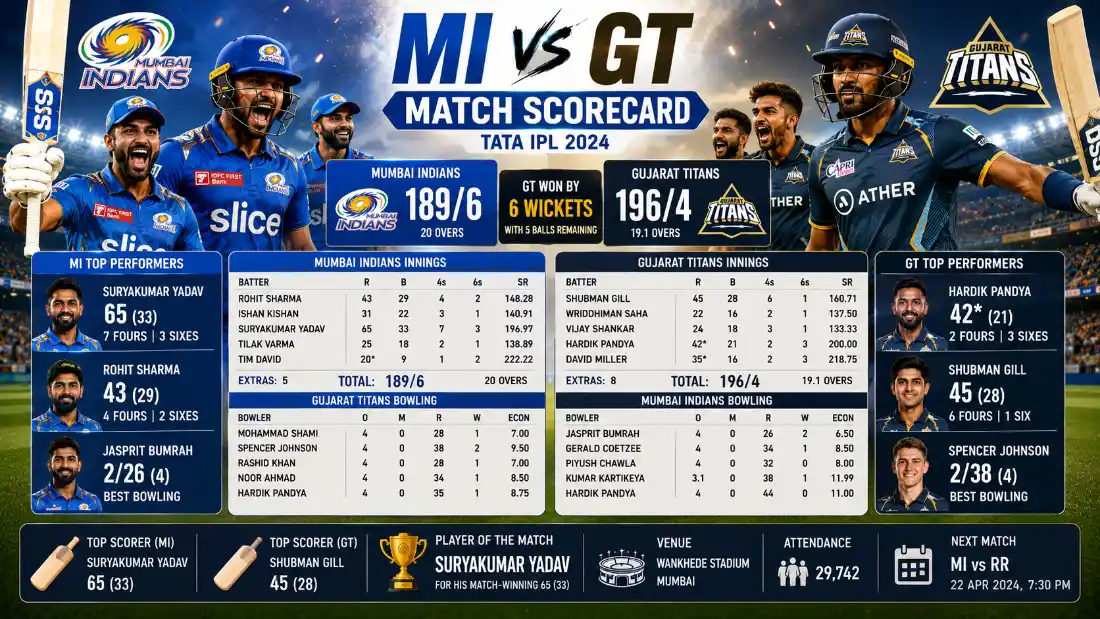
Mumbai Indians won by 99 runs at Narendra Modi Stadium, Ahmedabad, with Tilak Varma’s 101 off 45 balls the standout performance of the night. This snapshot is the fastest way to understand the full mumbai indians vs Gujarat Titans match scorecard without digging through ball-by-ball commentary.
- Result: Mumbai Indians won by 99 runs
- Venue: Narendra Modi Stadium, Ahmedabad
- Toss: Gujarat Titans won the toss and chose to field first
- Player of the Match: Tilak Varma-101 off 45 balls
- MI Innings: 199/5 in 20 overs
- GT Innings: 100 all out in 15.5 overs
- Margin of victory: 99 runs, one of the widest gaps between these two franchises this IPL cycle
Why This Match Matters Beyond the Scoreline
Every T20 encounter carries context, and this one carried more than most. Mumbai Indians walked into this fixture under scrutiny for their middle-order fragility and questions about bowling depth against top-order aggression. Gujarat Titans, by contrast, arrived with home advantage at a venue where they’ve historically enjoyed favorable conditions. The gap between expectation and outcome is what made this scorecard so significant-a struggling side dismantled a form team by nearly a hundred runs, and that swing in momentum matters just as much as the numbers themselves.
Match in 60 Seconds: The Fastest Summary You’ll Find
Direct answer for readers short on time: Mumbai batted first after losing the toss, slipped to 44/3 inside six overs, then recovered through Tilak Varma’s record-pace century to post 199/5. Gujarat Titans’ chase never got going, collapsing to 100 all out in under 16 overs as Mumbai’s pace attack ran through the top and middle order.
This is the compressed version of the full mumbai indians vs Gujarat Titans match scorecard for anyone who just needs the headline facts before moving to deeper analysis. The rest of this article unpacks exactly how a shaky start turned into a statement win, and why Gujarat’s chase fell apart so quickly.
The Three Moments That Defined the Match
- Early wobble: MI slipped to 44/3 inside the powerplay, the kind of start that has cost them matches all season
- The turning point: Tilak Varma’s assault flipped the innings, taking MI from defensive mode to a total well beyond par
- The collapse: GT lost five wickets inside nine overs chasing 200, killing any realistic hope of a competitive finish
How Mumbai Indians Built a Match-Winning Total
Mumbai Indians recovered from 44/3 in the powerplay to post 199/5 in 20 overs, driven almost entirely by Tilak Varma’s 45-ball century, one of the fastest hundreds in Mumbai Indians’ IPL history.
Losing the toss and being asked to bat first is rarely the preferred script on a fresh Ahmedabad surface, and Mumbai’s top order showed exactly why early wickets can spiral quickly in T20 cricket. Kagiso Rabada and the Gujarat pace attack extracted early movement, and by the end of the powerplay, Mumbai were staring at a genuine collapse. Suryakumar Yadav, Quinton de Kock, and Danish Malewar were all back in the dugout cheaply, leaving the innings needing a rescue act rather than a platform for acceleration.
Tilak Varma’s Innings: The Anatomy of a 45-Ball Century
What followed was one of the standout individual displays of IPL 2026. Tilak Varma reached his century off just 45 balls, striking eight fours and seven sixes at a strike rate beyond 220. This wasn’t cautious rebuilding-it was calculated aggression against a bowling attack that had Mumbai on the ropes just overs earlier.
The tactical brilliance here lies in timing. Varma didn’t try to force the pace immediately after the early wickets fell; he absorbed the first handful of deliveries, assessed which bowlers he could target, and then accelerated once support arrived at the other end. That patience-then-explosion approach is the blueprint modern T20 finishers use to turn a rescue mission into a match-winning total, and it’s exactly what separated Mumbai’s innings from a merely respectable score.
Supporting Cast: Why Hardik Pandya’s Cameo Mattered
Hardik Pandya’s brisk innings didn’t grab headlines, but it played a critical enabling role in the partnership. By rotating strike and absorbing pressure at one end, Pandya allowed Varma to target specific bowlers without worrying about being strangled for boundary options. In T20 cricket, the non-striker’s contribution is often invisible in the scorecard but decisive in the outcome. This partnership is a textbook example of complementary batting roles.
Bowling Card: Gujarat Titans’ Attack Under Pressure
| Bowler | Overs | Runs | Wickets | Economy |
| Mohammed Siraj | 4 | 25 | 1 | 6.25 |
| Kagiso Rabada | 4 | 33 | 3 | 8.25 |
| Ashok Sharma | 3 | 38 | 0 | 12.66 |
| Rashid Khan | 4 | 31 | 0 | 7.75 |
Key insight: Rabada’s three wickets came in the powerplay, but his second spell leaked runs heavily as Varma targeted him directly-a tactical pattern worth noting for anyone tracking bowler matchups in this mumbai indians vs Gujarat Titans match scorecard.
Why the Gujarat Titans’ Chase Collapsed So Quickly
Gujarat Titans were bowled out for 100 in 15.5 overs while chasing 200, losing early wickets in the powerplay and never recovering as Mumbai’s bowlers maintained relentless pressure through the middle overs.
Chasing 200 on a ground where totals can be gettable demanded intent from ball one, but Mumbai’s bowlers refused to allow any rhythm to build. Jasprit Bumrah struck early, and Mohammed Siraj followed with a crucial wicket inside the powerplay, leaving Gujarat needing to rebuild against a required run rate that kept climbing with every dot ball.
The Middle-Overs Squeeze
The real story of this chase is the middle overs, where Gujarat lost wickets in clusters rather than building steady partnerships. By the ninth over, Gujarat had slipped to a position where no realistic recovery was possible. Ashwani Kumar’s four-wicket burst through this phase was the decisive blow-bowling with control of both pace variation and length; he didn’t allow any Gujarat batter to settle into a scoring rhythm.
Tactical Breakdown: What Gujarat Got Wrong
- No partnership stability: Gujarat never built a partnership beyond 40 runs, which is almost impossible to overcome when chasing a total north of 190
- Bowling changes came too late: Mumbai’s captaincy decisions to introduce Ashwani Kumar during the squeeze phase paid off immediately.
- Batting approach lacked adaptation: Gujarat’s middle order continued conventional shot selection instead of directly targeting Mumbai’s weaker bowling option.s
Pitch and Conditions: Why the Chase Felt Harder Than the Total Suggested
Narendra Modi Stadium can offer true bounce for stroke-play, but as the evening progressed, the pitch began gripping more for cutters and slower deliveries. This subtle shift in conditions favored Mumbai’s chasing bowlers more than Gujarat’s chasing batters, and it’s a detail that rarely shows up directly in a basic scorecard but explains why 200 felt like 230 under lights.
Captaincy and Strategic Decisions That Shaped the Result
Mumbai’s decision to persist with an aggressive batting approach after early wickets, combined with well-timed bowling changes during Gujarat’s chase, were the two biggest strategic factors behind the 99-run margin.
Captaincy in T20 cricket is often judged retrospectively, but the decisions made in real time, not in hindsight, separate winning teams from merely competitive ones. Mumbai’s leadership backed Varma to play his natural attacking game rather than asking for caution after the early collapse, a decision that paid off spectacularly. On the bowling side, introducing pace variations at precisely the right junctures during Gujarat’s innings prevented any partnership from stabilizing.
Field Placements and Bowling Plans
Mumbai’s fielding setups during the middle overs consistently squeezed singles, forcing Gujarat’s batters into low-percentage boundary attempts. This is a subtle but crucial tactical element that separates teams executing a plan from teams simply bowling deliveries, and it directly fed into the wicket cluster that ended Gujarat’s chase.
Records, Statistics, and Why They Matter
Tilak Varma’s century is among the joint-fastest hundreds by a Mumbai Indians batter in IPL history, and the 99-run margin ranks among the largest victories in this fixture’s head-to-head record.
Statistics only matter when they’re tied to context, and this match offers several worth highlighting:
- Fastest MI centuries: Varma’s 45-ball hundred sits among the quickest tons in franchise history, underlining his rapid rise as a finisher
- Largest MI vs GT margins: A 99-run victory ranks among the more decisive results in this head-to-head rivalry
- Bowling economy shift: Ashwani Kumar’s middle-overs figures mark one of his most impactful spells of the season
- Batting collapse comparison: Gujarat’s total of 100 is one of their lowest scores against Mumbai in recent seasons
Why this matters for the season: These aren’t just numbers for record-keeping-they signal a genuine shift in form for both teams heading into crucial fixtures later in IPL 2026.
What This Result Means for Both Teams
The win ends Mumbai Indians’ four-match losing streak and boosts their playoff push, while Gujarat Titans face renewed questions about batting depth and home-conditions execution.
For the Mumbai Indians, this result does more than add two points to the table-it resets team confidence after a rough patch. Tilak Varma’s emergence as a genuine finishing option gives the batting order more balance heading into pressure fixtures later in the season. Momentum in T20 cricket compounds quickly, and a win of this magnitude often translates into improved performances across subsequent matches.
For the Gujarat Titans, the concerns run deeper than a single bad night. A batting collapse at home, against a Mumbai bowling attack executing a clear plan, raises questions about middle-order depth without contributions from senior players. If this pattern repeats, it could affect their standings significantly as the season progresses.
Head-to-Head Impact Going Forward
This result shifts the psychological edge in the mumbai indians vs Gujarat Titans match scorecard rivalry firmly toward Mumbai for any future encounters this season. Head-to-head momentum, while not decisive on its own, often influences team confidence and tactical planning in subsequent meetings between the same two sides.
Frequently Asked Questions
Who won the MI vs GT match in IPL 2026?
Mumbai Indians won by 99 runs at Narendra Modi Stadium, Ahmedabad.
Who was the Player of the Match in MI vs GT?
Tilak Varma was named Player of the Match for his innings of 101 off 45 balls.
What was the Mumbai Indians’ final score in this match?
Mumbai Indians scored 199/5 in their 20 overs.
What was the Gujarat Titans’ final score while chasing?
Gujarat Titans were bowled out for 100 in 15.5 overs.
Who won the toss, and what did they choose?
Gujarat Titans won the toss and chose to field first.
How fast was Tilak Varma’s century in this match?
Varma reached his century off just 45 balls, among the fastest hundreds in the Mumbai Indians’ IPL history.
Which bowler took the most wickets for the Mumbai Indians?
Ashwani Kumar was the standout bowler for Mumbai, taking four wickets during Gujarat’s collapse.
Which bowler was most effective for the Gujarat Titans?
Kagiso Rabada took three wickets, though he leaked runs in his second spell against Varma’s assault.
Where was this MI vs GT match played?
The match was played at Narendra Modi Stadium in Ahmedabad.
Did this win end a losing streak for the Mumbai Indians?
Yes, this victory snapped a four-match losing run for the Mumbai Indians in IPL 2026.